

Archive position — measured, not model output
0 likes on Devpost
2,263 of the 7,850 archived projects have more likes, and 5,587 share exactly 0 — so this project's #5,732 place in the like-ranked listing is a tie-break inside that group, not a ranking.
Projects (log scale)
Likes on Devpost. ▲ marks this project's group.
Show the figures
| Likes | Projects | Share of archive |
|---|---|---|
| 0 | 5,587 | 71.2% |
| 1 | 1,758 | 22.4% |
| 2 | 284 | 3.6% |
| 3–4 | 132 | 1.7% |
| 5–9 | 75 | 1.0% |
| 10+ | 14 | 0.2% |
 User Stories BotA demo video on every pull request
Get a demo video on every new feature
GitHub App that watches your pull requests and records a narrated, captioned demo.
Save time on demo prep and make informed decisions faster with a video walkthrough of every new feature.
Executive Summary
What the company appears to be
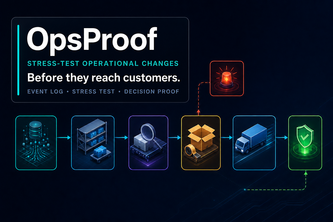
OpsProof is a self-reported tool that transforms timestamped operational event logs into deterministic simulation models for stress-testing changes before deployment. The author states it supports only two reviewed operation types, uses validated event data and Operation Packs, and avoids runtime AI dependencies.
What changed
The project evolved from an LLM-based approach to a local, deterministic simulation engine with clear input validation and refusal states. It now focuses on transparency, reproducibility, and bounded decision-making rather than broad generality or AI inference.
Single most important open question
Is there evidence of real-world usage or adoption of this tool by operational teams? The description provides no traction data, customer names, or revenue signals — only a self-reported MVP with no external validation.
What The Product Actually Is
The description states that OpsProof is a TypeScript application built with Next.js, React, Zod, Web Workers, Vitest, and Playwright. It includes a deterministic discrete-event simulation engine called FlowTwin, which models arrivals, FIFO queues, shared resource capacity, routing, outages, service slowdowns, utilization, SLA performance, Monte Carlo experiments, and bounded optimization.
The tool:
- Processes local Fulfillment or Support event logs.
- Validates data and calibrates a reviewed Operation Pack.
- Stress-tests demand spikes or outages.
- Identifies bottlenecks.
- Finds the lowest-cost tested recovery plan that meets an SLA.
- Produces a Decision Proof output with normal, stress, and recovery evidence across 100 fixed random seeds.
The system runs entirely in the browser, with no external API calls, databases, or runtime dependencies. It is described as a local event-log-to-decision workflow, not requiring an API key.
Inference The product appears to be a simulation-based decision-support tool for operations teams, focused on pre-deployment testing of changes using historical data and deterministic models.
Positioning & Claim Evolution
The author states that OpsProof was built around the question:
“What is the lowest-cost tested change that can protect an operational SLA before a modeled disruption reaches customers?”
This reflects a shift from intuition-based decision-making to data-driven, simulation-based planning, especially in response to situations like demand spikes or system failures.
The positioning evolved:
- From an LLM-powered process-mining tool (which was removed).
- To a bounded, deterministic simulation engine that requires validated inputs and explicit assumptions.
- To a transparent, auditable decision-making framework that refuses to recommend anything without evidence.
The author emphasizes:
- No runtime AI dependencies.
- Clear refusal states for unsupported inputs.
- Reproducible simulations using fixed random seeds.
- A narrow focus on two reviewed operation types.
Inference OpsProof positions itself as a low-risk, high-transparency tool for operational planning, not a broad AI platform or workforce scheduler.
Target Customer & ICP
The description states that OpsProof is designed to help:
- Operations teams with timestamped event data.
- Teams who currently rely on intuition and discover bottlenecks only after customer impact.
It supports two operation types:
- Fulfillment
- Support-center operations
The author notes that the tool is intentionally bounded, not a universal platform, and targets specific operational domains.
Inference The ICP appears to be operations teams in logistics, customer support, or service delivery, who have historical event logs and need to test changes before deployment.
Business Model & Pricing Evidence
The description does not provide any information about:
- Revenue streams
- Pricing models
- Monetization strategy
- Customer acquisition plans
It only states that the tool is a self-reported MVP with no external dependencies, and that it runs locally in the browser.
Inference No evidence of a business model or pricing structure exists in the description. The project appears to be a personal or hackathon effort, not yet commercialized.
Technical & Delivery Signals
The system is built using:
- Next.js, React, TypeScript
- Zod for validation
- Web Workers for simulation
- Playwright and Vitest for testing
- FlowTwin engine: discrete-event simulation with deterministic behavior
Key technical features include:
- Deterministic simulations with 100 fixed random seeds.
- No runtime AI API calls or external dependencies.
- Local processing in the browser.
- Clear refusal states when data is incompatible or no tested option qualifies.
- Export of a Decision Proof containing model, scenario, candidate set, and evidence.
The author notes strong verification practices:
- Unit tests
- Browser E2E tests
- Worker-runtime tests
- Accessibility checks
- Mobile layouts
- Reduced-motion behavior
- Production builds
Inference The tool is technically well-engineered for a local simulation environment, with clear validation, reproducibility, and testing practices.
Traction & Maturity Signals
The description provides no evidence of:
- Revenue
- Customers
- Adoption
- Usage metrics
- Product-market fit
- Market traction
It only states that the project is an intentionally bounded MVP, not a universal platform.
Inference There are no traction or maturity signals in the provided description. The product is described as a proof-of-concept or hackathon output, with no evidence of real-world usage.
Competitive Context
The description does not mention:
- Competitors
- Market positioning relative to others
- Existing tools in the space (e.g., simulation platforms, process mining tools, operational planning systems)
Inference No competitive context is provided. The tool appears to be self-contained, with no reference to existing solutions or market dynamics.
Open Questions & Risks
- No traction or adoption evidence: The project is described as a self-reported MVP with no external validation.
- Limited scope: It supports only two reviewed operation types, which may limit its commercial viability.
- No monetization strategy: No pricing, revenue model or customer acquisition plan are mentioned.
- Self-reported and unverified: All claims are from the author, with no third-party corroboration.
- Narrow focus: The tool is intentionally bounded — this could be a strength or a risk depending on market demand.
Inference The main risk is that the project may not have real-world relevance or commercial traction, despite its technical sophistication.
Questions the description leaves open
- What specific operational domains (e.g., logistics, support centers) are you targeting for adoption?
- Have you tested this tool with real teams or in live operations?
- How do you plan to scale beyond the current two operation types?
- What is your path to monetization or customer acquisition?
- Do you have any feedback from early users or domain experts?
- What are the limitations of the deterministic simulation engine in real-world scenarios?
Overall Assessment
The description states that OpsProof is a self-reported MVP built for a hackathon, with no evidence of traction, revenue, customers, or monetization.
It is described as:
- A local browser-based simulation tool
- Built with deterministic models and clear refusal states
- Focused on two reviewed operation types
- Not a general-purpose AI platform
Inference This project appears to be a technical proof-of-concept, not yet a commercial product. It lacks evidence of market traction, adoption, or business model.
Assessment Not ready for investment or partnership without further evidence of real-world usage, customer feedback, or commercial viability.
User Stories BotA demo video on every pull request
Get a demo video on every new feature
GitHub App that watches your pull requests and records a narrated, captioned demo.
Save time on demo prep and make informed decisions faster with a video walkthrough of every new feature.
Source
Submitted to the OpenAI 2026 hackathon on Devpost. Project home on Devpost. Back to the full gallery on Devpost.
This competitive analysis was produced by top-founders.com (opens in a new tab)
Generated by a language model from this project's public Devpost page — its tagline, the author's own write-up and any built-with tags listed there — as captured in August 2026. Short quotations are the author's words. It is an opinion on the idea as a business, not on the people behind it, and it reflects the description as published then. If the project has moved on, request a correction below. The analysis is not independent research and contains no verified traction, revenue or customer data.
An independent guide by KFG International LLC — not affiliated with, endorsed by, or connected to Devpost or OpenAI.