

Archive position — measured, not model output
0 likes on Devpost
2,263 of the 7,850 archived projects have more likes, and 5,587 share exactly 0 — so this project's #6,321 place in the like-ranked listing is a tie-break inside that group, not a ranking.
Projects (log scale)
Likes on Devpost. ▲ marks this project's group.
Show the figures
| Likes | Projects | Share of archive |
|---|---|---|
| 0 | 5,587 | 71.2% |
| 1 | 1,758 | 22.4% |
| 2 | 284 | 3.6% |
| 3–4 | 132 | 1.7% |
| 5–9 | 75 | 1.0% |
| 10+ | 14 | 0.2% |
 User Stories BotA demo video on every pull request
Get a demo video on every new feature
GitHub App that watches your pull requests and records a narrated, captioned demo.
Save time on demo prep and make informed decisions faster with a video walkthrough of every new feature.
Executive Summary
What the company appears to be
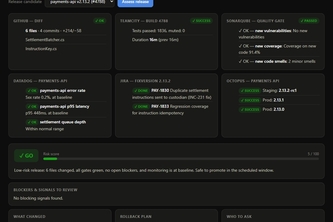
Release Sentinel is described as an agentic release-readiness co-pilot that aggregates engineering signals from multiple tools (GitHub, TeamCity, SonarQube, Datadog, Jira, Octopus Deploy) to assess whether a software build is safe to ship. It provides an assessment (GO/GO_WITH_CAUTION/NO_GO), risk score, ranked blockers, rollback plan, and hotspot authors.
What changed
The project was built as part of the OpenAI 2026 hackathon. It is self-reported as a proof-of-concept with a demo deployed to AWS EC2. The author states it uses Node.js, GPT-5.6 (via OpenAI API), and deterministic fallback logic.
Single most important open question
Is there any evidence of real-world adoption or integration into actual engineering workflows beyond the hackathon demo?
Note: This analysis is based solely on the self-reported description provided by the author. No independent verification, traction data, revenue, customer names, or historical evidence is available.
What The Product Actually Is
The description states that Release Sentinel is an agentic release-readiness co-pilot. It aggregates engineering signals from six sources:
- GitHub (diff size, hotspots, migrations, commit authors)
- TeamCity (build status, duration, muted tests)
- SonarQube (quality-gate results, new-code findings)
- Datadog (monitors, recent incidents)
- Jira (version issues, unresolved blockers)
- Octopus Deploy (history, rollback runbooks)
It provides a GO, GO_WITH_CAUTION, or NO_GO assessment, along with:
- A 0–100 risk score
- Ranked blockers with evidence and recommended action
- Summary of changes
- Concrete rollback plan
- Hotspot authors who can answer relevant questions
The system uses an HTTP server in Node.js, a JavaScript interface, and reasoning engine with JSON contract. It integrates with the OpenAI API (GPT-5.6) for reasoning when configured, or falls back to a deterministic rules engine otherwise.
Inference: The product is described as a tool that synthesizes data from multiple DevOps platforms into a unified release readiness assessment.
Positioning & Claim Evolution
The author states the project was inspired by “Codex review of development activities over the past 6 months and what would make a useful AI tool.” It was built to answer the question: “is this build safe to ship?”
It positions itself as an AI-powered co-pilot that correlates engineering signals, aiming to resolve what dashboards leave unresolved.
Claim: The product is positioned as a solution for engineers and DevOps teams seeking automated release readiness assessment.
Inference: It implies a shift from reactive dashboards to proactive decision-making in software delivery.
Target Customer & ICP
The description does not explicitly state the target customer or ideal customer profile (ICP). However, it is implied that the product targets:
- Software engineers
- DevOps teams
- Release managers
- Engineering leaders who oversee deployment decisions
It is described as a tool for assessing release readiness, suggesting it is aimed at those responsible for shipping code.
Inference: The target audience likely includes engineering teams in organizations using the tools mentioned (GitHub, TeamCity, Jira, etc.) and seeking AI-assisted decision-making.
Business Model & Pricing Evidence
There is no evidence of a business model or pricing structure in the description. The project is described as a hackathon submission, deployed to AWS EC2 for demo purposes.
Not evidenced: No mention of monetization, subscription tiers, usage-based pricing, or any commercial offering.
Technical & Delivery Signals
The system was built using:
- Node.js 20
- JavaScript
- OpenAI API (GPT-5.6)
- AWS EC2 deployment
- Nginx + HTTPS
- systemd service management
It includes:
- A small HTTP server
- A reasoning engine with JSON contract
- Automated tests for expected assessments and scores
- UI improvements
- Deployment hardening
Inference: The product is a lightweight, self-contained system built for demonstration purposes. It uses deterministic fallback logic in case of API failure.
Traction & Maturity Signals
The project is described as a hackathon submission and deployed to AWS EC2 for demo purposes. It includes:
- 3 calibrated scenarios (safe patch release, caution, high-risk)
- Automated tests
- UI refinement
- Real browser verification
Not evidenced: No evidence of real-world usage, customer feedback, or adoption beyond the demo.
Competitive Context
The description does not mention specific competitors. However, it implies a space that includes:
- Release readiness tools
- DevOps dashboards
- AI-assisted engineering decision-making platforms
It is positioned as an agentic co-pilot that synthesizes data from multiple sources — a concept similar to tools in the DevOps and CI/CD automation space.
Inference: It may compete with or complement existing tools like Jenkins, GitLab, CircleCI, or AI-powered platforms for engineering workflows.
Open Questions & Risks
- No real-world adoption or traction — it is a hackathon demo.
- Limited integration capability — the author notes lack of access to MCP servers (e.g., TeamCity, Jira) in the demo.
- Unverified claims — all descriptions are self-reported and unverified.
- Single-person team — only one member listed (RupWeb St John Webster).
- No pricing or business model — no indication of monetization strategy.
Inference: The product lacks commercial viability or traction, and its real-world utility is unproven.
Questions the description leaves open
- What are the actual engineering workflows in your target organizations that this tool aims to improve?
- How does it handle data privacy and access control for sensitive engineering systems?
- Are there any real-world integrations or pilot programs with teams using this tool?
- What is the roadmap for moving beyond the hackathon demo into a production-ready product?
- How do you plan to monetize this solution, if at all?
Overall Assessment
Not evidenced: No data on revenue, customers, or traction exists.
Assessment: Based on the self-reported description, Release Sentinel appears to be a hackathon demo with no demonstrated commercial viability or real-world adoption. It is not ready for investment or partnership consideration at this stage.
Confidence level: Low — the evidence base is minimal and entirely self-reported.
User Stories BotA demo video on every pull request
Get a demo video on every new feature
GitHub App that watches your pull requests and records a narrated, captioned demo.
Save time on demo prep and make informed decisions faster with a video walkthrough of every new feature.
Source
Submitted to the OpenAI 2026 hackathon on Devpost. Project home on Devpost. Back to the full gallery on Devpost.
This competitive analysis was produced by top-founders.com (opens in a new tab)
Generated by a language model from this project's public Devpost page — its tagline, the author's own write-up and any built-with tags listed there — as captured in August 2026. Short quotations are the author's words. It is an opinion on the idea as a business, not on the people behind it, and it reflects the description as published then. If the project has moved on, request a correction below. The analysis is not independent research and contains no verified traction, revenue or customer data.
An independent guide by KFG International LLC — not affiliated with, endorsed by, or connected to Devpost or OpenAI.