

Archive position — measured, not model output
0 likes on Devpost
2,263 of the 7,850 archived projects have more likes, and 5,587 share exactly 0 — so this project's #6,323 place in the like-ranked listing is a tie-break inside that group, not a ranking.
Projects (log scale)
Likes on Devpost. ▲ marks this project's group.
Show the figures
| Likes | Projects | Share of archive |
|---|---|---|
| 0 | 5,587 | 71.2% |
| 1 | 1,758 | 22.4% |
| 2 | 284 | 3.6% |
| 3–4 | 132 | 1.7% |
| 5–9 | 75 | 1.0% |
| 10+ | 14 | 0.2% |
 User Stories BotA demo video on every pull request
Get a demo video on every new feature
GitHub App that watches your pull requests and records a narrated, captioned demo.
Save time on demo prep and make informed decisions faster with a video walkthrough of every new feature.
Executive Summary
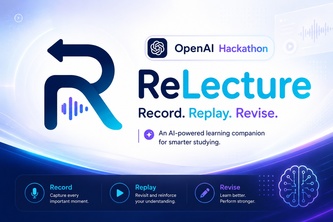
What the company appears to be: ReLecture is a self-reported local-first lecture companion tool that connects PDF slides, audio recordings, transcripts and AI-generated study notes. The author states it was built during OpenAI Build Week as a final-year university project.
What changed: The project evolved from a concept, research, branding, wireframes and accessibility planning into a working application rebuilt from scratch during Build Week. It is described as a personal solution to a problem the founder experienced as a student.
The single most important open question: Is there any evidence of real-world usage or adoption beyond the author's own testing and development? The description contains no information about customers, revenue, traction or market validation.
What The Product Actually Is
The description states that ReLecture is:
- A local-first lecture companion
- That connects PDF slides, recorded audio, slide-linked transcripts and GPT-5.6 study notes in one workspace
- Built with Next.js 16, React 19, TypeScript and Tailwind CSS
- Uses IndexedDB for local data storage via Dexie
- Implements browser-based recording using MediaRecorder API
- Integrates OpenAI's gpt-4o-transcribe-diarize model for transcription
- Uses GPT-5.6 for generating structured study packs including lecture overview, slide notes, key points, definitions, concepts and revision questions
The author describes it as a desktop interface with slide on the left and recording/transcript/notes panels on the right, with tablet/mobile layouts using a four-view selector.
Evidence: Self-reported by the author. No independent verification or demonstration provided.
Positioning & Claim Evolution
The description states:
- ReLecture was inspired by the founder's personal experience as a university student
- It aims to solve problems of trying to listen, understand and take notes simultaneously during lectures
- Traditional lecture capture leaves students with disconnected audio, slides and incomplete notes
- The tool reduces pressure during class and turns results into structured, useful content afterwards
- It was built around real frustration rather than inserting AI for its own sake
The author also states that the product problem, local-first direction, visual identity, accessibility priorities, feature scope and final product decisions were "mine" — implying personal ownership of strategic choices.
Evidence: Self-reported claims about inspiration, problem-solving approach and design decisions. No external validation or market positioning data provided.
Target Customer & ICP
The description states:
- The primary user is a university student
- Specifically mentions students who experience attention, processing or note-taking challenges
- The tool addresses the frustration of missing explanations while trying to write everything down
- It targets students who want lecture capture to reduce pressure and turn results into structured content
Evidence: Self-reported target audience based on personal experience. No data about customer segments, personas or market size.
Business Model & Pricing Evidence
The description states:
- The application uses paid API routes for transcription and study-note generation
- It implements server-side validation including Turnstile, rate limiting, file size checks and secret management
- API secrets remain server-side and responses use Cache-Control: no-store
- No pricing information or business model details are provided
- There is no mention of monetization strategy, subscription plans, or revenue streams
Evidence: Self-reported technical implementation of paid APIs. No commercial or financial data.
Technical & Delivery Signals
The description states:
- Built with Next.js 16, React 19, TypeScript and Tailwind CSS
- Uses Dexie for typed IndexedDB operations
- Implements browser MediaRecorder API for audio chunking
- Integrates OpenAI's gpt-4o-transcribe-diarize model
- Uses GPT-5.6 for structured study note generation
- Deploys to Cloudflare Workers through OpenNext
- Includes Cloudflare Turnstile and rate-limiting protections
- Implements atomic transactions in IndexedDB for data consistency
- Supports safe cascade deletion of lecture data
- Uses PDF.js for browser-based PDF rendering with dynamic scaling
Evidence: Self-reported technical stack and implementation details. No independent verification or performance metrics.
Traction & Maturity Signals
The description states:
- The project existed before Build Week as a final-year project concept, research, branding, wireframes and accessibility planning
- The working application was rebuilt from a clean codebase during OpenAI Build Week
- The author manually tested each acceptance case
- Accomplishments include building the complete working application during Build Week
- The prototype is described as the foundation for a final-year project
However, there is no evidence of:
- Real users or customer adoption
- Revenue or monetization
- Market traction or growth metrics
- Product usage data or engagement statistics
- Any form of commercial deployment beyond the author's own testing
Evidence: Self-reported development timeline and completion. No external validation or traction data.
Competitive Context
The description does not provide any information about:
- Competitors in the lecture capture or educational technology space
- Market positioning relative to existing tools
- Differentiation from similar products
- Industry benchmarks or competitive advantages
Evidence: Not evidenced.
Open Questions & Risks
The description indicates several potential risks:
- The tool is described as a personal project built during a hackathon, with no evidence of commercial viability or scalability
- It relies heavily on paid AI APIs for core functionality (transcription and study notes)
- The author explicitly states that the application cannot genuinely reopen offline, only local-first
- There is no evidence of customer validation, market demand or product-market fit
- The entire description is self-reported without independent verification
Evidence: Self-reported claims about limitations and development context. No external risk assessment.
Questions the description leaves open
- What specific user feedback have you received from students who tested this tool?
- How do you plan to validate market demand for this solution?
- Have you identified any potential competitors or substitutes in the educational technology space?
- What are your plans for monetization and scaling beyond a personal project?
- Can you demonstrate actual usage patterns or adoption data?
- How do you intend to handle privacy and data protection concerns with student content?
- What is your roadmap for addressing the technical limitations mentioned (e.g., rapid slide changes, PDF rendering issues)?
- How will you ensure long-term sustainability of API dependencies like OpenAI?
Evidence: These are questions based on the self-reported nature of the description and its lack of traction or commercial evidence.
Overall Assessment
The description presents ReLecture as a personal project built during a hackathon, with no evidence of:
- Commercial traction or revenue
- Customer adoption or market validation
- Product-market fit
- Scalable business model
- Independent verification of claims
The tool is described as a solution to a personal problem, not a validated market opportunity.
Evidence: Self-reported project description. No commercial due-diligence evidence available beyond the author's own account.
Confidence Level: Very low — this analysis is based entirely on unverified self-reporting with no external corroboration or traction data.
User Stories BotA demo video on every pull request
Get a demo video on every new feature
GitHub App that watches your pull requests and records a narrated, captioned demo.
Save time on demo prep and make informed decisions faster with a video walkthrough of every new feature.
Source
Submitted to the OpenAI 2026 hackathon on Devpost. Project home on Devpost. Back to the full gallery on Devpost.
This competitive analysis was produced by top-founders.com (opens in a new tab)
Generated by a language model from this project's public Devpost page — its tagline, the author's own write-up and any built-with tags listed there — as captured in August 2026. Short quotations are the author's words. It is an opinion on the idea as a business, not on the people behind it, and it reflects the description as published then. If the project has moved on, request a correction below. The analysis is not independent research and contains no verified traction, revenue or customer data.
An independent guide by KFG International LLC — not affiliated with, endorsed by, or connected to Devpost or OpenAI.