

Archive position — measured, not model output
2 likes on Devpost
221 of the 7,850 archived projects have more likes, and 284 share exactly 2 — so this project's #434 place in the like-ranked listing is a tie-break inside that group, not a ranking.
Projects (log scale)
Likes on Devpost. ▲ marks this project's group.
Show the figures
| Likes | Projects | Share of archive |
|---|---|---|
| 0 | 5,587 | 71.2% |
| 1 | 1,758 | 22.4% |
| 2 | 284 | 3.6% |
| 3–4 | 132 | 1.7% |
| 5–9 | 75 | 1.0% |
| 10+ | 14 | 0.2% |
 User Stories BotA demo video on every pull request
Get a demo video on every new feature
GitHub App that watches your pull requests and records a narrated, captioned demo.
Save time on demo prep and make informed decisions faster with a video walkthrough of every new feature.
Executive Summary
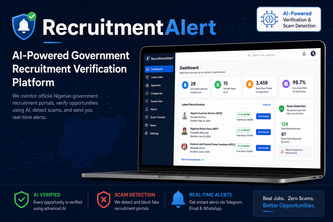
RecruitmentAlert is a self-reported AI-powered platform designed to verify Nigerian government job openings and deliver real-time alerts to users. The project was built as part of the OpenAI 2026 hackathon, with no evidence of revenue, customers or operational traction. It claims to monitor official recruitment portals, use AI for summarization and scam detection, and assign trust scores to opportunities.
The platform's positioning centers on solving a perceived problem of fake recruitment scams in Nigeria, using AI and automation to improve access to legitimate job opportunities. However, the description lacks any evidence of actual deployment, user base or monetization strategy.
The single most important open question
Is there any evidence that RecruitmentAlert has been deployed for real-world use, or that it has begun collecting or verifying recruitment data from actual government sources?
What The Product Actually Is
The description states that RecruitmentAlert is an AI-powered recruitment verification platform. It claims to:
- Monitor official Nigerian government recruitment portals.
- Detect newly published or updated recruitment opportunities.
- Use AI to summarize notices into easy-to-read information.
- Verify recruitment announcements and assign trust scores.
- Detect suspicious or fake recruitment links.
- Provide a searchable platform for verified opportunities.
- Send real-time notifications about legitimate recruitment.
The author describes the system as having:
- A frontend built with React, TypeScript, Tailwind CSS, and Vite.
- A backend built with Python, Django, Django REST Framework, PostgreSQL, Redis, and Celery.
- AI components powered by OpenAI API for summarization, scam detection, verification assistance, and trust scoring.
- A monitoring engine using scheduled portal monitoring, intelligent change detection, content fingerprinting, and duplicate detection.
Inference The product appears to be a prototype or proof-of-concept built in a hackathon environment. It is not evidenced to have been deployed beyond the development stage.
Positioning & Claim Evolution
The description states that RecruitmentAlert was inspired by the problem of fake recruitment websites and scams in Nigeria, where users lose money and opportunities due to unverified job ads.
It positions itself as a solution to help Nigerians find legitimate government jobs safely. The platform claims to:
- Monitor official portals continuously.
- Alert users before scams reach them.
- Provide real-time notifications.
- Improve access to verified recruitment data.
Inference The positioning is centered on trust and safety in a high-risk environment. It does not appear to have evolved beyond an idea or prototype stage, as no evidence of market traction or customer feedback is provided.
Target Customer & ICP
The description states that RecruitmentAlert is intended for Nigerians who are seeking government job opportunities and want to avoid scams.
It also mentions a potential expansion to "all Nigerian federal and state recruitment agencies", suggesting a focus on public sector employment seekers in Nigeria.
There is no evidence of segmentation beyond this, nor any indication of specific user personas or buyer profiles.
Inference The target customer is likely job seekers in Nigeria who are vulnerable to scams. However, no evidence exists that the platform has reached or engaged such users.
Business Model & Pricing Evidence
The description does not provide any information about pricing, monetization, or business model.
It mentions future features like a public API, WhatsApp and Telegram AI assistant, and personalized job recommendations, but no details on how these would generate revenue.
Inference No evidence of a business model or pricing structure is provided. The project appears to be in an early development stage, with no indication of commercial viability or monetization plans.
Technical & Delivery Signals
The platform is described as built using:
- Frontend: React, TypeScript, Tailwind CSS, Vite
- Backend: Python, Django, Django REST Framework, PostgreSQL, Redis, Celery
- AI: OpenAI API for summarization, scam detection, verification assistance, and trust scoring
- Monitoring engine: Scheduled portal monitoring, change detection, content fingerprinting, duplicate detection
The system is described as having:
- Background workers for continuous monitoring.
- Infrastructure designed to scale to monitor more recruitment sources.
Inference The technical stack suggests a modern, scalable architecture. However, no evidence of deployment or live usage is provided.
Traction & Maturity Signals
The description states that the project was built during a hackathon and includes accomplishments such as:
- Building a working platform from scratch.
- Integrating AI into the verification workflow.
- Monitoring multiple government portals.
- Creating trust scoring.
- Designing a clean interface focused on credibility.
However, there is no evidence of:
- Live deployment or usage.
- User base or adoption.
- Revenue or monetization.
- Customer feedback or market validation.
Inference The project appears to be in an early prototype or proof-of-concept phase. No traction or maturity signals are evident.
Competitive Context
The description does not mention any competitors or existing solutions in the recruitment verification space in Nigeria.
It implies that there is a gap in the market for a trusted platform to verify government job opportunities, but no evidence of existing players or competitive landscape is provided.
Inference No competitive context is evident. The project may be addressing an unmet need, but without data on competitors or market dynamics, this remains speculative.
Open Questions & Risks
- No evidence of real-world deployment or usage: The platform is described as a hackathon project with no proof of live operation.
- Unverified claims: All claims are self-reported and unverified; there is no third-party validation.
- Lack of traction or monetization strategy: No revenue, customers, or business model are evident.
- AI dependency without clear use case: The platform relies heavily on AI, but the exact value proposition for users remains unclear.
- No team size or structure: The team is listed as 0 members, which raises questions about execution capability.
Inference The project lacks any commercial or operational foundation. It is a self-reported idea with no evidence of progress beyond development.
Questions the description leaves open
- Has RecruitmentAlert been deployed for real-world use? If so, how many users are currently engaged?
- What specific government recruitment portals does the platform monitor?
- How does the AI verification process work in practice? Is there a human review component?
- Have you received any feedback from users or government agencies?
- What is your plan for monetization and scaling beyond Nigeria?
- How do you ensure that the monitoring engine doesn’t miss important updates or generate false positives?
- Are there any legal or regulatory considerations in monitoring government portals?
Overall Assessment
Not evidenced.
There is no evidence of commercial traction, revenue, customer base, or operational deployment. The project is described as a hackathon prototype with no indication of market validation or business model.
The description does not provide sufficient grounds to assess whether RecruitmentAlert has investment or partnership potential at this stage.
Inference At this time, there is insufficient evidence to support an investment or partnership decision. The project appears to be in early development and lacks any commercial foundation.
User Stories BotA demo video on every pull request
Get a demo video on every new feature
GitHub App that watches your pull requests and records a narrated, captioned demo.
Save time on demo prep and make informed decisions faster with a video walkthrough of every new feature.
Source
Submitted to the OpenAI 2026 hackathon on Devpost. Project home on Devpost. Back to the full gallery on Devpost.
This competitive analysis was produced by top-founders.com (opens in a new tab)
Generated by a language model from this project's public Devpost page — its tagline, the author's own write-up and any built-with tags listed there — as captured in August 2026. Short quotations are the author's words. It is an opinion on the idea as a business, not on the people behind it, and it reflects the description as published then. If the project has moved on, request a correction below. The analysis is not independent research and contains no verified traction, revenue or customer data.
An independent guide by KFG International LLC — not affiliated with, endorsed by, or connected to Devpost or OpenAI.