

Archive position — measured, not model output
0 likes on Devpost
2,263 of the 7,850 archived projects have more likes, and 5,587 share exactly 0 — so this project's #6,312 place in the like-ranked listing is a tie-break inside that group, not a ranking.
Projects (log scale)
Likes on Devpost. ▲ marks this project's group.
Show the figures
| Likes | Projects | Share of archive |
|---|---|---|
| 0 | 5,587 | 71.2% |
| 1 | 1,758 | 22.4% |
| 2 | 284 | 3.6% |
| 3–4 | 132 | 1.7% |
| 5–9 | 75 | 1.0% |
| 10+ | 14 | 0.2% |
 User Stories BotA demo video on every pull request
Get a demo video on every new feature
GitHub App that watches your pull requests and records a narrated, captioned demo.
Save time on demo prep and make informed decisions faster with a video walkthrough of every new feature.
Executive Summary
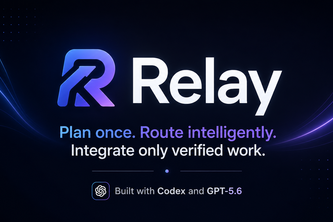
Relay is a self-reported tool for orchestrating AI coding agents in a controlled, deterministic workflow. The author describes it as a system that plans once, routes tasks to appropriate agents (Sol, Terra, Luna), and integrates only verified work into Git repositories. It is built as a TypeScript runtime with CLI, Codex plugin, and local dashboard components.
The project appears to be an experimental prototype developed by one person over a short timeframe, likely for the OpenAI 2026 hackathon. The description includes technical claims about durable planning, isolated worktrees, parallel execution, and deterministic integration — but no evidence of revenue, customers, or adoption beyond its own demonstration.
The single most important open question
Is there any evidence that this system has been used in production or at scale, or whether it can reliably integrate with real-world development workflows?
What The Product Actually Is
The description states that Relay is a multi-agent orchestration tool for AI coding tasks, built as a TypeScript runtime with CLI, Codex plugin, and dashboard components. It operates by:
- Creating a plan via an agent named Sol.
- Routing implementation to Terra.
- Handling bounded testing and documentation via Luna.
- Using a controller (Relay) to validate, commit, integrate, record evidence, and clean up.
Tasks are executed in isolated Git worktrees, preventing agents from approving or merging their own changes. Completed tasks are compacted into PLAN.md, while active tasks remain recoverable on disk.
It supports:
- Durable planning
- Isolated worktrees
- Parallel execution
- Deterministic integration
- Controller-owned validation
- Evidence export
- Replay, local, and live modes
- Installable Linux package
Inference: The system is described as a local development tool, not a cloud-hosted service or SaaS offering.
Positioning & Claim Evolution
The author positions Relay as a solution to problems in long AI coding sessions:
- High cost
- Fragility
- Lack of trust due to context drift and repeated work
It claims to address these issues by enabling:
- Plan once
- Route intelligently
- Integrate only verified work
This positioning suggests a shift from uncontrolled, open-ended AI workflows toward structured, verifiable, and recoverable ones.
Inference: The project evolved from an idea around improving trust in AI coding to a technical framework for managing multi-agent workflows with deterministic outcomes.
Target Customer & ICP
The description does not identify specific customer segments or personas. However, it implies use cases for:
- Developers working on complex coding tasks
- Teams seeking more reliable AI-assisted development
- Users who want to reduce the risk of unverified AI-generated code
There is no mention of enterprise customers, developer tooling integrations, or target industries.
Not evidenced: No explicit ICP defined. The author does not describe who would use this system beyond general developers or teams using AI coding tools.
Business Model & Pricing Evidence
The description provides no evidence of a business model or pricing structure. It describes Relay as a local tool, with no indication of monetization, licensing, or subscription models.
Inference: If it is intended for commercial use, the author has not described how it would be sold or priced.
Technical & Delivery Signals
The system is built using:
- TypeScript
- Node.js
- Git (with worktrees)
- OpenAI APIs (including GPT-5.6)
- Codex plugin architecture
- CLI and dashboard interfaces
It supports:
- Offline tests
- Live attempts
- Deterministic demo
- Judge-ready release package
- Replay mode
- Multiple execution modes (local, live)
The author notes that the final packaged live run completed successfully with:
- One Sol planning task
- One Terra implementation task
- Two parallel Luna tasks
- Three controller-owned commits
- Three integrations
- Three evidence bundles
Inference: The system is designed for reproducibility and control, not scalability or ease of deployment.
Traction & Maturity Signals
There is no evidence of traction, revenue, customers, or adoption beyond the author’s own demonstration. The project was submitted to a hackathon and appears to be a prototype.
The author mentions:
- A controlled benchmark showing performance differences between strategies
- Successful completion of a live run
- Packaging for Linux
But no data on usage, retention, or user feedback is provided.
Not evidenced: No metrics, users, or product-market fit indicators.
Competitive Context
The description does not reference competitors or similar tools. It does not state how Relay compares to existing AI coding tools or agent orchestration platforms.
Inference: The author likely did not research the competitive landscape beyond their own idea and implementation.
Open Questions & Risks
- Single-person development: The system was built by one person, raising questions about scalability, maintenance, and long-term viability.
- No production use or real-world testing: The project is described as a hackathon submission with no evidence of deployment in real workflows.
- Limited platform support: Only Linux is mentioned for installable packages; macOS, Windows, and ARM support are listed as future features.
- Unverified claims about performance: Benchmark results are presented but not independently validated.
- No commercialization strategy: No indication of how the tool would be monetized or distributed.
Questions the description leaves open
- What is your intended use case for Relay beyond the hackathon demo?
- Have you tested this system with real developers or teams in a non-demo setting?
- How does Relay handle edge cases like failed integrations or model failures?
- Is there any plan to support cloud-based deployment or multi-user environments?
- What are the limitations of the current architecture for scaling beyond local development?
Overall Assessment
Not evidenced: No financials, traction, or commercial strategy are provided.
The project is described as a proof-of-concept, likely built in a short timeframe for a hackathon. It shows technical capability but lacks evidence of market demand, product-market fit, or scalability.
Confidence level: Low
This is an experimental prototype with strong technical design claims, but no demonstrated commercial traction or user adoption. Any investment or partnership decision would require further validation of real-world utility and long-term viability.
User Stories BotA demo video on every pull request
Get a demo video on every new feature
GitHub App that watches your pull requests and records a narrated, captioned demo.
Save time on demo prep and make informed decisions faster with a video walkthrough of every new feature.
Source
Submitted to the OpenAI 2026 hackathon on Devpost. Project home on Devpost. Back to the full gallery on Devpost.
This competitive analysis was produced by top-founders.com (opens in a new tab)
Generated by a language model from this project's public Devpost page — its tagline, the author's own write-up and any built-with tags listed there — as captured in August 2026. Short quotations are the author's words. It is an opinion on the idea as a business, not on the people behind it, and it reflects the description as published then. If the project has moved on, request a correction below. The analysis is not independent research and contains no verified traction, revenue or customer data.
An independent guide by KFG International LLC — not affiliated with, endorsed by, or connected to Devpost or OpenAI.