

Archive position — measured, not model output
2 likes on Devpost
221 of the 7,850 archived projects have more likes, and 284 share exactly 2 — so this project's #425 place in the like-ranked listing is a tie-break inside that group, not a ranking.
Projects (log scale)
Likes on Devpost. ▲ marks this project's group.
Show the figures
| Likes | Projects | Share of archive |
|---|---|---|
| 0 | 5,587 | 71.2% |
| 1 | 1,758 | 22.4% |
| 2 | 284 | 3.6% |
| 3–4 | 132 | 1.7% |
| 5–9 | 75 | 1.0% |
| 10+ | 14 | 0.2% |
 User Stories BotA demo video on every pull request
Get a demo video on every new feature
GitHub App that watches your pull requests and records a narrated, captioned demo.
Save time on demo prep and make informed decisions faster with a video walkthrough of every new feature.
Executive Summary
What the company appears to be
ProofGate is a self-reported tool that claims to implement an "evidence-first release gate for pull requests". It uses AI agents (GPT-5.6) and deterministic code to reproduce, classify, and verify findings in code changes before they reach human reviewers.
What changed
The project was submitted as part of the OpenAI 2026 hackathon. The author describes it as a proof-of-concept demonstration with no commercial traction or revenue data.
Single most important open question
Is there any evidence that ProofGate has been used in production environments, or that it has moved beyond a demo-level implementation?
What The Product Actually Is
The description states that ProofGate is an evidence-first release gate for pull requests, designed to ensure that findings (regressions, defects) are reproduced, fixed, and independently verified by AI agents before reaching human reviewers.
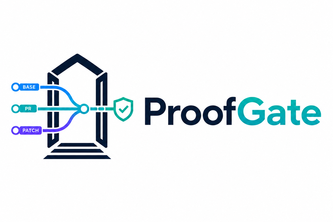
It operates across three isolated git worktrees:
- Base — behavior before the PR
- PR — what the contributor changed
- Patched — behavior after an agent's fix
The system uses specialized GPT-5.6 agents to reason about findings and classify them causally into categories such as confirmed regression, pre-existing defect, resolved, or rejected false positive.
It does not modify or push contributor branches; instead, it runs isolated reproductions and reports outcomes via a dashboard built with React/Vite.
Evidence
- The author states: “proofgate is an evidence-first release gate for pull requests.”
- It uses GPT-5.6 agents through the OpenAI Agents SDK.
- It isolates git worktrees and uses deterministic code to execute tests.
- It includes a dashboard that streams live runs.
Inference This system appears to be a prototype or proof-of-concept, not a production-ready tool.
Positioning & Claim Evolution
The author positions ProofGate as a solution to the problem of unproven code review findings, where tools "suspect things and terrible at proving them."
It introduces the concept of proof-carrying pull requests — where a finding must be reproducible, fixed, and verified before it reaches a human.
The project evolved from an idea to a working demo that includes:
- A full live run classifying all five finding types
- An independent verifier that re-runs every reproduction
- Honest-by-construction reporting (every status links back to real execution)
Evidence
- The author states: “We wanted to flip that. What if a finding wasn't allowed to reach you until the tool had already reproduced it, fixed it, and independently verified the fix?”
- It claims to have demonstrated correct classification of findings including pre-existing defects and false positives.
Inference The positioning is aspirational — it aims to change how code reviews are done by making them more rigorous and evidence-based. However, no commercial or adoption data supports this claim.
Target Customer & ICP
The description does not name specific customers or target industries. It implies a developer-facing audience, particularly those working in software development teams that use Git-based workflows (e.g., GitHub).
It is positioned for teams seeking to improve code quality and reduce noise in pull request reviews by automating verification of findings.
Evidence
- The tool is built for pull requests.
- It integrates with git and uses standard developer tools like Playwright, Vitest, and React.
- The author refers to “contributor” and “human reviewers.”
Inference The ICP likely includes engineering teams using Git-based CI/CD pipelines, especially those concerned with regression testing and code hygiene.
Business Model & Pricing Evidence
There is no evidence of a business model or pricing structure in the description. The project is described as a hackathon submission.
Evidence
- No mention of monetization.
- No indication of paid features or subscriptions.
- The author mentions “a hosted judge-friendly instance” as a future goal, but does not describe how this would be offered or priced.
Inference If ProofGate becomes a product, it may follow a SaaS model with hosted instances or integrations, but no such plans are evident in the current description.
Technical & Delivery Signals
The system is built as a TypeScript pnpm monorepo, using:
- better-sqlite3 for evidence storage
- Fastify + SSE for streaming
- React/Vite for dashboard UI
- Playwright and Vitest for reproduction runners
- GPT-5.6 agents via OpenAI Agents SDK
It enforces guardrails:
- Agents only return validated schemas, not shell commands or executable code.
- Everything runs with
shell: false, path-contained, and timed out.
Evidence
- The author states: “A TypeScript pnpm monorepo”.
- It uses deterministic orchestration and schema validation.
- It includes self-repair retry logic for structured output errors.
Inference The architecture suggests a high degree of control over LLM outputs and execution environments, which could support trustworthiness in a production setting — but again, this is unproven in practice.
Traction & Maturity Signals
There is no evidence of traction or maturity beyond the hackathon submission. The project is described as a demo with no real-world usage, customers, or revenue.
Evidence
- The project was submitted to a hackathon.
- No mention of users, adoption, or customer feedback.
- No data on performance, usage frequency, or integration success.
Inference This is a prototype or proof-of-concept, not a mature product with real-world deployment.
Competitive Context
The description does not name competitors. However, it implies a space that includes:
- Code review tools (e.g., GitHub Pull Request Reviews)
- Automated testing and CI/CD platforms
- AI-assisted debugging or verification systems
It positions itself as a novel approach to code review by introducing AI agents that reproduce and verify findings before they reach humans.
Evidence
- The author states: “Every code-review tool we've used is great at suspecting things and terrible at proving them.”
- It introduces a new paradigm of “proof-carrying pull requests.”
Inference It competes with tools focused on code quality, regression detection, and automated review processes. No direct competitors are named.
Open Questions & Risks
- Unproven in production: The system is described only as a hackathon demo.
- No commercial traction or users: No evidence of real-world adoption.
- High technical complexity with limited validation: While it uses deterministic control, the reliance on LLMs introduces risk of hallucination or misclassification.
- Limited scalability assumptions: The architecture is not described as scalable beyond a demo environment.
- Founder team size: Only one member listed, which may limit execution capacity.
Evidence
- No mention of users or customers.
- No revenue or funding data.
- The system is presented as a demo with no real-world deployment.
Inference The risk of failure is high if the project does not move beyond prototype stage and into scalable, reliable production use.
Questions the description leaves open
- Has ProofGate been tested in any real-world development environments?
- What are the limitations of the current implementation that would prevent it from scaling to enterprise-level usage?
- How does the system handle edge cases or failures in LLM reasoning?
- Are there plans for integrating with existing CI/CD pipelines or platforms like GitHub, GitLab, etc.?
- What is the roadmap for monetization or product development beyond the hackathon demo?
Overall Assessment
Not evidenced.
There is no evidence of revenue, customers, traction, or a clear path to commercial viability.
The project is described as a hackathon demo, not a product in development or deployment. It shows technical ambition and a novel idea but lacks any indication of real-world utility or scalability.
Confidence level Low
Next steps
If this were a live company, further diligence would require evidence of early adopters, pilot programs, or functional integrations with real development workflows. As it stands, the description offers no basis for investment or partnership consideration.
User Stories BotA demo video on every pull request
Get a demo video on every new feature
GitHub App that watches your pull requests and records a narrated, captioned demo.
Save time on demo prep and make informed decisions faster with a video walkthrough of every new feature.
Source
Submitted to the OpenAI 2026 hackathon on Devpost. Project home on Devpost. Back to the full gallery on Devpost.
This competitive analysis was produced by top-founders.com (opens in a new tab)
Generated by a language model from this project's public Devpost page — its tagline, the author's own write-up and any built-with tags listed there — as captured in August 2026. Short quotations are the author's words. It is an opinion on the idea as a business, not on the people behind it, and it reflects the description as published then. If the project has moved on, request a correction below. The analysis is not independent research and contains no verified traction, revenue or customer data.
An independent guide by KFG International LLC — not affiliated with, endorsed by, or connected to Devpost or OpenAI.