

Archive position — measured, not model output
2 likes on Devpost
221 of the 7,850 archived projects have more likes, and 284 share exactly 2 — so this project's #426 place in the like-ranked listing is a tie-break inside that group, not a ranking.
Projects (log scale)
Likes on Devpost. ▲ marks this project's group.
Show the figures
| Likes | Projects | Share of archive |
|---|---|---|
| 0 | 5,587 | 71.2% |
| 1 | 1,758 | 22.4% |
| 2 | 284 | 3.6% |
| 3–4 | 132 | 1.7% |
| 5–9 | 75 | 1.0% |
| 10+ | 14 | 0.2% |
 User Stories BotA demo video on every pull request
Get a demo video on every new feature
GitHub App that watches your pull requests and records a narrated, captioned demo.
Save time on demo prep and make informed decisions faster with a video walkthrough of every new feature.
Executive Summary
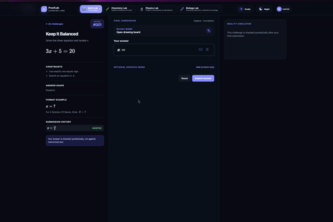
What the company appears to be: ProofLab is a self-reported interactive STEM learning platform focused on step-by-step mathematical reasoning. The platform allows learners to enter equations using natural math notation, build reasoning paths, and receive deterministic verification for each transition. It includes modules in Math, Chemistry, Physics, and Biology, with an emphasis on visual feedback and debugging-style learning.
What changed: The project description indicates a shift from generic answer-checking tools to a more structured, interactive approach that emphasizes identifying where reasoning fails and helping users repair it. This is framed as moving from "telling students that an answer is wrong" to enabling them to debug their own work.
The single most important open question: Is there evidence of any traction or user adoption beyond the authors' own development efforts?
What The Product Actually Is
The description states that ProofLab is an interactive STEM learning platform centered on visual, verifiable reasoning. It supports step-by-step work in algebra, inequalities, introductory calculus, and complex numbers.
- The Math Lab allows learners to enter equations using natural math notation.
- Learners build a reasoning path and receive deterministic verification for each transition.
- When a step fails, ProofLab identifies the first broken point and returns bounded evidence.
- It includes modules in Chemistry, Physics, and Biology for equation balancing, molecular concepts, motion, vectors, circuits, anatomy, genetics, evolution, and ecology.
- A LeetMath module provides a LeetCode-inspired challenge arena with symbolic validation of final answers.
Evidence: The description explicitly outlines these features.
Inference: That this is a tool designed to teach STEM concepts through interactive problem-solving rather than passive consumption.
Positioning & Claim Evolution
The authors state that ProofLab aims to make math feel more like debugging: tracing each step, finding the broken transition, understanding why it fails, and repairing it with confidence.
They also claim they wanted one platform where learners can move from Math into Chemistry, Physics, and Biology through interactive exploration instead of static notes.
Evidence: These are self-reported claims about intent and positioning.
Inference: The product is positioned as a debugging-style learning tool that moves beyond traditional answer-checking systems to support deeper conceptual understanding.
Target Customer & ICP
The description does not specify the exact target customer or ideal customer profile (ICP). It implies learners in STEM education, particularly those working on foundational math concepts and progressing into higher-level topics like calculus, complex numbers, and applied modeling.
Evidence: Not explicitly stated.
Inference: Likely students or educators in K-12 or early college STEM programs who benefit from structured reasoning feedback.
Business Model & Pricing Evidence
There is no mention of pricing models, monetization strategies, or business model details in the description.
Evidence: Not evidenced.
Inference: If this were a commercial product, it might be sold via subscription, licensing, or educational institution partnerships — but there's no indication of such plans.
Technical & Delivery Signals
The frontend uses Next.js, React, MathLive, KaTeX, Excalidraw, Chart.js, and interactive visual components.
The backend verification service is built with FastAPI, Pydantic, SymPy, and a restricted custom parser. It accepts only supported mathematical grammar and returns explicit valid, invalid, unsupported, or inconclusive results.
The architecture separates:
- Deterministic verification (decides whether mathematics is correct)
- AI teaching (explains verifier-confirmed evidence, offers hints, suggests repairs)
Codex was used to accelerate development and iterate quickly on the product experience.
Evidence: The description lists technologies used and describes how they are applied.
Inference: The system prioritizes correctness over generality in its symbolic verification engine, which may limit scalability but ensures reliability.
Traction & Maturity Signals
There is no evidence of revenue, customers, or user adoption beyond the authors' own development efforts. No data on usage metrics, retention, or engagement is provided.
Evidence: Not evidenced.
Inference: The project appears to be in early-stage development or prototype phase, based on the team size (2 members) and lack of traction indicators.
Competitive Context
The description does not provide information about competitors or market positioning relative to existing tools in STEM education or interactive learning platforms.
Evidence: Not evidenced.
Inference: Given its focus on step-by-step reasoning and debugging-style feedback, it may compete with tools like Khan Academy, Wolfram Alpha, or similar math tutoring platforms — but no direct comparison is made.
Open Questions & Risks
- No traction or revenue data: The platform has not demonstrated any real-world usage or monetization.
- Limited team size: Only two developers are mentioned; this could limit scalability and execution speed.
- Self-reported nature: All claims are unverified, including the effectiveness of the learning experience.
- Technical constraints: The system uses a restricted parser and returns "unsupported" for notation outside its scope — this may hinder broader adoption or usability.
- Unclear business model: No indication of how the platform will generate revenue or sustain itself.
Evidence: These are inferred from the lack of evidence in the description.
Questions the description leaves open
- What specific learning outcomes have you observed from users during testing?
- How do you plan to scale beyond a small team of two developers?
- Have you conducted any user research or usability tests with actual learners?
- What is your go-to-market strategy for reaching schools, educators, or students?
- Are there any partnerships or institutional pilots underway?
- How do you intend to monetize the platform if it's not already commercialized?
Overall Assessment
Not evidenced.
Inference: At this stage, ProofLab appears to be a prototype or proof-of-concept with strong technical execution and clear educational intent. However, without evidence of traction, revenue, or customer validation, there is insufficient basis for investment or partnership decisions at this time. The project shows promise in addressing a gap in STEM education but lacks the commercial signals needed to assess viability.
User Stories BotA demo video on every pull request
Get a demo video on every new feature
GitHub App that watches your pull requests and records a narrated, captioned demo.
Save time on demo prep and make informed decisions faster with a video walkthrough of every new feature.
Source
Submitted to the OpenAI 2026 hackathon on Devpost. Project home on Devpost. Back to the full gallery on Devpost.
This competitive analysis was produced by top-founders.com (opens in a new tab)
Generated by a language model from this project's public Devpost page — its tagline, the author's own write-up and any built-with tags listed there — as captured in August 2026. Short quotations are the author's words. It is an opinion on the idea as a business, not on the people behind it, and it reflects the description as published then. If the project has moved on, request a correction below. The analysis is not independent research and contains no verified traction, revenue or customer data.
An independent guide by KFG International LLC — not affiliated with, endorsed by, or connected to Devpost or OpenAI.