

Archive position — measured, not model output
0 likes on Devpost
2,263 of the 7,850 archived projects have more likes, and 5,587 share exactly 0 — so this project's #2,389 place in the like-ranked listing is a tie-break inside that group, not a ranking.
Projects (log scale)
Likes on Devpost. ▲ marks this project's group.
Show the figures
| Likes | Projects | Share of archive |
|---|---|---|
| 0 | 5,587 | 71.2% |
| 1 | 1,758 | 22.4% |
| 2 | 284 | 3.6% |
| 3–4 | 132 | 1.7% |
| 5–9 | 75 | 1.0% |
| 10+ | 14 | 0.2% |
 User Stories BotA demo video on every pull request
Get a demo video on every new feature
GitHub App that watches your pull requests and records a narrated, captioned demo.
Save time on demo prep and make informed decisions faster with a video walkthrough of every new feature.
Executive Summary
What the company appears to be
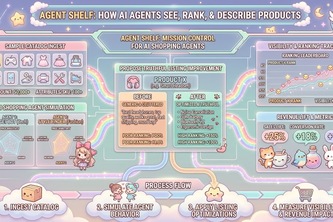
AgentShelf is a self-reported tool that simulates how AI shopping agents (e.g., ChatGPT) would rank and describe merchant products, then offers actionable fixes to improve visibility and estimated revenue lift. It operates in two modes: deterministic local demo and opt-in live OpenAI mode.
What changed
The author describes a shift in commerce from checkout plumbing to discovery — where being recommended and described correctly is now key. AgentShelf aims to give merchants insight into this invisible shelf, using AI simulation to guide listing improvements.
Single most important open question
Is there any evidence of traction or commercial adoption beyond the hackathon demo? The description states no revenue, customers, or usage data exist beyond the author’s own account.
Note: This analysis is based entirely on the self-reported project description provided by the caller. No external verification or historical data are available. All claims are treated as stated by the author and not proven.
What The Product Actually Is
The description states that AgentShelf runs a merchant's product catalog through an AI shopping agent (simulated via GPT-5.6 in live mode or deterministic local engine) and provides a four-step loop:
- Look: Load sample store and simulate shopper queries.
- Learn: Identify where products appear, disappear, and how they are described.
- Fix: Improve listings by making existing claims explicit; no new features or fabrications.
- Prove: Re-run queries after applying fixes to compare visibility and revenue lift.
It ships with two modes:
- A deterministic local demo that requires no credentials.
- An opt-in live OpenAI mode powered by GPT-5.6 for real agent reasoning.
There is also a preview-only Shopify integration page showing how a real integration would look without live API calls.
Inference: The product appears to be an AI-powered visibility and listing optimization tool, not a full commerce platform or marketplace.
Positioning & Claim Evolution
The author positions AgentShelf as the “instrument panel” for the invisible shelf in AI shopping. It is framed as a response to the shift from in-chat checkout to discover-in-AI-buy-on-site, where merchants must now optimize for visibility within AI agents.
Claims include:
- Merchants have no visibility into how their products are ranked or described by AI assistants.
- The tool helps them see and fix gaps in product descriptions that affect visibility.
- It proves sales lift rather than just reporting problems.
- It enforces a “truthful fix” constraint — never invents features or claims.
Inference: The positioning reflects an emerging trend in agentic commerce, where discovery is the new battleground. However, no evidence of prior market validation or customer feedback exists.
Target Customer & ICP
The description states that AgentShelf targets merchants who sell products and want to be recommended by AI shopping agents like ChatGPT, Gemini, etc., particularly those with catalogs on platforms like Shopify.
It is implied that the tool is aimed at:
- E-commerce sellers.
- Product managers or marketers focused on visibility in AI-assisted discovery.
- Merchants who are not currently visible in AI agent simulations.
Inference: The ICP likely includes small to mid-sized e-commerce businesses with product catalogs, but no explicit segmentation or customer personas are provided.
Business Model & Pricing Evidence
There is no evidence of pricing structure, monetization model, or revenue streams. The description mentions:
- A preview-only Shopify connection page.
- An opt-in live OpenAI mode.
- No mention of paid features or subscriptions.
Not evidenced: No indication of how the tool will be sold or whether it has a commercial model beyond the hackathon project.
Technical & Delivery Signals
The product is built with:
- FastAPI backend (managed with uv)
- React 19 + Vite frontend (managed with bun)
- SQLite for persistence
- OpenAI API (GPT-5.6) in live mode
- Codex used for scaffolding and UI generation
Key technical elements include:
- Provider abstraction: same interface for local and live engines.
- Structured outputs from AI to ensure parseable JSON.
- Deterministic local demo that mirrors live behavior.
Inference: The architecture suggests a clean, testable system built under time constraints. The use of provider abstraction is a strong signal for future scalability.
Traction & Maturity Signals
The project was submitted as part of the OpenAI 2026 hackathon and has no evidence of:
- Revenue
- Customers
- Product usage or adoption
- Live integrations
- Commercial traction beyond the demo
Not evidenced: No data on user engagement, product performance, or real-world deployment.
Competitive Context
The description does not mention any competitors. It implies that there is a gap in the market for tools that help merchants understand and optimize their visibility in AI shopping agents.
Inference: The space of agentic commerce tools is emerging, but no direct or indirect competition is identified in the description.
Open Questions & Risks
- No commercial traction: No evidence of revenue, customers, or adoption beyond the demo.
- Limited scope: The tool simulates agent behavior rather than scraping or reproducing live rankings.
- Unproven market demand: No indication that merchants are actively seeking this type of solution.
- Dependency on AI APIs: Reliance on OpenAI’s GPT-5.6 may introduce cost and availability risks.
- Self-reported maturity: The tool is described as a hackathon project, not a production-ready product.
Inference: The lack of any commercial or user data makes it difficult to assess viability or scalability.
Questions the description leaves open
- What specific merchant pain points are you solving for?
- Have you validated this with actual merchants or e-commerce teams?
- How do you plan to monetize the tool beyond the demo?
- Are there any early adopters or pilot customers?
- What is your roadmap for real Shopify integration and multi-surface coverage?
- How do you intend to scale beyond a single developer’s effort?
Overall Assessment
Not evidenced: No data on commercial traction, revenue, or customer adoption exists.
Confidence level: Low
AgentShelf is described as a hackathon project with no evidence of real-world usage or commercial viability. The tool presents an interesting concept in agentic commerce but lacks any demonstration of market demand or product-market fit. It may be early-stage and exploratory, not yet ready for investment or partnership.
Conclusion: Based on the self-reported description only, AgentShelf is a conceptual tool with potential in an emerging space, but it has no demonstrated traction or commercial readiness.
User Stories BotA demo video on every pull request
Get a demo video on every new feature
GitHub App that watches your pull requests and records a narrated, captioned demo.
Save time on demo prep and make informed decisions faster with a video walkthrough of every new feature.
Source
Submitted to the OpenAI 2026 hackathon on Devpost. Project home on Devpost. Back to the full gallery on Devpost.
This competitive analysis was produced by top-founders.com (opens in a new tab)
Generated by a language model from this project's public Devpost page — its tagline, the author's own write-up and any built-with tags listed there — as captured in August 2026. Short quotations are the author's words. It is an opinion on the idea as a business, not on the people behind it, and it reflects the description as published then. If the project has moved on, request a correction below. The analysis is not independent research and contains no verified traction, revenue or customer data.
An independent guide by KFG International LLC — not affiliated with, endorsed by, or connected to Devpost or OpenAI.