

Archive position — measured, not model output
0 likes on Devpost
2,263 of the 7,850 archived projects have more likes, and 5,587 share exactly 0 — so this project's #2,390 place in the like-ranked listing is a tie-break inside that group, not a ranking.
Projects (log scale)
Likes on Devpost. ▲ marks this project's group.
Show the figures
| Likes | Projects | Share of archive |
|---|---|---|
| 0 | 5,587 | 71.2% |
| 1 | 1,758 | 22.4% |
| 2 | 284 | 3.6% |
| 3–4 | 132 | 1.7% |
| 5–9 | 75 | 1.0% |
| 10+ | 14 | 0.2% |
 User Stories BotA demo video on every pull request
Get a demo video on every new feature
GitHub App that watches your pull requests and records a narrated, captioned demo.
Save time on demo prep and make informed decisions faster with a video walkthrough of every new feature.
Executive Summary
The company appears to be a single-person project, Agent Storefront, submitted as part of an OpenAI hackathon. The author describes it as a system where AI agents discover products from a catalog, match them to user requests, and complete checkout without human involvement. The product is demonstrated using a live product, SLEEPCOACHGAME.
What changed
The project was built over the course of a week using Codex and GPT-5.6, with no prior experience in these tools. It represents an experimental step toward enabling AI agents to act as buyers in a marketplace context.
The single most important open question
Is there a viable commercial model or market need for AI agents to independently purchase products on behalf of users, and how would this scale beyond one product?
What The Product Actually Is
- The description states that Agent Storefront is an AI agent system.
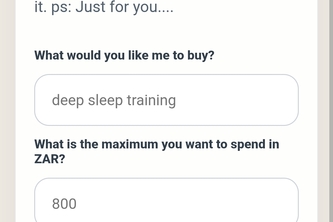
- It receives buy requests from users ("I want deeper sleep, budget R800").
- It fetches a published product catalog with machine-readable data (offer, price, claims, license terms).
- It evaluates fit between the request and product, selects, and completes checkout via a payment API.
- The demo uses SLEEPCOACHGAME as the live product item.
- Payments are currently in test mode using Paystack.
- The system is built with Codex and GPT-5.6.
Inference The system appears to be an experimental prototype for AI agents acting as buyers, not a production-ready marketplace or platform.
Positioning & Claim Evolution
- The author claims that Agent Storefront enables AI agents to "discover a product catalog, match it to their user's buy request, and complete checkout — no human in the purchase loop."
- It is positioned as part of a roadmap where AI agents move from recommending products to actually purchasing them.
- The project was submitted for an OpenAI hackathon, suggesting a focus on experimentation with AI agent capabilities.
Inference This is a self-described evolution from product recommendation to autonomous purchase behavior. No evidence of prior positioning or claims beyond this single description.
Target Customer & ICP
- Not evidenced.
Absence of evidence
The description does not identify target customers, personas, or ideal customer profiles (ICPs). It only describes the author’s own use case with SLEEPCOACHGAME.
Business Model & Pricing Evidence
- Not evidenced.
Absence of evidence
There is no mention of pricing models, revenue streams, or monetization strategies beyond the demo using a test payment system.
Technical & Delivery Signals
- Built with Codex and GPT-5.6 end-to-end.
- Uses node.js, Vercel, OpenAI, and Paystack (test mode).
- The agent decision loop and checkout integration were scaffolded by Codex.
- Payments run in test mode via Paystack.
Inference The system is a prototype built quickly using AI-assisted development tools. It lacks production-grade infrastructure or scalability considerations.
Traction & Maturity Signals
- Not evidenced.
Absence of evidence
There is no evidence of revenue, customers, user adoption, or product maturity beyond the single demo and one-person team.
Competitive Context
- Not evidenced.
Absence of evidence
No mention of competitors, existing solutions, or market positioning in relation to other AI agent platforms or marketplace systems.
Open Questions & Risks
- The project is a hackathon submission with no prior traction or commercial history.
- It uses test payments and lacks production-grade infrastructure.
- The author has no prior experience with Codex or GPT-5.6, suggesting a steep learning curve and limited development depth.
- No evidence of scalability, security, or compliance considerations for handling real transactions.
- The system is demonstrated only with one product (SLEEPCOACHGAME), limiting its generalizability.
Inference This is an experimental prototype with no commercial viability or market validation yet. It may be a proof-of-concept rather than a scalable business model.
Questions the description leaves open
- What is the actual user need that this solves, and how does it differ from existing AI recommendation systems?
- How would you scale this beyond one product (SLEEPCOACHGAME)?
- What are the legal and compliance implications of AI agents making purchases on behalf of users?
- Are there any plans to move out of test mode and into production payments?
- How do you plan to validate demand for AI agents as buyers in real-world scenarios?
Overall Assessment
- Not evidenced.
Absence of evidence
No information is provided about funding, valuation, or investment interest. The project is described as a hackathon submission by a single person with no commercial traction or business model details. It is not ready for investment or partnership consideration at this stage.
User Stories BotA demo video on every pull request
Get a demo video on every new feature
GitHub App that watches your pull requests and records a narrated, captioned demo.
Save time on demo prep and make informed decisions faster with a video walkthrough of every new feature.
Source
Submitted to the OpenAI 2026 hackathon on Devpost. Project home on Devpost. Back to the full gallery on Devpost.
This competitive analysis was produced by top-founders.com (opens in a new tab)
Generated by a language model from this project's public Devpost page — its tagline, the author's own write-up and any built-with tags listed there — as captured in August 2026. Short quotations are the author's words. It is an opinion on the idea as a business, not on the people behind it, and it reflects the description as published then. If the project has moved on, request a correction below. The analysis is not independent research and contains no verified traction, revenue or customer data.
An independent guide by KFG International LLC — not affiliated with, endorsed by, or connected to Devpost or OpenAI.