

Archive position — measured, not model output
0 likes on Devpost
2,263 of the 7,850 archived projects have more likes, and 5,587 share exactly 0 — so this project's #6,313 place in the like-ranked listing is a tie-break inside that group, not a ranking.
Projects (log scale)
Likes on Devpost. ▲ marks this project's group.
Show the figures
| Likes | Projects | Share of archive |
|---|---|---|
| 0 | 5,587 | 71.2% |
| 1 | 1,758 | 22.4% |
| 2 | 284 | 3.6% |
| 3–4 | 132 | 1.7% |
| 5–9 | 75 | 1.0% |
| 10+ | 14 | 0.2% |
 User Stories BotA demo video on every pull request
Get a demo video on every new feature
GitHub App that watches your pull requests and records a narrated, captioned demo.
Save time on demo prep and make informed decisions faster with a video walkthrough of every new feature.
Executive Summary
What the company appears to be
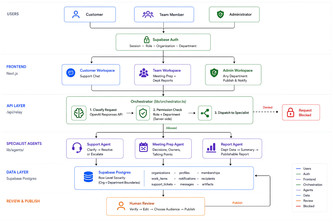
Relay, as described by its author, is a self-reported AI-powered orchestrator that routes business requests to appropriate specialist agents behind the scenes. It is built as a single-entry point for tasks like support, meeting prep, and reporting, with role-based access control and row-level security.
What changed
The project was submitted as part of an OpenAI 2026 hackathon. The author states that the full orchestration logic and agent workflows are coded but not yet live due to funding constraints around API calls.
Single most important open question
Is there a viable commercial opportunity in building a single-entry AI orchestrator for business tasks, or is this an experimental prototype with unclear path to traction?
What The Product Actually Is
The description states that Relay is:
- An AI orchestrator that takes any business request and routes it to the right specialist agent.
- Designed to handle three use cases: support questions, meeting prep, and reporting.
- Built using a full-stack tech stack including Next.js, React, PostgreSQL, Supabase, Tailwind, TypeScript, Vercel, and OpenAI models (specifically GPT-5.6).
- The application includes authentication, role-based access control, and row-level security enforced at the database level.
- The entire system was built end-to-end in Codex during a single continuous build session.
Not evidenced:
- No actual live API integrations or working agents are demonstrated.
- No customer data, usage metrics, or product functionality beyond design and architecture.
Positioning & Claim Evolution
The author claims that Relay is:
- A single intelligent entry point for business tasks.
- Designed to eliminate the need for teams to use multiple disconnected tools.
- Capable of routing requests automatically to specialists based on context.
This positioning suggests a shift from fragmented tooling toward unified AI-driven task orchestration. However, the claim is self-reported and lacks evidence of market validation or adoption.
Inferred:
- The author sees Relay as solving coordination inefficiencies in teams.
- It implies a move toward centralized AI workflows for enterprise use cases.
Target Customer & ICP
The description states that Relay supports:
- Customers, team members, and admins with role-based access.
- Access is enforced at the database level via row-level security.
- The system handles tasks across departments, suggesting a B2B SaaS or internal enterprise use case.
Not evidenced:
- No specific customer personas, industries, or company sizes are mentioned.
- No evidence of target market segmentation or buyer intent.
Inferred:
- Likely targets small to mid-sized teams or enterprise departments looking for better coordination and task automation.
- Possibly aimed at product managers, executives, or support teams who manage cross-functional workflows.
Business Model & Pricing Evidence
The description does not contain any information about:
- Revenue model
- Pricing structure
- Monetization strategy
- Customer acquisition costs
- Unit economics
Not evidenced:
- No indication of whether Relay is intended for subscription, one-time purchase, or freemium.
- No pricing data, tiers, or plans are described.
Inferred:
- If this becomes a commercial product, it may follow a SaaS model with role-based access and possibly tiered pricing based on team size or usage.
Technical & Delivery Signals
The author states that:
- The entire application was built in Codex across one continuous session.
- It includes authentication, role structure, database schema, and workflow logic.
- Each specialist agent (support, meeting prep, reporting) is designed to run on GPT-5.6.
- Row-level security is implemented at the database level.
Not evidenced:
- No live API connections or working models are shown.
- No performance benchmarks, scalability tests, or infrastructure details.
Inferred:
- The technical architecture shows a strong understanding of full-stack development and data security.
- The use of Codex suggests rapid prototyping capabilities but does not confirm production readiness.
Traction & Maturity Signals
The description states:
- The core product — including auth, permissions, and workflows — works cleanly today.
- The orchestration layer is fully designed and coded, though not yet connected to live agents.
- The author plans to fund the API layer and test with real teams.
Not evidenced:
- No actual customers, users, or adoption metrics.
- No revenue, ARR, or user feedback are provided.
- No evidence of product-market fit or early traction.
Inferred:
- This is a pre-product or pre-launch prototype, likely in the early stages of development.
- It has not yet been tested with real users or integrated into live workflows.
Competitive Context
The description does not mention any competitors or market positioning relative to existing tools. No comparison with similar products, platforms, or services is made.
Not evidenced:
- No competitive analysis, benchmarking, or differentiation from other AI orchestration or workflow tools.
- No evidence of awareness of the broader marketplace for AI task routing or internal team coordination tools.
Inferred:
- The space likely includes AI assistants (e.g., Notion AI, Zapier, Slack bots), enterprise workflow platforms, and internal collaboration tools.
- Relay may compete with or complement these by offering a unified entry point for diverse business tasks.
Open Questions & Risks
Key risks identified from the description:
- No live API integration: The system is not yet functional due to lack of funding for API calls.
- Unproven market demand: No evidence of customer interest, adoption, or traction.
- Single-founder project: Only one team member is listed, which may limit execution capacity.
- Prototype vs. product: The project appears to be a hackathon submission, not a commercial-grade offering.
- Unclear monetization path: No pricing, business model, or revenue strategy described.
Open questions:
- The lack of live functionality raises questions about viability and scalability.
- The absence of any customer data or feedback makes it hard to assess real-world utility.
Questions the description leaves open
- What specific business pain points are you solving, and how do you know they exist?
- Are there any early adopters or pilot users who have tested the system?
- How do you plan to fund the API layer and connect the orchestrator with live agents?
- What is your go-to-market strategy for reaching target customers?
- How will you scale beyond a single founder and prototype stage?
- What are the key assumptions in your product design, and how might they be wrong?
Overall Assessment
The description indicates that Relay is currently a pre-product prototype built during a hackathon. It includes detailed technical architecture and design but lacks live functionality, customer traction, or commercial viability evidence.
Not evidenced:
- No revenue, ARR, customers, or product usage data.
- No indication of market demand or competitive positioning.
- No clear path to monetization or scalability.
Inferred:
- This is a conceptual proof-of-concept with strong technical execution but no demonstrated traction or business model.
- It may be suitable for early-stage investment if the founder can demonstrate traction, customer validation, and a clear path to product-market fit.
- The project does not yet meet criteria for a mature commercial opportunity.
User Stories BotA demo video on every pull request
Get a demo video on every new feature
GitHub App that watches your pull requests and records a narrated, captioned demo.
Save time on demo prep and make informed decisions faster with a video walkthrough of every new feature.
Source
Submitted to the OpenAI 2026 hackathon on Devpost. Project home on Devpost. Back to the full gallery on Devpost.
This competitive analysis was produced by top-founders.com (opens in a new tab)
Generated by a language model from this project's public Devpost page — its tagline, the author's own write-up and any built-with tags listed there — as captured in August 2026. Short quotations are the author's words. It is an opinion on the idea as a business, not on the people behind it, and it reflects the description as published then. If the project has moved on, request a correction below. The analysis is not independent research and contains no verified traction, revenue or customer data.
An independent guide by KFG International LLC — not affiliated with, endorsed by, or connected to Devpost or OpenAI.