

Archive position — measured, not model output
0 likes on Devpost
2,263 of the 7,850 archived projects have more likes, and 5,587 share exactly 0 — so this project's #6,285 place in the like-ranked listing is a tie-break inside that group, not a ranking.
Projects (log scale)
Likes on Devpost. ▲ marks this project's group.
Show the figures
| Likes | Projects | Share of archive |
|---|---|---|
| 0 | 5,587 | 71.2% |
| 1 | 1,758 | 22.4% |
| 2 | 284 | 3.6% |
| 3–4 | 132 | 1.7% |
| 5–9 | 75 | 1.0% |
| 10+ | 14 | 0.2% |
 User Stories BotA demo video on every pull request
Get a demo video on every new feature
GitHub App that watches your pull requests and records a narrated, captioned demo.
Save time on demo prep and make informed decisions faster with a video walkthrough of every new feature.
Executive Summary
What the company appears to be
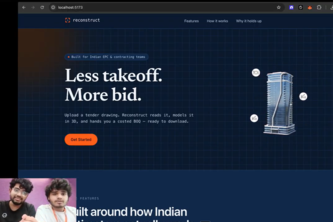
Reconstruct AI is a self-reported construction estimation tool built as a hackathon project. It claims to convert government tender drawings into costed Bill of Quantities (BOQs) using an AI pipeline that reads PDFs, reconstructs 3D models, and prices elements with live Indian material rates.
What changed
The project was submitted to the OpenAI 2026 hackathon. It is not evidenced to have moved beyond prototype or pilot stage.
Single most important open question
Is there any evidence of traction, revenue, or real-world usage beyond the author's own account?
What The Product Actually Is
The description states that Reconstruct AI is a drawing-first workspace for construction estimation, built as a hackathon project. It allows users to upload a tender PDF and:
- Render every sheet
- Index it into structural elements (footings, columns, beams, rebar schedules, notes)
- Let users ask questions grounded in specific parts of the drawing
- Reconstruct the whole drawing as an interactive 3D model with provenance traced back to original sheets
- Run a five-agent pipeline that:
- Reads elements
- Prices them using live ₹ rates
- Writes the final BOQ into a Google Sheet
The tool is described as being built with:
- Frontend: Vite + React + TypeScript
- Backend: FastAPI
- 3D rendering: Three.js
- Integrations: Google Sheets, OpenAI APIs
Inference The product appears to be a proof-of-concept or early-stage prototype, not a commercial offering.
Positioning & Claim Evolution
The author states that the tool was inspired by inefficiencies in how government tenders are bid on — specifically, the time spent manually reading drawings and pricing them. It positions itself as an AI-powered solution to reduce manual effort and avoid guesswork.
Key claims:
- “Reconstruct turns a tender drawing into a costed, source-grounded Bill of Quantities in mins”
- “Reading every sheet, rebuilding it in 3D, and pricing it in live Indian rates with zero invented numbers.”
- “The drawing itself becomes the interface.”
Inference The positioning is focused on efficiency, accuracy, and trustworthiness — especially around avoiding hallucinations or invented data.
Target Customer & ICP
The description states that Reconstruct AI targets construction contractors bidding on government tenders, particularly those using PWD/CPWD conventions (Indian government construction standards). It is built for teams already working in Google Sheets and familiar with tender processes.
It also mentions:
- “EPC contracting teams” as a potential pilot group
- “Someone without formal engineering training” can use it
Inference The ICP appears to be construction estimation teams in India, especially those involved in government tenders, who are looking for faster and more accurate BOQ generation.
Business Model & Pricing Evidence
There is no evidence of a business model or pricing structure in the description. The project is described as a hackathon submission with no mention of monetization, licensing, or customer acquisition.
Inference No commercial model is evident from the self-reported account.
Technical & Delivery Signals
The system uses:
- FastAPI for backend
- React + Vite + TypeScript for frontend
- Three.js for 3D visualization
- OpenAI APIs for LLM-based reasoning
- Sandboxed quantity arithmetic to ensure deterministic outputs
- Google Sheets integration as the delivery surface
Key technical features:
- Multi-agent pipeline with clear separation between LLM and deterministic code
- Provenance tracking from 3D model back to original PDF sheets
- Handling of messy scans (low-res, rotated, inconsistent scaling)
- “Zero invented numbers” constraint enforced via design
Inference The system is built with a focus on reproducibility, trustworthiness, and accuracy, especially in a domain where outputs have financial consequences.
Traction & Maturity Signals
The description states:
- It was submitted to the OpenAI 2026 hackathon
- It works end-to-end from upload to BOQ delivery
- It has been piloted with a “handful of EPC contracting teams”
- It is not yet commercialized or scaled beyond prototype
Inference The product is at an early stage — likely a proof-of-concept or prototype, not yet in production use or generating revenue.
Competitive Context
There is no mention of competitors in the description. However, the problem space (construction estimation using AI) aligns with:
- Existing construction tech tools
- AI-powered document processing and estimation platforms
- Tools that integrate with Google Sheets for BOQ management
Inference The competitive landscape is not described, but it likely includes other AI-based or digital construction tools.
Open Questions & Risks
- No revenue or customer data: The project is self-reported and lacks evidence of traction.
- Prototype-only status: It’s a hackathon submission with no indication of commercialization.
- Limited scope: Only supports PWD/CPWD conventions; unclear if it scales beyond that.
- Dependency on LLMs: Despite sandboxing, the pipeline includes LLM agents — raising questions about consistency and auditability at scale.
- Unproven adoption: No evidence of real-world usage or feedback from actual users.
Questions the description leaves open
- What is the current status of the product? Is it being used by any contractors or teams?
- How does the tool handle ambiguity in drawings — especially when dimensions are missing or unclear?
- What is the accuracy rate of the BOQs generated, and how is that validated?
- Are there plans to expand beyond PWD/CPWD conventions?
- Has the team considered integrating with other platforms (e.g., CAD tools, ERP systems)?
- How does the “zero invented numbers” constraint affect usability or adoption?
Overall Assessment
Not evidenced.
The project is described as a hackathon submission and lacks evidence of:
- Revenue
- Customers
- Traction
- Commercial viability
- Product-market fit beyond the author’s own use case
Confidence level Low.
This is a self-reported prototype, not a commercial product or business. Any investment or partnership decision would require further due diligence into real-world usage, scalability, and market validation — none of which are present in this description.
User Stories BotA demo video on every pull request
Get a demo video on every new feature
GitHub App that watches your pull requests and records a narrated, captioned demo.
Save time on demo prep and make informed decisions faster with a video walkthrough of every new feature.
Source
Submitted to the OpenAI 2026 hackathon on Devpost. Project home on Devpost. Back to the full gallery on Devpost.
This competitive analysis was produced by top-founders.com (opens in a new tab)
Generated by a language model from this project's public Devpost page — its tagline, the author's own write-up and any built-with tags listed there — as captured in August 2026. Short quotations are the author's words. It is an opinion on the idea as a business, not on the people behind it, and it reflects the description as published then. If the project has moved on, request a correction below. The analysis is not independent research and contains no verified traction, revenue or customer data.
An independent guide by KFG International LLC — not affiliated with, endorsed by, or connected to Devpost or OpenAI.