

Archive position — measured, not model output
0 likes on Devpost
2,263 of the 7,850 archived projects have more likes, and 5,587 share exactly 0 — so this project's #2,361 place in the like-ranked listing is a tie-break inside that group, not a ranking.
Projects (log scale)
Likes on Devpost. ▲ marks this project's group.
Show the figures
| Likes | Projects | Share of archive |
|---|---|---|
| 0 | 5,587 | 71.2% |
| 1 | 1,758 | 22.4% |
| 2 | 284 | 3.6% |
| 3–4 | 132 | 1.7% |
| 5–9 | 75 | 1.0% |
| 10+ | 14 | 0.2% |
 User Stories BotA demo video on every pull request
Get a demo video on every new feature
GitHub App that watches your pull requests and records a narrated, captioned demo.
Save time on demo prep and make informed decisions faster with a video walkthrough of every new feature.
Executive Summary
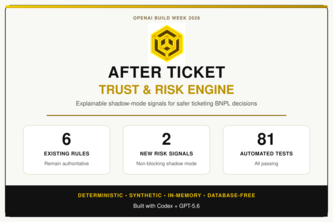
The description states that After Ticket Trust & Risk Engine is a new layer added to an existing ticketing BNPL platform during OpenAI Build Week. The author, a self-taught founder without traditional engineering background, describes this as a deterministic shadow-mode risk engine designed to provide explainable risk signals for safer ticketing BNPL decisions—without changing existing checkout outcomes.
The project is presented as a technical prototype built using AI tools like Codex and GPT-5.6, integrating into an existing system with minimal customer-facing impact. It introduces two new risk signals (unresolved prior repayment and purchase velocity) that trigger internal review but do not affect actual transaction approval.
Key commercial due-diligence read
The description does not provide evidence of any revenue, customers or product-market fit beyond the author's own claims. There is no indication whether the platform has been adopted by ticketing companies or if there is demand for such a solution in the market. The most important open question is: Is there real-world traction or interest from ticketing platforms that would justify further development or investment?
What The Product Actually Is
The description states:
- The Trust & Risk Engine is a new layer added to an existing buy-now-pay-later infrastructure platform for the ticketing industry.
- It operates in shadow mode, meaning it does not change existing checkout outcomes.
- It provides explainable risk signals based on two rules:
- PREVIOUS_UNRESOLVED_DEFAULT: when a customer has an unresolved prior repayment.
- PURCHASE_VELOCITY_24H: when a customer makes three purchases within 24 hours.
- The system includes a reviewer console with synthetic scenarios and a public live-verification route.
- It uses a deterministic decision contract and pure decision composer.
- The engine is integrated into existing service and route structure.
- Automated tests cover the engine, demo, and existing agreement flow.
This is described as an engineering prototype built during OpenAI Build Week, not a production-ready product.
Positioning & Claim Evolution
The description states:
- The platform was originally designed for the ticketing industry where checkout is time-sensitive and repayment risk must be handled carefully.
- It positions itself as providing "explainable, deterministic shadow-mode risk signals" for safer ticketing BNPL decisions.
- The author claims that this approach allows adding meaningful risk intelligence without creating untested customer impact.
- The system is described as a "shadow recommendation" that never turns an existing approval into a decline.
- The author emphasizes that the new layer preserves existing checkout outcomes and uses fail-open logic.
The positioning appears to be evolving from a general-purpose BNPL platform to one focused on safety and risk management in ticketing contexts, with AI-native development as a key differentiator.
Target Customer & ICP
The description states:
- The target industry is the ticketing industry.
- The platform is designed for buy-now-pay-later infrastructure within that space.
- It's intended for ticketing companies or platforms that offer BNPL options to customers.
- The system is described as being built for "safety-sensitive product" contexts where repayment risk must be carefully managed.
There is no evidence of specific customer segments, buyer personas, or market size claims. The description does not indicate whether the platform targets large event organizers, ticketing platforms, or individual vendors within the ticketing ecosystem.
Business Model & Pricing Evidence
Not evidenced.
The description does not contain any information about pricing models, revenue streams, monetization strategies, or business model details beyond the general context of a BNPL platform for ticketing.
Technical & Delivery Signals
The description states:
- Built with Codex and GPT-5.6 during OpenAI Build Week.
- Uses technologies including: express.js, javascript, node.js, react, typescript, restapi, vite, github, openai, openaicodex, codex.
- Implements a deterministic shadow-mode decision contract.
- Includes a pure decision composer for explainable risk recommendations.
- Has service and route integration with existing application.
- Features a reviewer console with synthetic scenarios.
- Includes a public, in-memory live-verification route.
- Contains automated tests covering engine, demo, and existing agreement flow.
- The implementation is described as fail-open and non-blocking.
- The merged pull request includes 81 passing automated tests.
The technical approach appears to be focused on AI-assisted development with repository-aware engineering tools, and the system is designed to maintain backward compatibility while adding new risk intelligence.
Traction & Maturity Signals
Not evidenced.
The description does not contain any information about actual customers, revenue, usage metrics, or product adoption. It only describes a prototype built during a hackathon event. There is no evidence of market traction, customer feedback, or business development beyond the author's own claims.
Competitive Context
Not evidenced.
The description does not provide any information about competitors, market positioning, or competitive landscape in the ticketing BNPL space. No mention of existing solutions or how this product compares to them.
Open Questions & Risks
- Lack of traction evidence: The project is described as a prototype built during a hackathon with no indication of real-world adoption or customer interest.
- Founder background risk: The founder describes himself as "self-taught, AI-native founder without a traditional software engineering background," which may signal technical capability gaps in execution.
- Unproven market demand: There is no evidence that ticketing companies are interested in this specific solution or that there's sufficient demand for such a product.
- Limited scope: The system operates only in shadow mode and does not enforce decisions, suggesting it may be a proof-of-concept rather than a production-ready risk management tool.
- Dependency on AI tools: Heavy reliance on AI development tools (Codex/GPT) could pose risks if those tools change or become unavailable.
Questions the description leaves open
- What is the actual market demand for this type of risk engine in ticketing companies?
- How does the existing After Ticket platform operate, and what are its current customers?
- Has there been any feedback from potential users about the need for this functionality?
- What are the specific use cases where ticketing companies would actually pay for such a solution?
- How will the transition from shadow mode to enforcement be managed?
- What is the long-term vision for the platform beyond the current prototype?
- Are there any existing partnerships or pilot programs with ticketing companies?
Overall Assessment
Not evidenced.
The description provides no information about financial performance, customer base, market opportunity, or investment readiness. It only describes a prototype built during a hackathon event without evidence of commercial traction or viability. Any investment or partnership decision would require additional due diligence beyond what is provided in this self-reported description.
User Stories BotA demo video on every pull request
Get a demo video on every new feature
GitHub App that watches your pull requests and records a narrated, captioned demo.
Save time on demo prep and make informed decisions faster with a video walkthrough of every new feature.
Source
Submitted to the OpenAI 2026 hackathon on Devpost. Project home on Devpost. Back to the full gallery on Devpost.
This competitive analysis was produced by top-founders.com (opens in a new tab)
Generated by a language model from this project's public Devpost page — its tagline, the author's own write-up and any built-with tags listed there — as captured in August 2026. Short quotations are the author's words. It is an opinion on the idea as a business, not on the people behind it, and it reflects the description as published then. If the project has moved on, request a correction below. The analysis is not independent research and contains no verified traction, revenue or customer data.
An independent guide by KFG International LLC — not affiliated with, endorsed by, or connected to Devpost or OpenAI.