

Archive position — measured, not model output
2 likes on Devpost
221 of the 7,850 archived projects have more likes, and 284 share exactly 2 — so this project's #398 place in the like-ranked listing is a tie-break inside that group, not a ranking.
Projects (log scale)
Likes on Devpost. ▲ marks this project's group.
Show the figures
| Likes | Projects | Share of archive |
|---|---|---|
| 0 | 5,587 | 71.2% |
| 1 | 1,758 | 22.4% |
| 2 | 284 | 3.6% |
| 3–4 | 132 | 1.7% |
| 5–9 | 75 | 1.0% |
| 10+ | 14 | 0.2% |
 User Stories BotA demo video on every pull request
Get a demo video on every new feature
GitHub App that watches your pull requests and records a narrated, captioned demo.
Save time on demo prep and make informed decisions faster with a video walkthrough of every new feature.
Executive Summary
What the company appears to be
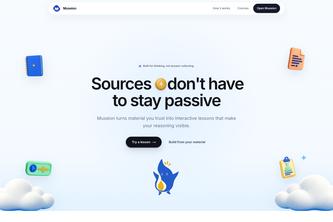
Museion is a self-reported educational platform that uses AI to guide learners through structured learning paths in STEM subjects. The product is built around a "learning contract" where deterministic code validates learner actions, while AI agents (like Maia) provide guidance and feedback without owning correctness or doing the thinking for the learner.
What changed
The author states they began with an early idea and used Codex and GPT 5.6 to build a complete learning environment, transitioning from a sparse product base to one that includes ten authored paths and 37 deterministic lessons across multiple disciplines.
Single most important open question
Does the self-reported educational approach described by the author have any measurable impact on actual learning outcomes or student performance?
The description states Museion is an AI-powered educational platform designed to guide learners through structured STEM lessons using a "learning contract" where AI agents provide guidance while deterministic code validates learner actions. The author claims to have built it using Codex and GPT 5.6, but there is no evidence of revenue, customers, or traction beyond the self-reported product description.
What The Product Actually Is
The description states Museion is a learning platform with seven-stage lessons: Ground, Predict, Interact, Diagnose, Explain, Transfer, and Revisit. It includes:
- Ten authored paths and 37 deterministic lessons across mathematics, physics, biology, computer science, and research methods
- A Creator Studio for course creation using Source Packs (up to eight materials with provenance tracking)
- An MCP endpoint for integration with AI tools like ChatGPT custom connectors, Codex, Claude Code, and Cursor
- Deterministic code that checks learning moves and matches known misconceptions
- A learning agent named Maia that asks Socratic questions without revealing answers
The product is described as being built using Codex and GPT 5.6 for architecture, implementation, testing, documentation, and deployment, but the author emphasizes that AI tools were used to assist rather than replace product judgment.
Positioning & Claim Evolution
The description states Museion positions itself as an alternative to "another chat box that can answer homework questions." The author claims:
- AI should guide learners without owning correctness or doing thinking for them
- The model can inspect context and ask useful questions but should not own correctness
- The product is based on a "simple contract" between sources, deterministic code, and learner decisions
- It focuses on making prediction, interaction, mistakes, explanation, and transfer visible parts of the lesson
The author's claim evolution shows a shift from an early idea to a complete learning environment, with emphasis on maintaining a clear authority boundary between AI (proposal/judgment layer) and deterministic code (correctness, evidence, permissions, publication decisions).
Target Customer & ICP
The description states Museion is designed for learners in STEM subjects, including those studying mathematics, physics, biology, computer science, and research methods. The author mentions:
- Learners who need to make predictions before seeing explanations
- Users who want to interact with concepts through curve tracing, recursive functions, and mental model testing
- Students working on transfer tasks that require independent decision-making
The target customer appears to be students or learners in STEM education contexts, though no specific demographic data or institutional targeting is mentioned.
Business Model & Pricing Evidence
Not evidenced. The description does not contain any information about pricing models, revenue streams, monetization strategies, or business model details beyond the self-reported product architecture and development approach.
Technical & Delivery Signals
The description states Museion was built using:
- Codex and GPT 5.6 for product architecture, implementation, testing, documentation, and deployment
- Next.js, React, TypeScript, Vercel, Playwright, Vitest, Remotion, OpenAI ImageGen
- A typed MCP endpoint for integration with AI tools
- Deterministic code checks for correctness and misconception matching
- Server-side validation of documents, material identities, citations, learning structure, and publication rules
- HTTPS requirements for MCP setup and server token boundaries
The author notes that Codex was used for "product architecture, learning science constraints, frontend implementation, lesson engines, Creator Studio, MCP, debugging, accessibility, documentation, GitHub integration, deployment checks, screenshots, and the final Remotion video."
Traction & Maturity Signals
Not evidenced. The description contains no information about revenue, customers, user adoption, or traction metrics beyond the self-reported development process and product features.
Competitive Context
Not evidenced. The description does not mention any competitors, market positioning relative to existing educational platforms, or competitive landscape analysis.
Open Questions & Risks
The description states several potential risks:
- The author acknowledges that building with an AI agent is not one prompt but requires "a loop of intent, evidence, constraints, implementation, testing, and review"
- There's a risk of "one local improvement could easily damage another part of the product" without proper orchestration
- The author notes that "an impressive demo is not yet proof of long term learning" and that they've written this boundary into interface and documentation
- The product requires significant human steering despite AI assistance, suggesting potential scalability challenges
- The author emphasizes that "models are good at proposing explanations, questions, structures, and repairs" but "are not the right place to hide correctness, evidence, permissions, or publication decisions"
- The project is described as a single-person effort with no mention of team expansion or institutional support
Questions the description leaves open
- What specific learning outcomes or performance improvements have been measured in actual educational settings?
- How does the product handle edge cases where deterministic code fails to detect misconceptions accurately?
- What is the validation process for the learning science constraints that inform the lesson design?
- How will the product scale beyond a single developer's capacity given its current architecture and human-intensive development approach?
- What are the specific technical limitations of the current deterministic code implementation that might affect accuracy or usability?
- How does the product ensure consistent quality across different subject areas and learning paths?
- What mechanisms exist to prevent misuse or unauthorized access to protected content despite URL provenance checks?
- How will the product handle integration with existing educational systems or LMS platforms?
Overall Assessment
Not evidenced. The description contains no information about funding rounds, valuations, investment interest, partnership opportunities, or commercial viability beyond the self-reported development approach and product features.
The author states that the project was submitted to the OpenAI 2026 hackathon on Devpost, but there is no evidence of any commercial traction, revenue, customer base, or market validation. The entire analysis is based on a single-person developer's self-reported account of building an educational platform using AI tools, with no independent verification of claims or measurable outcomes.
User Stories BotA demo video on every pull request
Get a demo video on every new feature
GitHub App that watches your pull requests and records a narrated, captioned demo.
Save time on demo prep and make informed decisions faster with a video walkthrough of every new feature.
Source
Submitted to the OpenAI 2026 hackathon on Devpost. Project home on Devpost. Back to the full gallery on Devpost.
This competitive analysis was produced by top-founders.com (opens in a new tab)
Generated by a language model from this project's public Devpost page — its tagline, the author's own write-up and any built-with tags listed there — as captured in August 2026. Short quotations are the author's words. It is an opinion on the idea as a business, not on the people behind it, and it reflects the description as published then. If the project has moved on, request a correction below. The analysis is not independent research and contains no verified traction, revenue or customer data.
An independent guide by KFG International LLC — not affiliated with, endorsed by, or connected to Devpost or OpenAI.