

Archive position — measured, not model output
1 like on Devpost
505 of the 7,850 archived projects have more likes, and 1,758 share exactly 1 — so this project's #1,836 place in the like-ranked listing is a tie-break inside that group, not a ranking.
Projects (log scale)
Likes on Devpost. ▲ marks this project's group.
Show the figures
| Likes | Projects | Share of archive |
|---|---|---|
| 0 | 5,587 | 71.2% |
| 1 | 1,758 | 22.4% |
| 2 | 284 | 3.6% |
| 3–4 | 132 | 1.7% |
| 5–9 | 75 | 1.0% |
| 10+ | 14 | 0.2% |
 User Stories BotA demo video on every pull request
Get a demo video on every new feature
GitHub App that watches your pull requests and records a narrated, captioned demo.
Save time on demo prep and make informed decisions faster with a video walkthrough of every new feature.
Executive Summary
What the company appears to be
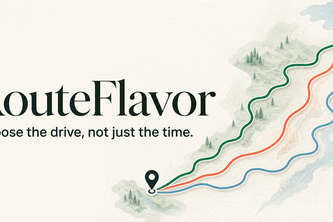
RouteFlavor is a navigation tool that allows drivers to choose between different driving routes based on preferences other than just travel time. The author states it compares real driving routes using Google Routes API and provides explanations via OpenAI, without generating new routes or altering route data.
What changed
This project was submitted as part of the OpenAI 2026 hackathon. It represents a self-reported attempt to improve upon traditional navigation apps by introducing user preference-based route selection and explainable AI for route recommendations.
Single most important open question
Does RouteFlavor have any commercial traction, revenue, or customer adoption beyond its hackathon submission?
What The Product Actually Is
The description states that RouteFlavor:
- Retrieves real driving alternatives from the Google Routes API
- Uses a preference slider to let drivers choose between "Fast & predictable" and "Scenic & adventurous"
- Evaluates routes using factors including travel time, distance, interstate usage, maneuver simplicity, route curvature, distinctiveness, and estimated scenic potential
- Provides explanations via OpenAI about each route's strengths, tradeoffs, and best use case
- Does not invent or alter routes; Google supplies the route facts while RouteFlavor scores them
- Includes worldwide place search, traffic-aware estimates, interactive maps, responsive design, and integration with Google Maps
Evidence All of this is self-reported by the author.
Confidence Low — based entirely on a single project description without any external validation or data.
Positioning & Claim Evolution
The author claims:
- Traditional navigation apps optimize only for speed
- RouteFlavor helps drivers choose journeys that fit their preferences, not just shortest time
- It offers "explainable AI" rather than AI-generated routing
- The tool makes route planning more personal, transparent, and intentional
Evidence These are stated claims in the project write-up.
Inference This suggests a positioning shift from purely functional navigation to user-centric journey selection. However, no evidence of market testing or customer feedback is provided.
Target Customer & ICP
The description states:
- The target audience is drivers who want more than just the fastest route
- Users select origin and destination, then adjust preferences
- It supports worldwide place search and international driving routes
Evidence Self-reported by the author.
Confidence Low — no evidence of actual customer segments or personas defined beyond "drivers".
Business Model & Pricing Evidence
The description does not contain any information about:
- Revenue model
- Pricing structure
- Monetization strategy
- Customer acquisition costs
- Unit economics
Evidence Not evidenced.
Technical & Delivery Signals
The author states:
- Built with Next.js, React, TypeScript, Tailwind CSS, OpenAI, Google Maps API, Redis, Vitest, Zod, Upstash
- Uses structured data from Google Routes API
- Implements caching, timeouts, rate limiting, and request validation
- Provides responsive mobile/desktop design
- Integrates with Google Maps for route preservation
Evidence Self-reported technical stack and features.
Confidence Low — no evidence of production deployment or performance metrics.
Traction & Maturity Signals
The description does not include:
- Any revenue data
- Customer base or user numbers
- Product usage statistics
- Market traction indicators
- Growth metrics
- Product maturity indicators (e.g., version history, feature releases)
Evidence Not evidenced.
Inference The project is described as a hackathon submission, suggesting early-stage development and no proven market adoption.
Competitive Context
The description does not mention:
- Direct competitors
- Market size or share
- Competitive advantages
- Differentiation from existing navigation tools
Evidence Not evidenced.
Confidence Low — the author makes no claims about competitive positioning or landscape awareness.
Open Questions & Risks
Key risks and open questions based on the description:
- No revenue, customers, or traction data — only a hackathon project
- Reliance on external APIs (Google Routes, OpenAI) without clear SLA or fallbacks
- Limited team size (1 person)
- No indication of scalability or infrastructure robustness
- Lack of business model clarity
- No evidence of market validation or user feedback
Evidence Inferred from lack of data and self-reported nature.
Questions the description leaves open
- What is the current stage of development beyond the hackathon?
- Have you conducted any user research or testing?
- How do you plan to monetize this product?
- What are your go-to-market strategies?
- Are there any partnerships or integrations planned with navigation platforms?
- Can you provide evidence of usage beyond the prototype?
- What is your long-term vision for RouteFlavor?
Overall Assessment
The author states that RouteFlavor was submitted to the OpenAI 2026 hackathon and is described as a proof-of-concept tool.
Assessment Not evidenced — no commercial traction, revenue, or customer data exists beyond the project description. The tool appears to be an early-stage idea with no demonstrated market validation or business model.
Confidence Very low — this analysis is based solely on unverified self-reporting and lacks any external corroboration or performance indicators.
User Stories BotA demo video on every pull request
Get a demo video on every new feature
GitHub App that watches your pull requests and records a narrated, captioned demo.
Save time on demo prep and make informed decisions faster with a video walkthrough of every new feature.
Source
Submitted to the OpenAI 2026 hackathon on Devpost. Project home on Devpost. Back to the full gallery on Devpost.
This competitive analysis was produced by top-founders.com (opens in a new tab)
Generated by a language model from this project's public Devpost page — its tagline, the author's own write-up and any built-with tags listed there — as captured in August 2026. Short quotations are the author's words. It is an opinion on the idea as a business, not on the people behind it, and it reflects the description as published then. If the project has moved on, request a correction below. The analysis is not independent research and contains no verified traction, revenue or customer data.
An independent guide by KFG International LLC — not affiliated with, endorsed by, or connected to Devpost or OpenAI.