

Archive position — measured, not model output
0 likes on Devpost
2,263 of the 7,850 archived projects have more likes, and 5,587 share exactly 0 — so this project's #6,220 place in the like-ranked listing is a tie-break inside that group, not a ranking.
Projects (log scale)
Likes on Devpost. ▲ marks this project's group.
Show the figures
| Likes | Projects | Share of archive |
|---|---|---|
| 0 | 5,587 | 71.2% |
| 1 | 1,758 | 22.4% |
| 2 | 284 | 3.6% |
| 3–4 | 132 | 1.7% |
| 5–9 | 75 | 1.0% |
| 10+ | 14 | 0.2% |
 User Stories BotA demo video on every pull request
Get a demo video on every new feature
GitHub App that watches your pull requests and records a narrated, captioned demo.
Save time on demo prep and make informed decisions faster with a video walkthrough of every new feature.
Executive Summary
What the company appears to be
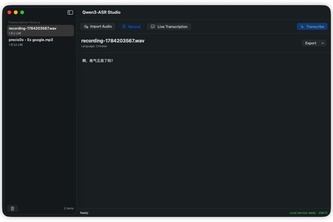
Qwen3-ASR Studio is a self-reported, privacy-first transcription tool for Apple Silicon Macs. The author describes it as a native macOS application that performs real-time and file-based transcription using local AI models (Qwen3-ASR, MiniCPM) with no cloud uploads.
What changed
The project evolved from basic file transcription into a self-contained desktop product during OpenAI Build Week. It now supports real-time microphone and system-audio transcription, local inference, and contextual text repair.
Single most important open question
Is there any evidence of actual user adoption or commercial traction beyond the author’s personal development effort?
Note: This analysis is based entirely on the self-reported project description provided by the author. No external verification, revenue data, customer names, or third-party sources are available. All claims are treated as unverified statements made by the author.
What The Product Actually Is
The description states that Qwen3-ASR Studio is a native macOS application built for Apple M-series chips. It supports:
- Transcription of audio and video files
- Real-time microphone transcription
- System-audio transcription via ScreenCaptureKit
- Local processing using the MLX framework
- Use of Qwen3-ASR 0.6B 4-bit model
- Contextual text repair with MiniCPM5 1B Q8
- Export formats: TXT, SRT, JSON
- Timeline segment generation
- Local storage of transcription history
It is described as a local AI transcription tool, where audio is not uploaded to remote providers.
Inference: The product is an end-user desktop application designed for developers or users who want private, local speech-to-text functionality on Macs. It uses open-source or proprietary models via local inference engines.
Positioning & Claim Evolution
The author positions Qwen3-ASR Studio as a privacy-first transcription tool for beginners, emphasizing:
- No cloud upload
- Local processing
- Real-time transcription
- Use of open-source AI models (Qwen3-ASR, MiniCPM)
- Built with beginner-friendly tools like Codex and GPT-5.6
It started as a personal project to solve a practical need but evolved into a self-contained desktop product during the OpenAI Build Week hackathon.
Claim: The author claims this is a useful, private, local transcription tool for Mac users who want real-time or file-based transcription without relying on cloud services.
Inference: The positioning reflects a niche market need — privacy-conscious developers or content creators seeking local AI tools.
Target Customer & ICP
The description states that the author is a coding beginner and built this tool to meet their own needs. There is no explicit mention of target customer segments beyond that.
Claim: The intended users are likely Mac developers or power users who value privacy, want local AI processing, and may be technically inclined enough to use a command-line or developer-oriented app.
Inference: No defined ICP beyond "tech-savvy individuals" or "beginners with coding interest." No evidence of market segmentation or customer personas.
Business Model & Pricing Evidence
There is no mention of pricing, monetization strategy, or business model in the description.
Claim: The project appears to be a personal development effort without any stated commercial intent.
Not evidenced: No revenue streams, subscriptions, licensing, or paid features are described.
Technical & Delivery Signals
The app is built using:
- Swift and SwiftUI for UI
- MLX framework for local Qwen3-ASR inference
- FFmpeg for audio handling
- AVFoundation for microphone input
- ScreenCaptureKit for system audio capture
- MiniCPM5 1B Q8 for text repair via llama.cpp backend
It supports:
- Streaming acoustic windows with live editing of uncertain phrases
- Finalization behavior that prevents truncation of last sentence
- Progress reporting and error recovery
- Packaging scripts and documentation
Inference: The technical stack suggests a lightweight, native macOS app designed for performance and privacy. It uses local inference to avoid cloud dependencies.
Traction & Maturity Signals
The project is described as:
- A personal development effort by one person (team size: 1)
- Submitted to an OpenAI hackathon
- Evolved from basic functionality into a full desktop product during Build Week
- Includes documentation, packaging scripts, and public release on Devpost
Not evidenced: No evidence of user adoption, downloads, customer feedback, or usage metrics. No mention of any commercial deployment or market presence.
Competitive Context
The description does not reference competitors or similar products directly.
Inference: Based on the features described (local transcription, real-time audio capture, privacy focus), it likely competes with tools like Otter.ai, Rev.com, or other local speech-to-text apps — though none are named.
Not evidenced: No competitive analysis, pricing comparison, or market positioning against existing tools.
Open Questions & Risks
- Single-person development: The team size is 1, suggesting limited scalability or long-term maintenance capacity.
- No commercial traction: No evidence of users, revenue, or adoption beyond the author’s own use case.
- Unverified claims: All descriptions are self-reported and unverified; no third-party validation exists.
- Limited scope: The app appears to be a proof-of-concept or hobby project rather than a scalable product.
- No monetization strategy: No indication of how this would become a viable business.
Inference: This is likely a prototype or personal tool, not a commercial-grade product. It may lack the infrastructure for broader market adoption.
Questions the description leaves open
- What is your actual experience with transcription tools? Did you have a specific problem that led to building this?
- How many users are currently using Qwen3-ASR Studio, if any?
- Are there plans to monetize or commercialize the tool?
- Have you considered integrating with other platforms or APIs beyond macOS?
- What is the long-term roadmap for the product beyond what’s described in the write-up?
Overall Assessment
This project is described as a personal development effort by one individual, likely a beginner developer, focused on solving a niche problem — local, real-time transcription on Macs.
Not evidenced: No commercial traction, revenue, or customer base. The product appears to be a prototype or proof-of-concept with no evidence of market demand or scalability.
Assessment: Not suitable for investment or partnership at this stage. It lacks the commercial maturity, user adoption, or clear business model required for due-diligence consideration. It may be an interesting side project but not a viable business opportunity without further development and traction.
User Stories BotA demo video on every pull request
Get a demo video on every new feature
GitHub App that watches your pull requests and records a narrated, captioned demo.
Save time on demo prep and make informed decisions faster with a video walkthrough of every new feature.
Source
Submitted to the OpenAI 2026 hackathon on Devpost. Project home on Devpost. Back to the full gallery on Devpost.
This competitive analysis was produced by top-founders.com (opens in a new tab)
Generated by a language model from this project's public Devpost page — its tagline, the author's own write-up and any built-with tags listed there — as captured in August 2026. Short quotations are the author's words. It is an opinion on the idea as a business, not on the people behind it, and it reflects the description as published then. If the project has moved on, request a correction below. The analysis is not independent research and contains no verified traction, revenue or customer data.
An independent guide by KFG International LLC — not affiliated with, endorsed by, or connected to Devpost or OpenAI.