

Archive position — measured, not model output
0 likes on Devpost
2,263 of the 7,850 archived projects have more likes, and 5,587 share exactly 0 — so this project's #6,222 place in the like-ranked listing is a tie-break inside that group, not a ranking.
Projects (log scale)
Likes on Devpost. ▲ marks this project's group.
Show the figures
| Likes | Projects | Share of archive |
|---|---|---|
| 0 | 5,587 | 71.2% |
| 1 | 1,758 | 22.4% |
| 2 | 284 | 3.6% |
| 3–4 | 132 | 1.7% |
| 5–9 | 75 | 1.0% |
| 10+ | 14 | 0.2% |
 User Stories BotA demo video on every pull request
Get a demo video on every new feature
GitHub App that watches your pull requests and records a narrated, captioned demo.
Save time on demo prep and make informed decisions faster with a video walkthrough of every new feature.
Executive Summary
What the company appears to be
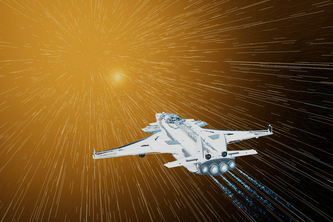
QX-1: Quantum Transit Lab is a self-reported prototype of an immersive, browser-based quantum travel experience built by one developer (Ivan Lu). It simulates a journey through three stages of quantum navigation using real-time 3D graphics, WebXR, and Three.js. The project is described as a speculative design and visualization prototype, not a scientifically accurate simulation.
What changed
The author states that QX-1 evolved from a static spacecraft concept into an interactive experience with procedural effects, multiple camera modes, dynamic cockpit displays, and VR support. It includes visual systems for quantum transitions, engine exhaust, and particle effects, all rendered in real time within the browser.
Single most important open question
Is there any evidence of commercial traction, revenue, or customer adoption beyond the author’s own development?
Note: This analysis is based solely on the self-reported project description provided by the caller. No external verification, archived data, or third-party sources are available. All claims are treated as unverified statements made by the author.
What The Product Actually Is
The description states that QX-1 is an immersive browser-based quantum travel experience centered around an original futuristic spacecraft. It allows users to navigate through three stages of quantum navigation:
- Jump Initiation: Golden particles and energy streaks converge as the quantum drive begins charging.
- Quantum Cruise: The spacecraft enters a high-speed blue procedural transit tunnel.
- Real-Space Exit: The tunnel disappears, revealing a planetary environment.
Users can manually adjust parameters such as transit speed, energy intensity, and tunnel radius. Visual systems—including procedural tunnels, star streaks, quantum wavefronts, engine exhaust, structural accents, and camera vibration—can be enabled or disabled.
The experience includes nine camera modes (cinematic, chase, top, close-up, cockpit, quantum-core, wide, first-person VR views), and in WebXR mode, users are positioned inside the cockpit at the pilot’s head location. The cockpit features embedded dynamic displays showing navigation, airframe systems, engine status, transit speed, core energy, and flight-phase information.
It was built using HTML, CSS, JavaScript, Three.js, WebGL, and WebXR. Custom GLSL shaders generate procedural visuals including quantum tunnels, animated backgrounds, plasma cores, atmospheric planets, energy fields, and particle effects.
Inference: The product is a technical prototype designed for demonstration or exploration rather than commercial use. It does not appear to include any monetization features or user onboarding mechanisms.
Positioning & Claim Evolution
The author describes QX-1 as a speculative design and visualization prototype exploring how future transportation technology could be experienced through a browser and VR headset. It is explicitly stated that it is not presented as a scientifically accurate quantum simulation, but rather a creative interpretation of what quantum travel might feel like.
Key claims from the description:
- The goal was to transform the spacecraft into an interactive experience communicating speed, scale, energy, and atmosphere.
- It combines futuristic industrial design, real-time 3D graphics, and virtual reality.
- The project aims to show how imagined future tech can be communicated not only through images but also through space, movement, interaction, and immersion.
Claim vs Fact: These are self-reported intentions. There is no evidence of market positioning, branding strategy, or user feedback that would validate these claims beyond the author’s own narrative.
Target Customer & ICP
Not evidenced.
The description does not identify any specific customer segments, personas, or ideal customer profiles (ICPs). It describes an experience intended for users who are interested in immersive 3D environments and speculative design, but no explicit target audience is defined.
Absence of evidence: No indication of who the end-users are, their needs, or how they would engage with this product beyond personal interest or experimentation.
Business Model & Pricing Evidence
Not evidenced.
There is no mention of pricing models, monetization strategies, licensing terms, or business structures. The project is described as a prototype and not as a commercial offering.
Absence of evidence: No data on revenue streams, customer acquisition costs, or pricing plans.
Technical & Delivery Signals
The author reports that the experience was built with:
- HTML, CSS, JavaScript
- Three.js, WebGL, WebXR
- Blender for modeling and optimization
- GLSL shaders for procedural visuals
- Canvas API for cockpit displays
- Physically based rendering techniques (ACES filmic tone mapping, environmental lighting, fog, additive blending, bloom post-processing)
The spacecraft asset contains:
- 177 individual meshes
- 377,480 triangles
- 31 materials
- 93 structural pivot nodes
It supports real-time performance across both desktop and VR platforms. The runtime is bundled locally without reliance on external CDNs.
Inference: The technical stack suggests a high-end, performance-intensive experience suitable for advanced developers or enthusiasts. However, no evidence of scalability, deployment infrastructure, or production readiness.
Traction & Maturity Signals
Not evidenced.
There is no mention of users, downloads, engagement metrics, or adoption data. The project is described as a personal development effort submitted to a hackathon and not as a product with traction or market validation.
Absence of evidence: No signs of user base, revenue, or growth indicators beyond the author’s own account.
Competitive Context
Not evidenced.
The description does not reference competitors, similar products, or market positioning relative to others in the space. It is unclear whether there are comparable offerings in the immersive 3D or quantum travel simulation domain.
Absence of evidence: No competitive landscape or differentiation analysis provided.
Open Questions & Risks
- Single-person development: The project was built by one individual (Ivan Lu), which raises questions about scalability, long-term maintenance, and team capacity.
- Prototype nature: It is described as a speculative design and visualization prototype, not a commercial product. There is no evidence of market demand or monetization.
- Technical complexity without production context: While the technical execution appears sophisticated, there is no indication of how it would be deployed at scale or integrated into existing systems.
- No user feedback or testing: No mention of usability studies, focus groups, or iterative improvements based on real-world usage.
- Hackathon submission: The project was submitted to a hackathon, suggesting it may have been developed under time constraints and for demonstration purposes rather than long-term viability.
Inference: These factors suggest that while the prototype is technically impressive, its commercial potential remains unproven.
Questions the description leaves open
- What is the intended use case beyond personal or experimental development?
- Are there any plans to monetize this experience or integrate it into a larger platform?
- How does the current performance compare across different hardware configurations and browsers?
- Has the prototype been tested with non-technical users, and what were the results?
- What are the long-term goals for QX-1 beyond its current scope?
- Is there any interest from potential partners or investors in building out this concept further?
Overall Assessment
Not evidenced.
There is no evidence of funding rounds, valuations, or investment activity related to QX-1. The project appears to be a solo developer effort submitted to a hackathon and not part of any formal business venture or investment pipeline.
Confidence level: Low — based entirely on self-reported information with no external validation or traction data.
User Stories BotA demo video on every pull request
Get a demo video on every new feature
GitHub App that watches your pull requests and records a narrated, captioned demo.
Save time on demo prep and make informed decisions faster with a video walkthrough of every new feature.
Source
Submitted to the OpenAI 2026 hackathon on Devpost. Project home on Devpost. Back to the full gallery on Devpost.
This competitive analysis was produced by top-founders.com (opens in a new tab)
Generated by a language model from this project's public Devpost page — its tagline, the author's own write-up and any built-with tags listed there — as captured in August 2026. Short quotations are the author's words. It is an opinion on the idea as a business, not on the people behind it, and it reflects the description as published then. If the project has moved on, request a correction below. The analysis is not independent research and contains no verified traction, revenue or customer data.
An independent guide by KFG International LLC — not affiliated with, endorsed by, or connected to Devpost or OpenAI.