

Archive position — measured, not model output
0 likes on Devpost
2,263 of the 7,850 archived projects have more likes, and 5,587 share exactly 0 — so this project's #2,298 place in the like-ranked listing is a tie-break inside that group, not a ranking.
Projects (log scale)
Likes on Devpost. ▲ marks this project's group.
Show the figures
| Likes | Projects | Share of archive |
|---|---|---|
| 0 | 5,587 | 71.2% |
| 1 | 1,758 | 22.4% |
| 2 | 284 | 3.6% |
| 3–4 | 132 | 1.7% |
| 5–9 | 75 | 1.0% |
| 10+ | 14 | 0.2% |
 User Stories BotA demo video on every pull request
Get a demo video on every new feature
GitHub App that watches your pull requests and records a narrated, captioned demo.
Save time on demo prep and make informed decisions faster with a video walkthrough of every new feature.
Executive Summary
What the company appears to be
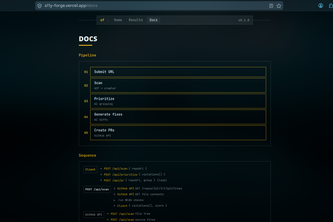
a11y-forge is a self-reported tool that scans public GitHub repositories for WCAG 2.2 AA compliance using AI-powered static analysis. It claims to offer zero-config accessibility auditing, with results presented as A+–F scores, grouped violations, and downloadable reports (HTML, PDF, SVG). The tool is described as built autonomously using Codex and GPT-5.6, and is positioned as free and open source.
What changed
The project was submitted to the OpenAI 2026 hackathon on Devpost. It is a self-contained, single-developer effort with no evidence of prior traction or commercialization.
Single most important open question
Is there any evidence that a11y-forge has been used beyond its own development and submission context? The description states it is free and open source, but does not indicate adoption, usage metrics, or revenue — all of which are unverified claims.
What The Product Actually Is
The description states that a11y-forge autonomously scans public GitHub repositories for WCAG 2.2 AA violations. It claims to provide an A+–F score in ~2 minutes, with violations grouped by category and ranked by user impact. Reports are available in HTML, PDF, and SVG formats, and includes screen reader preview simulation.
It uses a pipeline that fetches repository trees via GitHub API, downloads up to 150 source files, runs 12 static WCAG check types (including AST parsing, CSS inspection, regex patterns), groups violations using GPT-5.6 with deterministic fallback logic, and generates reports.
Evidence
- The author states: “a11y-forge autonomously scans public GitHub repos for WCAG 2.2 AA violations.”
- The author describes the pipeline including GitHub API usage, AST parsing, regex patterns, and GPT-5.6.
- The tool is described as generating HTML/PDF reports and SVG badges.
Inference The tool appears to be a developer-facing utility built for open-source projects, with no indication of enterprise or commercial use.
Positioning & Claim Evolution
The description states that a11y-forge was inspired by the lack of accessible automated tools for open source projects. It positions itself as a solution to manual testing being slow and expensive, and aims to make zero-config accessibility scanning available to every open source maintainer.
Evidence
- The author states: “Web accessibility is a legal requirement (ADA, Section 508, EU Directive). Most open source projects never get audited — manual testing is slow and expensive.”
- The tool is positioned as a way to democratize accessibility auditing for open source maintainers.
- It is described as free and open source.
Inference The positioning is focused on open-source developers and legal compliance, not enterprise or commercial adoption. There is no indication of evolution from a hackathon prototype to a product with traction.
Target Customer & ICP
The description states that the tool is intended for open source maintainers who want zero-config accessibility scanning. It targets those who are legally required to comply with WCAG but lack resources or tools for auditing.
Evidence
- The author states: “a11y-forge makes zero-config accessibility scanning accessible to every open source maintainer.”
- It is described as solving a problem for open source projects, not enterprise users.
Inference The ICP appears to be open source maintainers and small teams with limited resources. No evidence of targeting enterprise customers or paying users.
Business Model & Pricing Evidence
The description states that a11y-forge is free and open source. There is no mention of pricing, subscriptions, monetization, or paid features.
Evidence
- The author states: “Free, open source.”
- No pricing model or revenue streams are described.
Inference There is no evidence of a business model beyond open-source distribution. No commercialization or monetization strategy is evident.
Technical & Delivery Signals
The tool is built using Next.js 16.2, TypeScript 5, Tailwind v4, Octokit v5, OpenAI SDK, @babel/parser, pdf-lib, vitest + Playwright. It uses Codex CLI for development acceleration and GPT-5.6 for runtime prioritization.
Evidence
- The author lists technologies: Next.js, TypeScript, Tailwind, Octokit, OpenAI SDK, Babel, pdf-lib, vitest, Playwright.
- Development was done during the OpenAI Build Week 2026 hackathon.
- Codex CLI was used for scaffolding and debugging.
Inference The tool is a developer-built prototype with no evidence of production-grade delivery or scalability beyond its own development context.
Traction & Maturity Signals
There is no evidence of traction, adoption, or usage metrics. The project is described as a hackathon submission with no indication of external use or user base.
Evidence
- The author states: “Everything above is the authors' own account. It is not independently verified, and no revenue, customer or traction data is available beyond what they state.”
- No mention of users, downloads, or usage statistics.
- No evidence of product-market fit or commercial adoption.
Inference The tool has not demonstrated any traction or maturity beyond its own development context.
Competitive Context
No competitive analysis is provided in the description. The author does not reference existing tools or market players for accessibility scanning.
Evidence
- No mention of competitors.
- No indication of how a11y-forge differentiates from other tools.
Inference The competitive landscape is unknown, and there is no evidence of awareness or positioning relative to existing solutions in the space.
Open Questions & Risks
- Unverified claims: The description is self-reported and unverified.
- No traction or adoption: No evidence of usage beyond its own development context.
- Single developer: Team size is listed as 1, suggesting limited scalability or support.
- No commercialization: The tool is described as free and open source with no monetization strategy.
- Hackathon origin: The project was built for a hackathon, not a product-market fit.
Evidence
- The author states: “It is not independently verified.”
- No evidence of revenue, customers, or usage metrics.
- Team size = 1.
- No pricing or monetization strategy.
Questions the description leaves open
- What is the actual scope of the tool’s WCAG coverage? Is it limited to specific checks?
- How does the tool handle private repositories or large-scale enterprise scanning?
- Are there any plans for monetization or commercial use beyond open source?
- Has the tool been tested on real-world open source projects, and what feedback was received?
- What are the technical limitations of GPT-5.6 in this context, especially with rate limits or accuracy?
Overall Assessment
Not evidenced.
Evidence The description does not provide any information about investment interest, partnership potential, or commercial viability beyond its own development and submission to a hackathon.
Inference Given the lack of traction, revenue, or commercialization, there is no basis for an investment or partnership assessment. The tool appears to be a prototype with no demonstrated product-market fit or scalability.
User Stories BotA demo video on every pull request
Get a demo video on every new feature
GitHub App that watches your pull requests and records a narrated, captioned demo.
Save time on demo prep and make informed decisions faster with a video walkthrough of every new feature.
Source
Submitted to the OpenAI 2026 hackathon on Devpost. Project home on Devpost. Back to the full gallery on Devpost.
This competitive analysis was produced by top-founders.com (opens in a new tab)
Generated by a language model from this project's public Devpost page — its tagline, the author's own write-up and any built-with tags listed there — as captured in August 2026. Short quotations are the author's words. It is an opinion on the idea as a business, not on the people behind it, and it reflects the description as published then. If the project has moved on, request a correction below. The analysis is not independent research and contains no verified traction, revenue or customer data.
An independent guide by KFG International LLC — not affiliated with, endorsed by, or connected to Devpost or OpenAI.