

Archive position — measured, not model output
2 likes on Devpost
221 of the 7,850 archived projects have more likes, and 284 share exactly 2 — so this project's #265 place in the like-ranked listing is a tie-break inside that group, not a ranking.
Projects (log scale)
Likes on Devpost. ▲ marks this project's group.
Show the figures
| Likes | Projects | Share of archive |
|---|---|---|
| 0 | 5,587 | 71.2% |
| 1 | 1,758 | 22.4% |
| 2 | 284 | 3.6% |
| 3–4 | 132 | 1.7% |
| 5–9 | 75 | 1.0% |
| 10+ | 14 | 0.2% |
 User Stories BotA demo video on every pull request
Get a demo video on every new feature
GitHub App that watches your pull requests and records a narrated, captioned demo.
Save time on demo prep and make informed decisions faster with a video walkthrough of every new feature.
Executive Summary
What the company appears to be
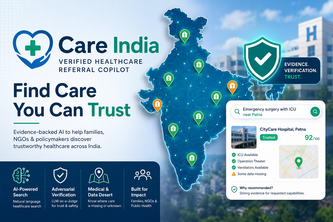
Care India is a self-reported AI-powered healthcare referral system designed to help families, NGOs, and public-health teams locate trustworthy Indian healthcare facilities using natural-language queries. It claims to verify hospital data, detect unreliable information, and identify medical deserts.
What changed
The project was submitted as part of the OpenAI 2026 hackathon. The description indicates it is a prototype built over a short timeframe with limited production history or commercial traction.
Single most important open question
Is there evidence that Care India has moved beyond a hackathon prototype into real-world usage, adoption, or revenue-generating activity?
Note: This analysis is based entirely on the self-reported project description provided by the author. No external verification, funding data, customer base, or traction metrics are available.
What The Product Actually Is
The description states that Care India is:
- An AI referral copilot for healthcare in India.
- A system that allows users to search hospitals using natural language (e.g., “Find a hospital near Patna that can handle emergency surgery and has ICU support”).
- Capable of showing results on an interactive map.
- Designed to verify hospital claims through evidence-based checks.
- Equipped with features like trust scores, reasoning for recommendations, and detection of medical deserts and data deserts.
It uses:
- Next.js (frontend)
- FastAPI (backend)
- Databricks Vector Search
- Unity Catalog and Delta tables
- LangGraph
- MLflow
- Codex and GPT-5.6
Inference: The product appears to be a proof-of-concept or early-stage prototype built for a hackathon, not yet deployed in production.
Positioning & Claim Evolution
The description states that Care India:
- Helps families, NGOs, and public-health teams find trustworthy healthcare facilities.
- Detects unreliable data and identifies medical deserts.
- Provides evidence-backed recommendations with clear reasoning.
- Is an “evidence-backed AI referral copilot.”
It positions itself as solving a problem of incomplete or inconsistent healthcare records in India.
Claim vs. Fact: The description is self-reported and does not provide any evidence of actual deployment, user feedback, or impact beyond the hackathon context.
Target Customer & ICP
The description states that Care India targets:
- Families seeking medical help
- NGO workers making referrals
- Public-health teams identifying underserved areas
Inference: The target audience is primarily end-users and public-sector actors in India who need reliable healthcare data. However, no evidence of actual customer acquisition or engagement exists.
Business Model & Pricing Evidence
The description does not mention:
- Any pricing model
- Revenue streams
- Monetization strategy
- Paid features or subscriptions
Not evidenced: There is no indication of how the product would generate revenue or whether it has a business model beyond its hackathon prototype.
Technical & Delivery Signals
The project was built using:
- Next.js (frontend)
- React, React Leaflet
- FastAPI (backend)
- Databricks Vector Search
- Unity Catalog and Delta tables
- LangGraph
- MLflow
- Codex and GPT-5.6 for development support
It includes:
- Natural-language search
- Interactive map interface
- AI-driven verification of hospital data
- Trust scoring and reasoning engine
- Detection of medical desert and data desert conditions
Inference: The tech stack suggests a modern, scalable architecture but lacks evidence of production deployment or performance metrics.
Traction & Maturity Signals
The description states:
- It was built for the OpenAI 2026 hackathon.
- Team size: 4 members.
- No mention of users, customers, or revenue.
- No data on usage volume, retention, or adoption.
Not evidenced: There is no evidence of traction, user engagement, or product maturity beyond a hackathon submission.
Competitive Context
The description does not reference:
- Competitors
- Market landscape
- Existing solutions in the Indian healthcare referral space
Not evidenced: No competitive positioning or market differentiation data is provided.
Open Questions & Risks
Key concerns based on the self-reported description:
- No real-world usage — built for a hackathon, no evidence of deployment.
- Unverified data sources — reliance on healthcare records that may be incomplete or inconsistent.
- AI trustworthiness — claims of AI verification without demonstration of accuracy or reliability.
- Lack of monetization strategy — no indication of how the product will be monetized.
- Dependency on GPT-5.6 and Codex — raises questions about scalability, cost, and long-term viability.
Inference: The project is unproven in real-world conditions and lacks commercial readiness.
Questions the description leaves open
- Has Care India been tested or piloted with actual users (families, NGOs, health teams)?
- What data sources are being used to verify hospital claims? Are they publicly available or proprietary?
- How is the trust score calculated and validated?
- Is there any plan for live verification of hospital services or real-time availability?
- Have you considered regulatory compliance in healthcare data handling?
- What is your roadmap for moving from prototype to production-scale deployment?
Overall Assessment
Assessment: Not evidenced.
The description indicates that Care India is a hackathon project with no demonstrated traction, revenue, or customer base. It is not clear whether it has moved beyond the prototype stage or has any commercial viability.
Confidence level: Low — based on self-reported evidence only, with no external validation or data on adoption, users, or performance.
User Stories BotA demo video on every pull request
Get a demo video on every new feature
GitHub App that watches your pull requests and records a narrated, captioned demo.
Save time on demo prep and make informed decisions faster with a video walkthrough of every new feature.
Source
Submitted to the OpenAI 2026 hackathon on Devpost. Project home on Devpost. Back to the full gallery on Devpost.
This competitive analysis was produced by top-founders.com (opens in a new tab)
Generated by a language model from this project's public Devpost page — its tagline, the author's own write-up and any built-with tags listed there — as captured in August 2026. Short quotations are the author's words. It is an opinion on the idea as a business, not on the people behind it, and it reflects the description as published then. If the project has moved on, request a correction below. The analysis is not independent research and contains no verified traction, revenue or customer data.
An independent guide by KFG International LLC — not affiliated with, endorsed by, or connected to Devpost or OpenAI.