

Archive position — measured, not model output
1 like on Devpost
505 of the 7,850 archived projects have more likes, and 1,758 share exactly 1 — so this project's #2,228 place in the like-ranked listing is a tie-break inside that group, not a ranking.
Projects (log scale)
Likes on Devpost. ▲ marks this project's group.
Show the figures
| Likes | Projects | Share of archive |
|---|---|---|
| 0 | 5,587 | 71.2% |
| 1 | 1,758 | 22.4% |
| 2 | 284 | 3.6% |
| 3–4 | 132 | 1.7% |
| 5–9 | 75 | 1.0% |
| 10+ | 14 | 0.2% |
 User Stories BotA demo video on every pull request
Get a demo video on every new feature
GitHub App that watches your pull requests and records a narrated, captioned demo.
Save time on demo prep and make informed decisions faster with a video walkthrough of every new feature.
Executive Summary
What the company appears to be
WISE-XAI is an educational platform for scientific model selection that guides users through a structured workflow to diagnose datasets, compare models, design valid evaluations, interpret results, and generate reproducible outputs. It is built as a prototype using Python, Streamlit, and AI tools like GPT-5.6 and Codex.
What changed
The project was submitted as part of the OpenAI 2026 hackathon. It represents an initial working prototype focused on tabular regression/classification with limited model support (e.g., linear/logistic baselines, Random Forest), temporal/grouped holdouts, and SHAP/perm. importance explainability.
Single most important open question
Is there evidence of traction or commercial interest beyond the hackathon submission? The description does not indicate any revenue, customers, or adoption beyond its own self-reported development.
Note: This analysis is based solely on the author's own account — no external verification. All claims are self-reported and unverified.
What The Product Actually Is
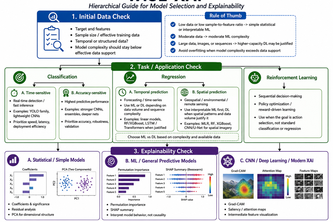
The description states that WISE-XAI is a workflow for interpretable scientific evaluation designed to help students and scientists make responsible model selection decisions. It allows users to upload CSV datasets or use built-in demo data, then guides them through seven stages:
- Data Overview
- Target Insights
- Feature Relationships
- Validation Design
- Model Comparison
- Explainability
- Scientific Recommendation and Outputs
It supports:
- Tabular regression/classification tasks
- Linear/logistic baselines
- Random Forest comparison
- Temporal, group-based, and random holdouts
- Correlation/feature-target association analysis
- Permutation importance and SHAP explanations
- GPT-5.6-powered scientific interpretation
- Reproducible starter code and summary figures
The system is built using Python, Streamlit, scikit-learn, pandas, NumPy, Plotly, SHAP, OpenAI API, and Codex.
Inference: The product appears to be a tool for educational or research use rather than production ML deployment. It emphasizes transparency over automation.
Positioning & Claim Evolution
The author positions WISE-XAI as an alternative to "AutoML" systems that blindly select models based on performance alone. Instead, it promotes:
- Starting with the data and scientific question
- Prioritizing interpretability, reliability, reproducibility, and applicability over small gains in accuracy
- Avoiding common pitfalls like temporal leakage or class imbalance
It claims to offer:
- Educational guidance for model selection
- Transparent baseline comparisons
- AI-assisted interpretation without replacing deterministic analysis
- A framework that can scale to more advanced models and data types
Claim vs Fact: The description states these are the intended goals, but there is no evidence of actual usage or impact beyond the prototype.
Target Customer & ICP
The description indicates WISE-XAI targets:
- Students and scientists
- Users who need to make responsible model selection decisions
- Those working with tabular data in research or education settings
It does not specify a clear customer segment beyond this general audience. There is no mention of enterprise users, specific industries, or institutional adoption.
Inference: The ICP likely includes academic researchers, graduate students, and educators using ML for scientific work.
Business Model & Pricing Evidence
There is no evidence provided about:
- Revenue streams
- Pricing models
- Monetization strategy
- Customer acquisition plans
- Subscription tiers or licensing options
The project is described as a hackathon submission with no indication of commercial viability or monetization.
Not evidenced: No business model or pricing data available.
Technical & Delivery Signals
The prototype uses:
- Python, Streamlit, scikit-learn, pandas, NumPy, Plotly, SHAP
- GPT-5.6 for scientific interpretation
- Codex for development assistance
- OpenAI API integration
It includes components such as:
- Dataset profiling
- Feature and target analysis
- Model-comparison engine
- Validation engine
- Explainability layer
- Reproducible output layer
Inference: The architecture is modular and extensible, suggesting potential for future expansion into more complex data types (e.g., image/text/time-series) and model families.
Traction & Maturity Signals
The description states:
- This is an initial working prototype
- It was submitted to the OpenAI 2026 hackathon
- No revenue, customers, or adoption metrics are mentioned
Not evidenced: No signs of traction, user base, or market validation beyond the hackathon submission.
Competitive Context
The description does not reference direct competitors. However, it implies a space that includes:
- AutoML platforms (e.g., H2O.ai, DataRobot)
- Explainable AI tools (e.g., LIME, SHAP, Captum)
- Educational ML frameworks
- Scientific computing environments (e.g., Jupyter, RStudio)
Inference: WISE-XAI may compete with or complement these tools by focusing on scientific rigor and interpretability over pure performance.
Open Questions & Risks
Key concerns include:
- Lack of evidence for traction or commercial viability
- Prototype-only status; no indication of scaling beyond initial scope
- Heavy reliance on GPT-5.6 for interpretation — raises questions about reproducibility, consistency, and data privacy
- No mention of data handling practices or compliance considerations
- Unclear path to monetization or product-market fit
Inference: The project lacks commercial readiness and market validation.
Questions the description leaves open
- What is the intended transition from prototype to full platform?
- How will you ensure reproducibility and consistency of GPT-5.6 outputs?
- Are there plans for data privacy, security, or compliance (e.g., GDPR)?
- Have you tested WISE-XAI with real-world datasets or users outside the hackathon?
- What are your long-term goals for model support, data types, and scalability?
- How do you plan to monetize or commercialize this platform?
- Is there any feedback from potential users or institutions regarding its utility?
Overall Assessment
Not evidenced: There is no evidence of revenue, customers, or traction beyond the hackathon submission.
Confidence Level: Low — based on minimal self-reported information and lack of external validation.
The project shows promise as an educational tool for responsible model selection but has not demonstrated commercial viability or market demand. It remains in early-stage development with no clear path to monetization or institutional adoption.
Assessment Summary: Not ready for investment or partnership at this time. Requires further development, traction, and clarity on business model before evaluation.
User Stories BotA demo video on every pull request
Get a demo video on every new feature
GitHub App that watches your pull requests and records a narrated, captioned demo.
Save time on demo prep and make informed decisions faster with a video walkthrough of every new feature.
Source
Submitted to the OpenAI 2026 hackathon on Devpost. Project home on Devpost. Back to the full gallery on Devpost.
This competitive analysis was produced by top-founders.com (opens in a new tab)
Generated by a language model from this project's public Devpost page — its tagline, the author's own write-up and any built-with tags listed there — as captured in August 2026. Short quotations are the author's words. It is an opinion on the idea as a business, not on the people behind it, and it reflects the description as published then. If the project has moved on, request a correction below. The analysis is not independent research and contains no verified traction, revenue or customer data.
An independent guide by KFG International LLC — not affiliated with, endorsed by, or connected to Devpost or OpenAI.