

Archive position — measured, not model output
0 likes on Devpost
2,263 of the 7,850 archived projects have more likes, and 5,587 share exactly 0 — so this project's #6,154 place in the like-ranked listing is a tie-break inside that group, not a ranking.
Projects (log scale)
Likes on Devpost. ▲ marks this project's group.
Show the figures
| Likes | Projects | Share of archive |
|---|---|---|
| 0 | 5,587 | 71.2% |
| 1 | 1,758 | 22.4% |
| 2 | 284 | 3.6% |
| 3–4 | 132 | 1.7% |
| 5–9 | 75 | 1.0% |
| 10+ | 14 | 0.2% |
 User Stories BotA demo video on every pull request
Get a demo video on every new feature
GitHub App that watches your pull requests and records a narrated, captioned demo.
Save time on demo prep and make informed decisions faster with a video walkthrough of every new feature.
Executive Summary
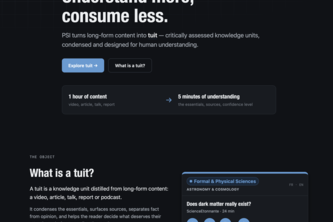
The company appears to be a solo project (team size: 1) named PSI - PostSingularity Institute, self-described as building a tool that converts long-form content into “tuits” — condensed, critically assessed knowledge units designed for human understanding. The author states that the product is nearly in production and has already generated over a thousand tuits. It uses AI platforms like Claude, Gemini, and others, with an agent-based deployment approach.
What changed: The project was submitted to the OpenAI 2026 hackathon, indicating it is at an early stage of development or prototype. No evidence of revenue, customers, or monetization exists beyond the author's claims.
The single most important open question: Is there a viable commercial model for tuits as a knowledge product, and how will PSI scale beyond its current prototype?
What The Product Actually Is
The description states that PSI turns long-form content (videos, articles, talks, reports, podcasts) into “tuits” — which are described as “critically assessed knowledge units, condensed and designed for human understanding.” These tuits aim to surface sources, separate fact from opinion, and help users decide whether to engage with the original content.
- The author states: PSI creates “knowledge units distilled from long-form content.”
- The author states: A tuit is a “synthetic note” that condenses essentials and surfaces sources.
- The author states: First objective: turn long YouTube videos into 5-minute synthetic notes with essential critics.
Inference: The product appears to be an AI-powered summarization tool focused on critical analysis of content, but the exact mechanics or UI are not described.
Positioning & Claim Evolution
The project is positioned as a solution to the problem of information overload and scarce attention. It claims to reduce noise, preserve judgment, and accelerate understanding.
- The author states: “Information has become abundant. Human attention stays scarce.”
- The author states: PSI “reduces the noise, preserves judgment and accelerates understanding.”
- The author states: “PSI turns long-form content into tuit — critically assessed knowledge units.”
Inference: The positioning is that of a knowledge curation or summarization tool for the post-AI-singularity era. It implies a future where humans need better tools to process information.
Target Customer & ICP
The description does not name specific customer segments or personas. However, it implies a user base interested in consuming long-form content and seeking efficient ways to understand it.
- The author states: PSI helps users “decide what deserves their attention — before spending time on it.”
- The author states: It is designed for “human understanding.”
Inference: The target customer likely includes knowledge workers, students, researchers, or anyone who consumes long-form content and seeks to process it quickly.
Business Model & Pricing Evidence
There is no evidence of pricing, monetization strategy, or business model in the description.
- The author states: “Monetisation to support the project.”
- The author states: “Become a major actor as a knowledge provider for humans after AI singularity.”
Inference: The author implies that monetization is a future goal, but no details are provided.
Technical & Delivery Signals
The project uses several AI platforms (Claude, Gemini, Codex, etc.) and was built with backend, frontend, and agent-based deployment. It has been deployed to production-like status.
- The author states: “Built with accessibility, backend, claude, codex, deepseek, frontend, gemini, glm, manus.ai”
- The author states: “Backend & Frontend are almost in production”
- The author states: “More than one thousand 'tuit' already available on https://postsingularityinstitute.com”
Inference: The project is technically functional and has a basic deployment. It uses AI tools for content processing, but no details on architecture or scalability.
Traction & Maturity Signals
The author claims that more than 1,000 tuits are already available, and the product is nearly in production.
- The author states: “More than one thousand 'tuit' already available”
- The author states: “Backend & Frontend are almost in production”
Inference: The project has reached a prototype or early MVP stage. No evidence of user engagement, retention, or revenue exists.
Competitive Context
No mention of competitors or market context is provided in the description.
- The author states: No direct competitor comparison.
- The author states: “Become a major actor as a knowledge provider for humans after AI singularity.”
Inference: The competitive landscape is unknown. It may overlap with summarization tools, content curation platforms, or AI-powered note-taking apps, but no evidence of such overlaps exists.
Open Questions & Risks
- Single founder: Team size is 1; no evidence of team expansion or support.
- No monetization strategy: No pricing, revenue model, or customer acquisition plan.
- Unproven traction: The project has not demonstrated user engagement or adoption beyond its own claims.
- AI dependency: Heavy reliance on AI platforms without clarity on control, accuracy, or scalability.
- Unclear value proposition: The term “tuit” is not defined in common usage; it’s unclear if this is a new concept or a rebranding of existing tools.
Questions the description leaves open
- What is the exact definition of a “tuit”? How does it differ from existing summarization tools?
- How are tuits generated? Is there human review or curation involved?
- What is the monetization strategy, and how will PSI sustain itself?
- What is the long-term vision for scaling beyond 1,000 tuits?
- How does PSI plan to compete with existing summarization tools or AI assistants?
- What are the technical limitations of using multiple AI platforms in tandem?
Overall Assessment
Not evidenced.
There is no evidence of revenue, customers, traction, or a clear business model. The project appears to be an early-stage prototype with limited commercial viability as described. It lacks the signals typically required for investment or partnership consideration.
The author’s claims are self-reported and unverified, and there is no indication that PSI has moved beyond a proof-of-concept stage. The lack of data on user engagement, monetization, or competitive positioning makes it difficult to assess its potential for growth or commercial success.
User Stories BotA demo video on every pull request
Get a demo video on every new feature
GitHub App that watches your pull requests and records a narrated, captioned demo.
Save time on demo prep and make informed decisions faster with a video walkthrough of every new feature.
Source
Submitted to the OpenAI 2026 hackathon on Devpost. Project home on Devpost. Back to the full gallery on Devpost.
This competitive analysis was produced by top-founders.com (opens in a new tab)
Generated by a language model from this project's public Devpost page — its tagline, the author's own write-up and any built-with tags listed there — as captured in August 2026. Short quotations are the author's words. It is an opinion on the idea as a business, not on the people behind it, and it reflects the description as published then. If the project has moved on, request a correction below. The analysis is not independent research and contains no verified traction, revenue or customer data.
An independent guide by KFG International LLC — not affiliated with, endorsed by, or connected to Devpost or OpenAI.