

Archive position — measured, not model output
2 likes on Devpost
221 of the 7,850 archived projects have more likes, and 284 share exactly 2 — so this project's #267 place in the like-ranked listing is a tie-break inside that group, not a ranking.
Projects (log scale)
Likes on Devpost. ▲ marks this project's group.
Show the figures
| Likes | Projects | Share of archive |
|---|---|---|
| 0 | 5,587 | 71.2% |
| 1 | 1,758 | 22.4% |
| 2 | 284 | 3.6% |
| 3–4 | 132 | 1.7% |
| 5–9 | 75 | 1.0% |
| 10+ | 14 | 0.2% |
 User Stories BotA demo video on every pull request
Get a demo video on every new feature
GitHub App that watches your pull requests and records a narrated, captioned demo.
Save time on demo prep and make informed decisions faster with a video walkthrough of every new feature.
Executive Summary
What the company appears to be
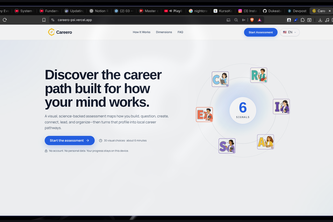
Careero is a self-reported project submitted to the OpenAI 2026 hackathon. The description states it aims to help students find careers that align with their identity and connect them with schools and scholarships, aiming to reduce the "blind" nature of career and education choices.
What changed
There is no evidence of prior activity or development beyond this single submission to a hackathon. No prior traction, funding, or product history is reported.
The single most important open question
Is there any evidence of actual user feedback, market validation, or product development beyond the hackathon submission?
Analysis basis
This report is based solely on the self-reported description provided by the author. It contains no verified data, revenue figures, customer names, or third-party corroboration. All claims are stated by the project author and not independently confirmed.
What The Product Actually Is
The description states that Careero helps students find careers that fit who they are, and then connects them with schools and scholarships nearby. It is described as a tool to reduce "blind" decision-making in career and education paths.
Evidence
- The author describes the product’s purpose: helping students align career choices with identity and connect with educational opportunities.
- No further detail on how this is achieved, what features exist, or whether it's a web app, mobile app, or other format.
Inference
- Based on the tech stack (codex, node.js, react, vite), it likely involves a frontend web application built using modern JavaScript frameworks.
Not evidenced
- No product screenshots, user flows, or feature breakdowns.
- No indication of how the matching algorithm or data sources work.
- No mention of whether this is a prototype, MVP, or full product.
Positioning & Claim Evolution
The author states that Careero helps students find careers that fit who they are and then connects them with schools and scholarships near them. The tagline implies a focus on personalization and reducing uncertainty in student decision-making.
Evidence
- Tagline: “Careero helps students find careers that fit who they are then schools and scholarships near them so they do not have to choose blind the way we once did.”
- No indication of how this positioning evolved from an initial idea or market need.
- No mention of competitors, differentiation, or prior versions.
Inference
- The product appears to be positioned as a career and education guidance tool for students, possibly targeting high school or college-age users.
- It may be part of a broader movement toward AI-assisted personalization in education.
Not evidenced
- No evidence of prior positioning or claims made before this submission.
- No indication of how the product differentiates from existing tools (e.g., career tests, scholarship matchers).
- No mention of user personas or use cases beyond general student support.
Target Customer & ICP
The description states that Careero is for students who are trying to find careers and educational opportunities without knowing what fits them.
Evidence
- The tagline implies a focus on students navigating career and education decisions.
- No further segmentation or targeting details provided.
Inference
- Likely targets high school or college-age students, possibly in the U.S. or similar educational systems.
- May be aimed at students from underrepresented groups or those with limited access to guidance.
Not evidenced
- No specific customer personas.
- No evidence of user research or feedback.
- No indication of whether the tool is for individual users or institutional adoption (e.g., schools, counselors).
Business Model & Pricing Evidence
There is no evidence in the description of a business model or pricing strategy.
Evidence
- No mention of monetization, revenue streams, or pricing plans.
- No indication of whether this is a freemium, subscription, or one-time use product.
Inference
- Given it's a hackathon submission, it may be a prototype with no commercial intent yet.
- If launched, it might rely on partnerships with schools, scholarship providers, or AI platforms.
Not evidenced
- No business model details.
- No pricing information.
- No evidence of any monetization strategy beyond the initial idea.
Technical & Delivery Signals
The project is built using codex, node.js, react, and vite. It was submitted to a hackathon.
Evidence
- Built with: codex, node.js, react, vite.
- Submitted to OpenAI 2026 hackathon.
- No indication of deployment, scalability, or production readiness.
Inference
- Likely a frontend-heavy web application using modern JavaScript frameworks.
- May be a prototype or MVP built in a short timeframe.
Not evidenced
- No information on backend architecture, data sources, or API integrations.
- No evidence of performance metrics, security practices, or scalability planning.
- No mention of cloud hosting, CI/CD pipelines, or testing frameworks.
Traction & Maturity Signals
There is no evidence of traction or maturity beyond the hackathon submission.
Evidence
- Submitted to a hackathon (OpenAI 2026).
- Team size: 2.
- No mention of users, customers, or product adoption.
- No prior versions, funding, or milestones.
Inference
- Likely in early-stage development or prototype phase.
- May have been built as part of a competition with no follow-up plans.
Not evidenced
- No user engagement metrics.
- No customer feedback or usage data.
- No evidence of product iteration or roadmap.
Competitive Context
There is no mention of competitors or market context in the description.
Evidence
- No reference to existing tools for career guidance, scholarship matching, or student support.
- No indication of competitive advantages or positioning in the market.
Inference
- Likely operates in a crowded space (e.g., career guidance platforms, scholarship matchers).
- May compete with tools like College Board, Payscale, or AI-powered career advisors.
Not evidenced
- No competitive analysis.
- No evidence of market research or awareness of existing solutions.
- No mention of how Careero would differentiate from competitors.
Open Questions & Risks
Several risks and open questions emerge from the lack of evidence:
Evidence
- No product, revenue, or traction data.
- No clear business model or monetization strategy.
- No indication of user feedback or market validation.
Inference
- High risk of being a concept without execution.
- Lack of team experience or prior success may hinder development.
- Potential over-reliance on AI tools (e.g., codex) without deeper technical or domain expertise.
Not evidenced
- No evidence of intellectual property, data privacy compliance, or regulatory considerations.
- No indication of long-term viability or scalability.
Questions the description leaves open
- What specific problem are you solving for students, and how did you identify it?
- How do you plan to validate the product with real users?
- What is your roadmap beyond this hackathon submission?
- Are there any existing tools or platforms that you're directly competing with?
- Do you have a plan for monetization or scaling the product?
- What are the key assumptions underlying your approach, and how might they be wrong?
Overall Assessment
Not evidenced.
There is no evidence of a viable business model, traction, or product maturity to support an investment or partnership decision.
Inference
- This appears to be an early-stage idea or prototype submitted for a hackathon.
- It lacks the commercial due-diligence signals required for any meaningful evaluation.
Confidence level Very low. The description provides no basis for assessing product-market fit, team capability, or commercial viability.
User Stories BotA demo video on every pull request
Get a demo video on every new feature
GitHub App that watches your pull requests and records a narrated, captioned demo.
Save time on demo prep and make informed decisions faster with a video walkthrough of every new feature.
Source
Submitted to the OpenAI 2026 hackathon on Devpost. Project home on Devpost. Back to the full gallery on Devpost.
This competitive analysis was produced by top-founders.com (opens in a new tab)
Generated by a language model from this project's public Devpost page — its tagline and any built-with tags listed there, since the author published no write-up — as captured in August 2026. Short quotations are the author's words. It is an opinion on the idea as a business, not on the people behind it, and it reflects the description as published then. If the project has moved on, request a correction below. The analysis is not independent research and contains no verified traction, revenue or customer data.
An independent guide by KFG International LLC — not affiliated with, endorsed by, or connected to Devpost or OpenAI.