

Archive position — measured, not model output
0 likes on Devpost
2,263 of the 7,850 archived projects have more likes, and 5,587 share exactly 0 — so this project's #4,193 place in the like-ranked listing is a tie-break inside that group, not a ranking.
Projects (log scale)
Likes on Devpost. ▲ marks this project's group.
Show the figures
| Likes | Projects | Share of archive |
|---|---|---|
| 0 | 5,587 | 71.2% |
| 1 | 1,758 | 22.4% |
| 2 | 284 | 3.6% |
| 3–4 | 132 | 1.7% |
| 5–9 | 75 | 1.0% |
| 10+ | 14 | 0.2% |
 User Stories BotA demo video on every pull request
Get a demo video on every new feature
GitHub App that watches your pull requests and records a narrated, captioned demo.
Save time on demo prep and make informed decisions faster with a video walkthrough of every new feature.
Executive Summary
What the company appears to be:
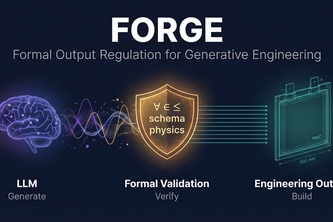
FORGE - AXIOM Guard is a developer tool that applies deterministic validation to AI-generated engineering artefacts, using a neuro-symbolic architecture. It integrates with large language models (LLMs) like GPT-5.6 and enforces constraints through a retry loop, returning corrective feedback when specifications violate engineering rules.
What changed:
The project evolved from a research prototype for a master’s thesis into a focused demonstration at the OpenAI Build Week hackathon. It now presents an inspectable workflow where LLMs generate engineering specs, which are validated against deterministic constraints before acceptance.
Single most important open question:
Is there evidence of traction or commercial adoption beyond this self-reported demo and research platform?
Note: This analysis is based solely on the self-reported description provided by the author. No external verification, revenue data, customer names, or usage metrics are available.
What The Product Actually Is
The description states that FORGE - AXIOM Guard supervises AI-generated engineering specifications using a three-layer neuro-symbolic architecture:
- Der Generator: GPT-5.6 generates structured engineering proposals.
- Der Validator: Python-based checks evaluate schema compliance and engineering constraints.
- Der Supervisor: Controls retry logic, acceptance/rejection, and trace preservation.
It is demonstrated through lithium-ion battery-cell design, where:
- A prompt leads to a specification generated by GPT-5.6.
- The system parses and validates it against deterministic rules.
- If a constraint fails, corrective feedback is returned.
- The model retries with corrections until all constraints pass.
- An audit trail is preserved including original prompts, failed attempts, token usage, and provenance hashes.
Inference: The tool appears to be a developer-facing validation layer for AI-generated engineering artefacts. It does not appear to be a standalone product for end-users but rather an integration point or middleware in a larger engineering workflow.
Positioning & Claim Evolution
The author positions AXIOM Guard as a way to "place deterministic validation and a controlled retry loop between generation and acceptance" of AI-generated engineering artefacts.
Key claims:
- LLMs can produce fluent output, but not necessarily valid engineering.
- The tool introduces a “supervision boundary” around probabilistic generation.
- It allows for transparent, inspectable, and governable AI-assisted engineering work.
- It is built on a reusable architecture that can be applied to other domains beyond battery cells.
Claim vs Fact: These are self-descriptions of intent and functionality. There is no evidence of actual deployment or customer feedback.
Target Customer & ICP
The description implies the target audience includes:
- Engineers working with AI-generated specifications.
- Developers integrating LLMs into engineering workflows.
- Teams seeking to validate AI outputs in regulated or safety-critical domains.
It does not specify a clear ICP (Ideal Customer Profile) beyond "engineers" and "AI developers". The tool is described as a developer-facing workflow, suggesting it targets technical users who are already using or considering LLMs in engineering contexts.
Not evidenced: No explicit customer segmentation, personas, or use cases beyond the battery-cell example.
Business Model & Pricing Evidence
There is no mention of pricing, monetization strategy, or business model in the description. The project is presented as a hackathon submission and research prototype.
Not evidenced: No indication of how this would be sold, licensed, or consumed commercially.
Technical & Delivery Signals
The system uses:
- GPT-5.6 via OpenAI API
- FastAPI for backend endpoints
- Streamlit for UI
- Colored Petri Net visualization
- Pydantic for schema validation
- Docker for containerization
- GitHub for version control
- JSON, YAML, and REST APIs
It includes:
- Retry logic with constraint checking
- Audit trail preservation (token usage, model identity, hashes)
- Telemetry model integration
- Support for local and cloud LLMs
- Verified replay functionality
Inference: The architecture suggests a modular, extensible system designed for engineering workflows. It is not described as a SaaS offering or hosted solution.
Traction & Maturity Signals
The project has:
- A research foundation from a master’s thesis.
- A demonstration at OpenAI Build Week.
- An existing platform with components like constraint registry and calculation engine.
- A documented workflow with failure cases and corrective feedback.
However, there is no evidence of:
- Revenue
- Customers
- Product-market fit
- Usage metrics
- Adoption beyond the demo
Absence of evidence: No traction data or commercial adoption mentioned.
Competitive Context
The description does not name competitors. However, it implies a space involving:
- AI-generated engineering artefacts
- LLM integration with validation layers
- Neuro-symbolic AI supervision
- Engineering workflow automation tools
This overlaps with areas like:
- AI governance platforms
- Code review and linting tools (e.g., GitHub Copilot, SonarQube)
- Constraint-based design systems
- AI-assisted engineering simulation tools
Not evidenced: No competitive landscape or differentiation analysis.
Open Questions & Risks
- Unproven commercial viability: The project is described as a demo and research prototype with no evidence of traction.
- Limited scope: The demonstration focuses only on battery-cell design; generalization to other domains is claimed but not demonstrated.
- Dependency on LLMs: Reliance on GPT-5.6 and OpenAI APIs introduces risk from API availability, cost, or changes in model behavior.
- No pricing or monetization strategy: No indication of how the tool would be sold or consumed at scale.
- Single founder team: The project is attributed to one individual (Cristian Leu), which may limit scalability.
Inference: These are risks based on the self-reported nature and lack of external validation.
Questions the description leaves open
- What real-world engineering domains have you tested this system with beyond battery cells?
- How do you plan to scale the constraint definitions across different engineering artefacts?
- Are there any existing customers or pilot programs using this tool?
- What is your roadmap for monetization and product development?
- Can you provide evidence of how often the retry loop actually improves output quality in practice?
- How does the system handle edge cases where constraints are ambiguous or conflicting?
- What are the technical limitations of integrating with different LLMs (e.g., local vs cloud)?
- Have you considered compliance or audit requirements for regulated industries?
Overall Assessment
Not evidenced: There is no evidence of revenue, customers, or traction to support a commercial investment or partnership decision.
The project appears to be an early-stage research prototype with a compelling idea and a functional demo. However, without any indication of market demand, adoption, or monetization strategy, it cannot be evaluated as a viable investment or partnership opportunity at this time.
Confidence level: Low — based on thin evidence and self-reporting only.
User Stories BotA demo video on every pull request
Get a demo video on every new feature
GitHub App that watches your pull requests and records a narrated, captioned demo.
Save time on demo prep and make informed decisions faster with a video walkthrough of every new feature.
Source
Submitted to the OpenAI 2026 hackathon on Devpost. Project home on Devpost. Back to the full gallery on Devpost.
This competitive analysis was produced by top-founders.com (opens in a new tab)
Generated by a language model from this project's public Devpost page — its tagline, the author's own write-up and any built-with tags listed there — as captured in August 2026. Short quotations are the author's words. It is an opinion on the idea as a business, not on the people behind it, and it reflects the description as published then. If the project has moved on, request a correction below. The analysis is not independent research and contains no verified traction, revenue or customer data.
An independent guide by KFG International LLC — not affiliated with, endorsed by, or connected to Devpost or OpenAI.