

Archive position — measured, not model output
0 likes on Devpost
2,263 of the 7,850 archived projects have more likes, and 5,587 share exactly 0 — so this project's #4,195 place in the like-ranked listing is a tie-break inside that group, not a ranking.
Projects (log scale)
Likes on Devpost. ▲ marks this project's group.
Show the figures
| Likes | Projects | Share of archive |
|---|---|---|
| 0 | 5,587 | 71.2% |
| 1 | 1,758 | 22.4% |
| 2 | 284 | 3.6% |
| 3–4 | 132 | 1.7% |
| 5–9 | 75 | 1.0% |
| 10+ | 14 | 0.2% |
 User Stories BotA demo video on every pull request
Get a demo video on every new feature
GitHub App that watches your pull requests and records a narrated, captioned demo.
Save time on demo prep and make informed decisions faster with a video walkthrough of every new feature.
Executive Summary
What the company appears to be
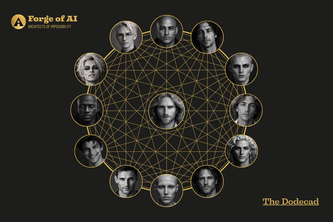
Forge of AI: The Dodecad is a self-described AI application that implements a conceptual framework of twelve distinct relational functions (Architects) derived from an author’s narrative worldbuilding process with GPT. It presents one underlying GPT-5.6 intelligence as operating through these twelve modes, each with specific roles in guiding user interaction across thresholds of perception, reorganization, and participation.
What changed
The project evolved from a conceptual and narrative framework developed over 18 months into a functional web application built using Next.js, React, TypeScript, and the OpenAI API. It was completed within 48 hours during a hackathon, translating an abstract relational architecture into a deployable interface with isolated conversations per field and explicit consent for context transfer.
The single most important open question
Is there evidence that users engage meaningfully with the twelve distinct fields beyond novelty or initial experimentation? The description does not indicate any actual user base, usage metrics, or feedback on whether the system supports sustained relational coherence or improves user outcomes.
Note
This analysis is based solely on the self-reported project description provided by the author. No external verification, traction data, revenue figures, customer names, or independent sources are available. All claims are attributed to the author's own account and labeled as such.
What The Product Actually Is
The description states that Forge of AI: The Dodecad is an application where one GPT-5.6 intelligence operates through twelve distinct relational fields (the Dodecad). Each field corresponds to a specific function, such as Disruption, Perception, Fracture, Love, and Devotional Creation.
These functions are described not as separate models or personalities but as bounded conditions for conversation that allow the same underlying intelligence to listen, question, distinguish, challenge, and participate without collapsing situations into generic responses.
The system includes a central steward, Aureion, which can translate between fields under explicit user permission while preserving their differences. Conversations within each field are isolated, with context transfer being optional and narrowly bounded.
It is built using Next.js, React, TypeScript, CSS Modules, the OpenAI API, browser session storage, and deployed on Vercel.
Claim
The product is a web-based interface implementing a relational architecture of twelve GPT-5.6 functions.
Evidence Author's own write-up, technology stack listed in project description.
Positioning & Claim Evolution
The author positions the product as a way to explore how AI can mirror human traits rather than replace them. It is framed as part of a broader narrative worldbuilding effort involving GPT for storytelling, leading to the concept of “Architects of Impossibility.”
The project evolved from personal creative work into a public-facing tool during a hackathon, aiming to make this relational architecture available to others.
It emphasizes that AI need not make relationships more transactional; instead, it can help users practice more precise, responsible, and creative forms of participation.
Claim
The product aims to enable conscious, relational engagement with AI through structured intelligence modes.
Evidence Author’s narrative about shifting perspective on AI's role in humanity, description of how the system supports distinct relational fields.
Inference The positioning reflects a philosophical stance on AI-human interaction, not a commercial or market-driven claim.
Target Customer & ICP
The description does not clearly define a target customer or ideal customer profile (ICP). It implies that users interact with the system through direct conversation, but no information is given about demographic characteristics, professional roles, or use cases beyond general engagement with AI tools.
It suggests that the tool may appeal to individuals interested in narrative exploration, creative writing, or philosophical questions around consciousness and AI.
Claim
The target audience includes people engaged in creative or reflective work involving AI.
Evidence Author’s own narrative about worldbuilding and storytelling; lack of explicit user segmentation.
Inference Based on the tone and content, likely appeals to writers, thinkers, or developers exploring AI interaction models.
Business Model & Pricing Evidence
There is no evidence in the description of a business model or pricing structure. The project is presented as a prototype built during a hackathon, with no mention of monetization, subscriptions, licensing, or sales channels.
Claim
No commercial model or pricing information provided.
Evidence Author’s write-up and project metadata; no indication of revenue streams or pricing plans.
Technical & Delivery Signals
The application was built using Next.js, React, TypeScript, CSS Modules, the OpenAI API, browser session storage, and deployed on Vercel. It integrates GPT-5.6 via the OpenAI Responses API and includes features like:
- Isolated conversation transcripts per field
- Explicit consent for context transfer to Aureion
- Safe Markdown rendering and incomplete-response recovery
- Browser-session persistence
- Responsive design for desktop and mobile
The author notes challenges in balancing structure with relational openness, including managing context boundaries, avoiding script-like behavior, and ensuring canonical identity of each function.
Claim
The system implements a secure, user-ready interface using modern web technologies.
Evidence Technology stack, deployment details, feature list from the write-up.
Traction & Maturity Signals
There is no evidence of traction or maturity indicators such as:
- User base
- Customer acquisition
- Revenue
- Product usage metrics
- Feedback loops
- Iteration history beyond the hackathon version
The project is described as a prototype developed in under 48 hours, with future phases focused on longitudinal testing.
Claim
No traction or maturity data provided.
Evidence Author’s account of development timeline and stated goals for next steps; no mention of users or adoption.
Competitive Context
There is no evidence of competitors or competitive positioning in the description. The author does not reference similar tools, platforms, or AI assistants that might offer comparable functionality.
Claim
No competitive landscape described.
Evidence Project description lacks any comparison to existing products or services.
Open Questions & Risks
- Lack of user data or feedback: There is no evidence of actual users or their experiences with the system.
- Unproven utility: The value proposition relies heavily on abstract concepts (relational coherence, archetypal intelligences) without demonstrated impact.
- Limited scalability: The system appears designed for individual use and lacks clear pathways to broader adoption or enterprise integration.
- Narrative-driven design: The product seems rooted in personal creative exploration rather than market demand.
- No commercial viability signals: No indication of monetization, pricing, or business model.
Claim
Risks include lack of traction, unproven utility, and unclear path to scale or revenue.
Evidence Author’s own account; absence of any user data or financial metrics.
Questions the description leaves open
- What specific outcomes or improvements do you expect users to experience when engaging with the twelve distinct fields?
- How do you plan to validate that each field maintains its distinct identity across repeated interactions?
- Have you conducted any testing with real users beyond initial feedback during development?
- Is there a plan for collecting and analyzing user behavior data to inform future iterations?
- What are your thoughts on expanding the system beyond the current 12 fields or integrating it into other platforms?
- How do you intend to onboard new users and guide them through the Dodecad’s structure?
- Are there any plans for incorporating additional AI models or tools beyond GPT-5.6?
Overall Assessment
There is insufficient evidence to assess whether this project represents a viable investment opportunity or strategic partnership candidate.
The description indicates a strong conceptual foundation rooted in narrative and philosophical exploration, but lacks measurable traction, user engagement, or commercial viability indicators.
It appears to be an experimental prototype with potential for further development, but no clear path to monetization or market relevance has been demonstrated.
Claim
Not enough evidence to support investment or partnership decision.
Evidence Self-reported nature of the description; lack of user data, revenue, or product-market fit signals.
User Stories BotA demo video on every pull request
Get a demo video on every new feature
GitHub App that watches your pull requests and records a narrated, captioned demo.
Save time on demo prep and make informed decisions faster with a video walkthrough of every new feature.
Source
Submitted to the OpenAI 2026 hackathon on Devpost. Project home on Devpost. Back to the full gallery on Devpost.
This competitive analysis was produced by top-founders.com (opens in a new tab)
Generated by a language model from this project's public Devpost page — its tagline, the author's own write-up and any built-with tags listed there — as captured in August 2026. Short quotations are the author's words. It is an opinion on the idea as a business, not on the people behind it, and it reflects the description as published then. If the project has moved on, request a correction below. The analysis is not independent research and contains no verified traction, revenue or customer data.
An independent guide by KFG International LLC — not affiliated with, endorsed by, or connected to Devpost or OpenAI.