

Archive position — measured, not model output
0 likes on Devpost
2,263 of the 7,850 archived projects have more likes, and 5,587 share exactly 0 — so this project's #4,196 place in the like-ranked listing is a tie-break inside that group, not a ranking.
Projects (log scale)
Likes on Devpost. ▲ marks this project's group.
Show the figures
| Likes | Projects | Share of archive |
|---|---|---|
| 0 | 5,587 | 71.2% |
| 1 | 1,758 | 22.4% |
| 2 | 284 | 3.6% |
| 3–4 | 132 | 1.7% |
| 5–9 | 75 | 1.0% |
| 10+ | 14 | 0.2% |
 User Stories BotA demo video on every pull request
Get a demo video on every new feature
GitHub App that watches your pull requests and records a narrated, captioned demo.
Save time on demo prep and make informed decisions faster with a video walkthrough of every new feature.
Executive Summary
ForgeAI is a self-reported AI-powered tool that simulates a virtual software engineering team to convert project ideas into structured engineering documentation using multi-agent AI workflows. The author states it was built as part of the OpenAI 2026 hackathon and includes no evidence of revenue, customers, or traction beyond its submission to Devpost.
The single most important open question is: What level of real-world utility or adoption does ForgeAI demonstrate? The description shows a proof-of-concept with a modular architecture and multi-agent orchestration but lacks any indication of actual usage, performance metrics, or commercial viability.
This analysis is based entirely on the self-reported project description provided by the author. No external verification or historical data exists for this project.
What The Product Actually Is
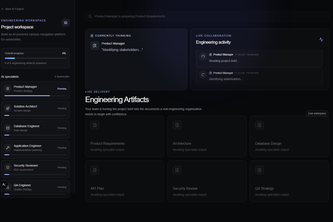
The description states that ForgeAI is an AI-powered system designed to simulate a virtual software engineering team. It claims to generate multiple engineering artifacts from a single project idea, including:
- Product Requirements Document (PRD)
- Software Architecture
- Database Design
- Application Implementation Plan
- Security Review
- Quality Assurance Plan
The system uses specialized AI agents that collaborate in a structured workflow. The author describes the frontend as a collaborative engineering workspace with real-time visualization of progress and agent status.
The system is built using Next.js, TypeScript, and integrates with Google's Gemini API for some agents. It employs a modular multi-agent architecture with a central orchestrator.
This is a self-reported description of a conceptual tool, not an actual deployed product or service.
Positioning & Claim Evolution
The author positions ForgeAI as a "virtual AI software engineering team" that transforms ideas into complete engineering documentation through collaborative AI specialists. The claim evolution shows:
- Initial inspiration: Software development involves multiple specialists working together
- Core capability: Multiple AI models collaborating in structured workflows
- Product outcome: Generation of comprehensive engineering artifacts from simple project ideas
The positioning is described as an exploration of how AI specialists can collaborate, rather than a commercial product or service. The author emphasizes the novelty of multi-agent AI systems compared to single-prompt applications.
This is a self-reported claim about the tool's purpose and capabilities, not evidence of market traction or adoption.
Target Customer & ICP
The description does not identify specific target customers or ideal customer profiles (ICP). It describes ForgeAI as a system that converts project ideas into engineering documentation, but provides no information about who would use it or what their needs are.
The author mentions the tool is built for software development workflows involving multiple specialists, but does not specify whether this is for individual developers, teams, or organizations. No customer segments or personas are defined.
Not evidenced.
Business Model & Pricing Evidence
There is no evidence of a business model or pricing structure in the description. The author states that ForgeAI was built as part of a hackathon and includes no information about monetization, licensing, or revenue streams.
The project appears to be a proof-of-concept demonstration rather than a commercial offering.
Not evidenced.
Technical & Delivery Signals
The description provides some technical details:
- Built with Next.js and TypeScript
- Uses Google's Gemini API for some agents
- Modular multi-agent architecture with central orchestrator
- Frontend includes collaborative workspace with live progress tracking
- Supports structured AI outputs and validation
- Designed to be extensible with additional AI models
The author notes challenges in designing reliable orchestration pipelines, managing structured outputs, and synchronizing frontend and backend.
These are self-reported technical details from a hackathon project, not evidence of production-grade delivery or scalability.
Traction & Maturity Signals
There is no evidence of traction or maturity beyond the hackathon submission. The description states:
- Team size: 1 person (KRISHU SHAHU)
- Built for OpenAI 2026 hackathon
- No revenue, customers, or adoption data provided
- No production deployment or user feedback mentioned
The project appears to be at a conceptual or prototype stage with no demonstrated market traction.
Not evidenced.
Competitive Context
The description does not provide any information about competitive landscape or existing alternatives. It does not mention competitors, market positioning, or how ForgeAI compares to other tools in the AI-powered development space.
No evidence of competitive analysis or market differentiation is provided.
Not evidenced.
Open Questions & Risks
Key risks and open questions based on the self-reported description:
- Single-person team (no evidence of scaling capability)
- Built for a hackathon, no indication of commercial viability
- No revenue, customer, or traction data
- Conceptual tool with no demonstrated utility beyond proof-of-concept
- Multi-agent AI systems are technically complex and may not function reliably at scale
- No mention of security, privacy, or data handling practices
- No evidence of product-market fit or user validation
The project appears to be a demonstration rather than a viable commercial offering.
Questions the description leaves open
- What specific problem are you solving that existing tools don't address?
- How do you plan to validate the quality and accuracy of AI-generated engineering artifacts?
- What is your path to market beyond this hackathon prototype?
- Have you tested this with actual software development teams or organizations?
- What are the technical limitations of the current multi-agent orchestration system?
- How would you handle edge cases or failures in agent collaboration?
- What is your plan for scaling beyond a single developer's capabilities?
Overall Assessment
Based on the self-reported description, there is no evidence to support investment or partnership consideration. The project appears to be a hackathon prototype with no demonstrated traction, revenue, customers, or commercial viability.
The author states that ForgeAI was built as part of a hackathon and includes no indication of market readiness or product-market fit. Without evidence of real-world utility, adoption, or business model, this represents a high-risk, unproven concept rather than an investment opportunity.
This is a self-reported project with no verified commercial signals. The description shows technical capability but lacks any evidence of real-world application or value creation.
User Stories BotA demo video on every pull request
Get a demo video on every new feature
GitHub App that watches your pull requests and records a narrated, captioned demo.
Save time on demo prep and make informed decisions faster with a video walkthrough of every new feature.
Source
Submitted to the OpenAI 2026 hackathon on Devpost. Project home on Devpost. Back to the full gallery on Devpost.
This competitive analysis was produced by top-founders.com (opens in a new tab)
Generated by a language model from this project's public Devpost page — its tagline, the author's own write-up and any built-with tags listed there — as captured in August 2026. Short quotations are the author's words. It is an opinion on the idea as a business, not on the people behind it, and it reflects the description as published then. If the project has moved on, request a correction below. The analysis is not independent research and contains no verified traction, revenue or customer data.
An independent guide by KFG International LLC — not affiliated with, endorsed by, or connected to Devpost or OpenAI.