

Archive position — measured, not model output
0 likes on Devpost
2,263 of the 7,850 archived projects have more likes, and 5,587 share exactly 0 — so this project's #6,193 place in the like-ranked listing is a tie-break inside that group, not a ranking.
Projects (log scale)
Likes on Devpost. ▲ marks this project's group.
Show the figures
| Likes | Projects | Share of archive |
|---|---|---|
| 0 | 5,587 | 71.2% |
| 1 | 1,758 | 22.4% |
| 2 | 284 | 3.6% |
| 3–4 | 132 | 1.7% |
| 5–9 | 75 | 1.0% |
| 10+ | 14 | 0.2% |
 User Stories BotA demo video on every pull request
Get a demo video on every new feature
GitHub App that watches your pull requests and records a narrated, captioned demo.
Save time on demo prep and make informed decisions faster with a video walkthrough of every new feature.
Executive Summary
What the company appears to be
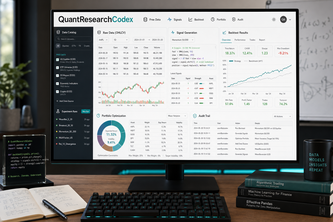
QuantResearch is a self-reported Python-based framework for backtesting and paper trading short-term options reversal strategies. The author describes it as an institutional-grade, open-source tool that bridges quantitative research and live execution through event-driven architecture and modular components.
What changed
The project was submitted to the OpenAI 2026 hackathon by a single founder, Venu Talluri. It is described as a personal effort to build a production-ready framework for options trading strategies with an emphasis on realism in execution modeling and scalability.
The single most important open question
Is there evidence of any real-world usage or traction beyond the author’s own development? The description contains no mention of customers, revenue, or adoption — only self-reported claims about functionality and architecture.
What The Product Actually Is
- The description states that QuantResearch is a Python framework for backtesting and paper trading short-term options reversal strategies.
- It includes:
- A Universe Selection Engine, which filters thousands of option chains to liquid, high-implied-volatility targets.
- A Staged-Entry Backtester, tracking multi-tier execution with realistic slippage modeling.
- A Paper Trading Bridge connecting to brokerage APIs via WebSockets for real-time execution.
- The framework is built using a modular, event-driven architecture.
- It uses statistical indicators such as standard deviations from moving averages to generate entry signals:
$$
\vert{}S_t - \mu\vert{} > k \cdot \sigma
$$
Note
This is a self-reported description. No evidence of actual product delivery, usage or performance data is provided.
Positioning & Claim Evolution
- The author positions QuantResearch as:
- An institutional-grade, open-source environment.
- A tool that transitions strategies from research to live paper trading without rewriting code.
- It claims to be a production-ready framework capable of handling both historical CSV data and live WebSocket streams.
- The project evolved from a personal need to model dynamic, real-world options trades — particularly those involving mean reversion and staged entries.
Inference The positioning implies a niche audience in quantitative finance or algorithmic trading. However, the lack of external validation or product usage makes this claim unproven.
Target Customer & ICP
- The description does not name specific target customers.
- It suggests use cases for:
- Quantitative researchers working with options strategies.
- Traders or developers who want to simulate and test short-term reversal strategies.
- Users requiring realistic slippage and execution modeling in live environments.
Not evidenced No indication of whether the framework has been used by others, nor any segmentation or targeting beyond the author’s own needs.
Business Model & Pricing Evidence
- The project is described as an open-source tool, with no mention of commercial licensing or pricing.
- There is no evidence of a monetization strategy or revenue model.
- The author mentions plans to expand integrations and introduce risk-overlay modules, but does not describe how these would be monetized.
Inference If the framework remains open-source, it likely has no direct business model. Any future commercialization would depend on additional features or services around its use.
Technical & Delivery Signals
- Built entirely in Python.
- Uses:
- Asynchronous processing with asyncio
- Data structures optimized with pandas and numpy
- Event-driven architecture
- WebSockets for live brokerage API connections
- Implements a custom transaction cost model to simulate slippage based on market depth.
- Designed to support both historical CSV data and live WebSocket streams.
Inference The technical stack suggests a developer-oriented, high-performance tool. However, no evidence of deployment, scalability testing or production use is provided.
Traction & Maturity Signals
- The project was submitted to the OpenAI 2026 hackathon, indicating early-stage development.
- The author claims to have built a production-ready framework.
- It includes:
- A working prototype with modular components
- Integration with live brokerage APIs
- Support for both backtesting and paper trading
Not evidenced No evidence of user adoption, performance metrics, or real-world usage beyond the author’s own development.
Competitive Context
- The description does not mention competitors.
- It implies a niche in options trading automation, particularly around short-term reversal strategies.
- Tools in this space may include:
- Backtesting platforms like Backtrader, Zipline, or QuantConnect
- Custom-built frameworks for derivatives or options-specific workflows
Inference The framework appears to target a specialized segment of quantitative finance developers and traders. However, no competitive analysis or differentiation is stated.
Open Questions & Risks
- The project is self-reported with no independent verification.
- No evidence of:
- Revenue
- Customers
- Traction
- Product-market fit
- The author is a single individual (1-person team), which raises questions about scalability and long-term maintenance.
- The framework is described as open-source, but there’s no indication of community engagement or contribution.
Inference Without evidence of real-world usage, the project may be more of a proof-of-concept than a viable product. Risk of overstatement in claims.
Questions the description leaves open
- What is the actual extent of your testing? Has the framework been used in any live or simulated trading scenarios beyond personal use?
- Are there any users or adopters outside of yourself who are actively using this tool?
- How do you plan to monetize or commercialize an open-source product like this?
- What is the current state of your brokerage integrations? Have they been tested in live environments?
- Can you provide evidence of performance or accuracy of the slippage and execution models?
Overall Assessment
- The project is described as a personal hackathon effort by one individual.
- It lacks any evidence of traction, revenue, or customer adoption.
- While technically impressive, it remains a self-reported prototype with no external validation.
- The framework may be useful for niche developers or researchers but does not yet demonstrate commercial viability.
Assessment Not ready for investment or partnership. Requires further demonstration of real-world usage and traction before any strategic consideration.
User Stories BotA demo video on every pull request
Get a demo video on every new feature
GitHub App that watches your pull requests and records a narrated, captioned demo.
Save time on demo prep and make informed decisions faster with a video walkthrough of every new feature.
Source
Submitted to the OpenAI 2026 hackathon on Devpost. Project home on Devpost. Back to the full gallery on Devpost.
This competitive analysis was produced by top-founders.com (opens in a new tab)
Generated by a language model from this project's public Devpost page — its tagline, the author's own write-up and any built-with tags listed there — as captured in August 2026. Short quotations are the author's words. It is an opinion on the idea as a business, not on the people behind it, and it reflects the description as published then. If the project has moved on, request a correction below. The analysis is not independent research and contains no verified traction, revenue or customer data.
An independent guide by KFG International LLC — not affiliated with, endorsed by, or connected to Devpost or OpenAI.