

Archive position — measured, not model output
0 likes on Devpost
2,263 of the 7,850 archived projects have more likes, and 5,587 share exactly 0 — so this project's #6,195 place in the like-ranked listing is a tie-break inside that group, not a ranking.
Projects (log scale)
Likes on Devpost. ▲ marks this project's group.
Show the figures
| Likes | Projects | Share of archive |
|---|---|---|
| 0 | 5,587 | 71.2% |
| 1 | 1,758 | 22.4% |
| 2 | 284 | 3.6% |
| 3–4 | 132 | 1.7% |
| 5–9 | 75 | 1.0% |
| 10+ | 14 | 0.2% |
 User Stories BotA demo video on every pull request
Get a demo video on every new feature
GitHub App that watches your pull requests and records a narrated, captioned demo.
Save time on demo prep and make informed decisions faster with a video walkthrough of every new feature.
Executive Summary
What the company appears to be
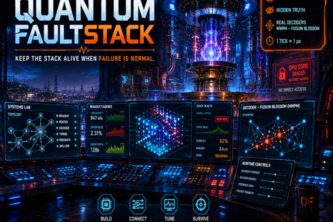
Quantum Faultstack is an educational simulation game built in Rust using the Bevy engine, designed to teach systems engineering concepts relevant to large-scale quantum computing. It focuses on classical infrastructure required for fault-tolerant quantum computers, including control, readout, timing, routing, decoding, calibration, feedback, and error correction.
What changed
The project was extended during OpenAI Build Week 2026 to become a more deliberate training experience with structured educational objectives, using Codex and GPT-5.6 for development support.
Single most important open question
Does the author's self-reported educational impact translate into measurable learning outcomes or adoption?
The description states that Quantum Faultstack is an educational systems simulation about classical infrastructure required to operate and scale a fault-tolerant quantum computer, but there is no evidence of revenue, customers, traction, or adoption metrics. The project appears to be a solo developer's experimental educational tool with no verified commercial activity.
What The Product Actually Is
The description states that Quantum Faultstack is:
- An educational systems simulation about classical infrastructure required for fault-tolerant quantum computers
- A game that explores engineering systems surrounding quantum processors including control, readout, timing, routing, decoding, calibration, feedback, and error correction
- Built in Rust using the Bevy game engine with entity-component-system architecture
- Compiled to WebAssembly for web-based play
- Uses real algorithms and statistical models including minimum-weight perfect-matching decoding through Fusion Blossom, probabilistic error generation, and queueing systems
- Designed as a hands-on experimentation tool where players build and operate systems, observe behavior, diagnose failures, and improve architecture
Positioning & Claim Evolution
The description states that Quantum Faultstack:
- Teaches players to think about quantum computers as complete systems rather than focusing only on qubits and quantum algorithms
- Aims to make the challenges of scalable quantum computing visible and understandable
- Focuses on systems-engineering problems rather than just quantum mechanics concepts
- Uses superconducting quantum-computing terminology but applies lessons across modalities (trapped ions, neutral atoms, spins, photonic systems)
- Is designed for active learning with concrete engineering concepts, player operation, evidence exposure, and principle connection
- Was extended during OpenAI Build Week to become a more deliberate training experience
Target Customer & ICP
The description states that Quantum Faultstack targets:
- Students and engineers learning quantum systems engineering
- Individuals interested in understanding the challenges of scalable quantum computing
- Learners who benefit from hands-on experimentation and hypothesis testing
- People wanting to understand how classical infrastructure supports quantum hardware at scale
However, there is no evidence provided about specific customer segments, usage patterns, or market validation.
Business Model & Pricing Evidence
The description states:
- The project is built as an educational simulation game
- It includes a web demo playable in browser
- The repository contains a dedicated Build Week baseline for pre-existing and new work
- No pricing information, monetization strategy, or business model details are provided
Technical & Delivery Signals
The description states that Quantum Faultstack:
- Is written in Rust using Bevy game engine with ECS architecture
- Uses WebAssembly compilation for browser distribution
- Includes packet-based classical control and measurement pipeline
- Implements QPU evidence generation with hidden internal error state
- Has readout and detector-event processing capabilities
- Uses minimum-weight perfect-matching decoding through Fusion Blossom
- Incorporates correction proposals, frame updates, latency, queues, deadlines, and backpressure systems
- Features persistent hardware assembly and system layouts
- Contains structured missions and learning objectives
- Has deterministic testing around simulation and progression behavior
- Used Codex for repository-scale analysis, implementation, testing, debugging, refactoring, and iteration
- Used GPT-5.6 to help develop educational explanations
Traction & Maturity Signals
The description states:
- The project existed before OpenAI Build Week as an evolving Rust and Bevy simulation
- It was extended during OpenAI Build Week 2026 for a more deliberate training experience
- The repository contains a dedicated Build Week baseline so pre-existing and new work can be reviewed separately
- The author retains responsibility for product direction, quantum-computing model, architecture, teaching goals, and final engineering decisions
However, there is no evidence of:
- Revenue generation
- Customer adoption or usage metrics
- Market traction
- Product maturity beyond initial development
- User engagement data
- Community growth or feedback
Competitive Context
The description states that Quantum Faultstack:
- Focuses on classical infrastructure for quantum computing rather than traditional quantum algorithms
- Teaches systems engineering concepts relevant to large-scale quantum computing
- Uses real algorithms and statistical models for behavior simulation
- Is designed as an educational tool with active learning principles
- Targets the intersection of quantum computing education and systems engineering
No evidence is provided about:
- Direct competitors in this specific niche
- Market positioning relative to existing quantum education tools
- Competitive advantages or differentiators
- Industry benchmarks or market share
Open Questions & Risks
The description indicates several potential risks:
- Balancing realism with clarity in educational content
- Maintaining boundary between hidden simulation truth and observable evidence
- Technical realism serving gameplay effectively
- Clear identification of Build Week work within pre-existing project
- Risk that the educational approach may not translate to measurable learning outcomes
- Limited market validation for a niche educational tool
- Solo developer capacity for future expansion
- Unclear monetization strategy or commercial viability
Questions the description leaves open
- What specific learning outcomes have been measured or demonstrated through use of this simulation?
- How does the educational approach translate to actual understanding of quantum systems engineering concepts?
- What is the current user base and engagement metrics for the web demo?
- Are there any partnerships or institutional adoption of this educational tool?
- What are the specific technical challenges in scaling beyond the current simulation scope?
- How do you plan to monetize or commercialize this educational platform?
- What evidence supports the claim that players can "reason from evidence" rather than just follow scripted paths?
- How does the project's focus on systems engineering align with broader quantum computing industry needs?
Overall Assessment
The description states that Quantum Faultstack is:
- An educational simulation game focused on classical infrastructure for quantum computing
- Built by a solo developer (Ben Schneider Ph.D)
- Designed as an experimental learning environment for quantum systems engineering
- Aims to make large-scale quantum computing understandable, experimentable, and buildable
- Has potential for expansion into additional quantum modalities and larger decoder workloads
However, there is no evidence of:
- Revenue or profitability
- Customer traction or adoption
- Market validation
- Commercial viability
- Clear monetization strategy
- Competitive positioning in the education market
- Product-market fit metrics
The project appears to be a solo developer's experimental educational tool with no verified commercial activity or traction. The author's claims about educational impact and learning outcomes are self-reported without independent verification.
User Stories BotA demo video on every pull request
Get a demo video on every new feature
GitHub App that watches your pull requests and records a narrated, captioned demo.
Save time on demo prep and make informed decisions faster with a video walkthrough of every new feature.
Source
Submitted to the OpenAI 2026 hackathon on Devpost. Project home on Devpost. Back to the full gallery on Devpost.
This competitive analysis was produced by top-founders.com (opens in a new tab)
Generated by a language model from this project's public Devpost page — its tagline, the author's own write-up and any built-with tags listed there — as captured in August 2026. Short quotations are the author's words. It is an opinion on the idea as a business, not on the people behind it, and it reflects the description as published then. If the project has moved on, request a correction below. The analysis is not independent research and contains no verified traction, revenue or customer data.
An independent guide by KFG International LLC — not affiliated with, endorsed by, or connected to Devpost or OpenAI.