

Archive position — measured, not model output
2 likes on Devpost
221 of the 7,850 archived projects have more likes, and 284 share exactly 2 — so this project's #306 place in the like-ranked listing is a tie-break inside that group, not a ranking.
Projects (log scale)
Likes on Devpost. ▲ marks this project's group.
Show the figures
| Likes | Projects | Share of archive |
|---|---|---|
| 0 | 5,587 | 71.2% |
| 1 | 1,758 | 22.4% |
| 2 | 284 | 3.6% |
| 3–4 | 132 | 1.7% |
| 5–9 | 75 | 1.0% |
| 10+ | 14 | 0.2% |
 User Stories BotA demo video on every pull request
Get a demo video on every new feature
GitHub App that watches your pull requests and records a narrated, captioned demo.
Save time on demo prep and make informed decisions faster with a video walkthrough of every new feature.
Executive Summary
Digital Krishna is a self-reported web platform that combines AI companionship, spiritual wisdom, storytelling, and reflection. The project was built during the OpenAI 2026 hackathon by a team of three (Yash, Aman, Sanya Katiyar) using technologies including React, JavaScript, AWS, GPT-5.6, Codex, and Python.
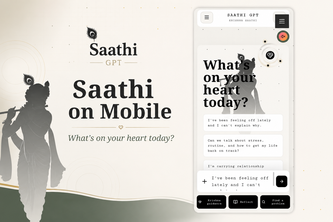
The platform aims to provide personalized guidance for modern struggles through an AI companion named "Saathi GPT", connected scripture libraries (Bhagavad Gita, Ramcharitmanas, Upanishads), and Krishna stories linked to emotional themes. It is described as a tool to help users move from confusion to clarity by offering reflective AI responses, teachings, stories, and practical next steps.
The description states that the team focused on making Saathi more structured, safer, multilingual, and connected with scripture and story libraries. They claim to have used Codex and GPT-5.6 extensively for debugging, product architecture planning, user experience improvement, content structuring, interface design iteration, and implementation refinement.
Key commercial due-diligence question: Is there evidence of a viable business model or path to monetization beyond the hackathon prototype?
What The Product Actually Is
The description states that Digital Krishna is a web platform combining:
- A Saathi GPT AI companion for personal reflection and guidance
- A scripture library featuring Bhagavad Gita, Ramcharitmanas, Upanishads, and story-linked wisdom
- Krishna stories connected to emotional themes and life challenges (up to 450 stories)
- Visual storytelling and animation to make wisdom more engaging
- A mobile-friendly experience
The platform is described as a tool to help users move from confusion to clarity by exploring:
- AI-guided responses,
- Related teachings or verses,
- Meaningful Krishna stories,
- Practical next steps.
It is built using React, JavaScript, HTML, CSS, and deployed on AWS infrastructure. Communication between frontend and backend occurs via REST APIs.
Inference: The product appears to be a prototype for an emotionally grounded spiritual guidance platform, combining AI, content curation, and storytelling.
Positioning & Claim Evolution
The description states that the project was inspired by Krishna's guidance of Arjuna in the Bhagavad Gita, where Krishna did not make decisions for Arjuna but helped him understand fear, responsibility, and next steps.
The team claims to be creating a modern platform where people can share everyday problems, receive calm guidance, explore verified scripture, and learn through Krishna stories. They describe it as a way to provide "a friend like Krishna" in everyone's life.
They also state that the goal is to help users move from confusion to clarity — turning Digital Krishna into more than a content platform — it becomes an experience of reflection, learning, and emotional grounding.
Inference: The positioning has evolved from a spiritual inspiration (Krishna) to a modern digital companion, using AI and structured content delivery.
Target Customer & ICP
The description states that the team noticed many people feel confused, lonely, or stressed, but do not always have someone they can talk to immediately. They aim to provide guidance for those who are suffering from anxiety, depression, mental health trauma, or life struggles.
They describe their target as individuals seeking empathetic conversation and guidance — especially those looking for a way to understand their fears, responsibilities, and next steps without judgment.
The platform is designed to be mobile-friendly, suggesting a broad audience that may access it on-the-go.
Inference: The ICP appears to be emotionally distressed individuals seeking spiritual or reflective support, particularly in moments of confusion or stress. However, no specific demographic data or segmentation is provided.
Business Model & Pricing Evidence
Not evidenced.
The description does not mention any pricing model, monetization strategy, or revenue streams beyond the hackathon prototype. There is no indication of whether users pay for access, subscriptions, or other commercial arrangements.
Inference: No evidence exists to suggest a defined business model or pricing structure.
Technical & Delivery Signals
The platform was built using:
- Frontend: React, JavaScript, HTML, CSS
- Backend: REST APIs communicating with AI models
- AI Tools Used: GPT-5.6, Codex, supervised fine-tuning (mentioned as a challenge)
- Deployment: AWS infrastructure
- Development Process: Use of Codex and GPT-5.6 for debugging, architecture planning, UX refinement, content structuring, and interface design
The team mentions building a Saathi GPT interface, a scripture library with structured sections, and Krishna stories organized by emotional themes.
They also note that they are working on improving the AI companion flow, increasing knowledge through content search, enhancing video quality and quantity of stories, and expanding multilingual support.
Inference: The technical stack suggests a modern web-based product with AI integration, but no evidence of production deployment or scalability beyond prototype development.
Traction & Maturity Signals
Not evidenced.
There is no mention of user numbers, engagement metrics, retention data, revenue, ARR, customer acquisition, or any form of traction. The project is described as a hackathon submission and lacks any indication of real-world usage or adoption.
Inference: No evidence of traction or maturity beyond the prototype stage.
Competitive Context
Not evidenced.
The description does not reference competitors, market size, or competitive positioning within the AI + spiritual guidance space. There is no mention of existing platforms offering similar services (e.g., mental health apps, AI companions, or spiritual content libraries).
Inference: No evidence of competitive landscape analysis or awareness of similar offerings.
Open Questions & Risks
- Unverified claims: All descriptions are self-reported and unverified.
- No traction or monetization strategy: The project is described as a hackathon prototype with no evidence of real-world usage or revenue.
- Lack of clarity on AI model specifics: While GPT-5.6 and fine-tuning are mentioned, there is no detail on how the model was trained or customized for this use case.
- No clear path to scale or product-market fit: The team does not describe any roadmap beyond "next steps" such as user testing, feedback loops, or go-to-market plans.
- Emotional support without clinical validation: The platform claims to offer emotional grounding and mental health support, but there is no evidence of clinical oversight or safety protocols.
Inference: High risk due to lack of real-world data, unclear monetization, and unproven product-market fit.
Questions the description leaves open
- What specific user feedback have you gathered during the development process?
- How do you plan to validate that your AI guidance is both helpful and safe for emotionally vulnerable users?
- Have you considered ethical implications of providing spiritual or emotional support through an AI?
- Is there any existing market research or customer interviews that informed the product design?
- What are the key assumptions underlying your business model, and how do you plan to test them?
- How will you ensure content accuracy and cultural sensitivity across different languages and regions?
- What is your roadmap for moving from prototype to a scalable product?
Overall Assessment
Not evidenced.
There is no evidence of funding rounds, valuation, or investor interest beyond the hackathon submission. The project is described as a prototype, with no indication of commercial viability or traction.
Inference: Based on the self-reported description alone, there is insufficient evidence to support an investment or partnership decision. The project lacks key signals of product-market fit, scalability, or monetization strategy. It remains a conceptual prototype without demonstrated commercial potential.
User Stories BotA demo video on every pull request
Get a demo video on every new feature
GitHub App that watches your pull requests and records a narrated, captioned demo.
Save time on demo prep and make informed decisions faster with a video walkthrough of every new feature.
Source
Submitted to the OpenAI 2026 hackathon on Devpost. Project home on Devpost. Back to the full gallery on Devpost.
This competitive analysis was produced by top-founders.com (opens in a new tab)
Generated by a language model from this project's public Devpost page — its tagline, the author's own write-up and any built-with tags listed there — as captured in August 2026. Short quotations are the author's words. It is an opinion on the idea as a business, not on the people behind it, and it reflects the description as published then. If the project has moved on, request a correction below. The analysis is not independent research and contains no verified traction, revenue or customer data.
An independent guide by KFG International LLC — not affiliated with, endorsed by, or connected to Devpost or OpenAI.