

Archive position — measured, not model output
0 likes on Devpost
2,263 of the 7,850 archived projects have more likes, and 5,587 share exactly 0 — so this project's #6,187 place in the like-ranked listing is a tie-break inside that group, not a ranking.
Projects (log scale)
Likes on Devpost. ▲ marks this project's group.
Show the figures
| Likes | Projects | Share of archive |
|---|---|---|
| 0 | 5,587 | 71.2% |
| 1 | 1,758 | 22.4% |
| 2 | 284 | 3.6% |
| 3–4 | 132 | 1.7% |
| 5–9 | 75 | 1.0% |
| 10+ | 14 | 0.2% |
 User Stories BotA demo video on every pull request
Get a demo video on every new feature
GitHub App that watches your pull requests and records a narrated, captioned demo.
Save time on demo prep and make informed decisions faster with a video walkthrough of every new feature.
Executive Summary
What the company appears to be
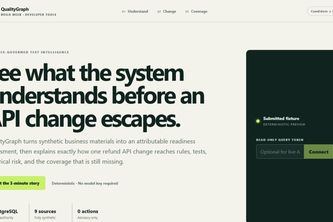
QualityGraph is a self-reported tool that claims to help teams understand the business impact of API changes by mapping evidence-backed relationships between rules, tests, and coverage gaps. It operates on synthetic commerce data and presents findings through a judge-facing interface without relying on AI-generated truth.
What changed
The project was built during a hackathon and includes a pre-existing platform baseline tagged with an immutable commit, along with new features developed during the competition period. These include a synthetic fixture, impact traversal logic, a responsive UI, and a resettable local runtime environment.
Single most important open question
Is there any evidence of real-world usage or integration beyond the hackathon demo? The description states no revenue, customers, or traction data exist outside of self-reported claims.
What The Product Actually Is
The description states that QualityGraph:
- Ingests a deterministic synthetic commerce bundle.
- Produces two governed views:
- Business Understanding Readiness
- API Change Impact
- Presents these findings in a judge-facing page with three sections: Understand, Change, Coverage.
- Works without requiring a model key.
- Can exercise real module-scoped read APIs.
It also states that the system uses Python (FastAPI, Pydantic, SQLAlchemy), React (TypeScript), PostgreSQL, Neo4j, Temporal, Playwright, and Docker Compose for local runtime.
Inference The product appears to be a proof-of-concept or prototype built for a hackathon, focused on demonstrating how API change impact can be traced through structured data and evidence rather than relying on AI outputs alone.
Positioning & Claim Evolution
The description states:
- The tool aims to make reasoning visible and attributable without allowing generated output to become automatic truth.
- It focuses on revealing affected rules, tests, and missing coverage.
- It emphasizes the importance of distinguishing between candidate evidence, review approval, and effective Truth.
- The authors claim that governance makes model-assisted reasoning more useful by making uncertainty and authority explicit.
Inference The positioning appears to be a niche solution for API quality assurance in complex systems where understanding change impact is critical. It positions itself as an alternative to AI-driven tools that might obscure or misrepresent evidence.
Target Customer & ICP
The description does not explicitly name target customers or define an ideal customer profile (ICP). However, it implies:
- Teams working with APIs and business logic.
- Organizations needing to trace the impact of changes in a governed way.
- Users who want to avoid treating AI output as truth.
Inference The likely ICP includes software engineering teams, API governance teams, or product development teams within enterprises where API quality and change management are high-value concerns.
Business Model & Pricing Evidence
There is no evidence of pricing, business model, or monetization strategy in the description. The project was built as part of a hackathon and lacks any indication of commercial viability or revenue streams.
Not evidenced
Technical & Delivery Signals
The description states:
- Built with Python 3.12, FastAPI, Pydantic, SQLAlchemy, Alembic, asyncpg.
- Frontend uses React 19, TypeScript, Vite, and generated OpenAPI types.
- Uses PostgreSQL as the system of record.
- Neo4j is used for rebuildable projections.
- Temporal handles workflow orchestration.
- Playwright, Vitest, Pytest, Ruff, Mypy, Import Linter are used for testing and linting.
- Docker Compose enables a resettable local judge stack.
It also mentions:
- A 74.72% readiness assessment backed by nine attributable synthetic sources.
- A reproducible change graph with 12 evidence-backed edges.
- One browser test that crosses the real FastAPI boundary.
- A one-command resettable Compose runtime.
Inference The technical stack suggests a modern, scalable architecture suitable for enterprise use cases. The presence of Docker and Temporal indicates some level of operational maturity, though this is limited to the demo environment.
Traction & Maturity Signals
There is no evidence of traction or maturity beyond the hackathon submission:
- No revenue data.
- No customer base.
- No production deployments.
- No public usage metrics.
- No post-hackathon updates or iterations.
Not evidenced
Competitive Context
The description does not mention competitors or direct market comparisons. It focuses on the unique value proposition of avoiding AI-generated truth and emphasizing evidence-backed reasoning.
Not evidenced
Open Questions & Risks
Key risks include:
- The tool is presented as a hackathon prototype with no real-world usage.
- No evidence of commercial traction, customers, or revenue.
- The system relies heavily on synthetic data; its applicability to real-world scenarios is unclear.
- Lack of transparency around how the “governed views” are enforced or audited in practice.
Inference The risk of overpromising and underdelivering is high. The lack of external validation or production use raises concerns about scalability, adoption, and long-term viability.
Questions the description leaves open
- What specific business problems does QualityGraph solve that existing tools do not?
- How does the system handle real-world data inputs instead of synthetic ones?
- Are there any plans to integrate with CI/CD pipelines or existing API governance platforms?
- Has the team validated the approach with actual engineering teams or stakeholders?
- What is the roadmap for moving beyond the current hackathon prototype?
Overall Assessment
There is no evidence of commercial traction, revenue, or customer adoption. The project is described as a hackathon submission with no indication of ongoing development or market validation.
Not evidenced
User Stories BotA demo video on every pull request
Get a demo video on every new feature
GitHub App that watches your pull requests and records a narrated, captioned demo.
Save time on demo prep and make informed decisions faster with a video walkthrough of every new feature.
Source
Submitted to the OpenAI 2026 hackathon on Devpost. Project home on Devpost. Back to the full gallery on Devpost.
This competitive analysis was produced by top-founders.com (opens in a new tab)
Generated by a language model from this project's public Devpost page — its tagline, the author's own write-up and any built-with tags listed there — as captured in August 2026. Short quotations are the author's words. It is an opinion on the idea as a business, not on the people behind it, and it reflects the description as published then. If the project has moved on, request a correction below. The analysis is not independent research and contains no verified traction, revenue or customer data.
An independent guide by KFG International LLC — not affiliated with, endorsed by, or connected to Devpost or OpenAI.