

Archive position — measured, not model output
2 likes on Devpost
221 of the 7,850 archived projects have more likes, and 284 share exactly 2 — so this project's #300 place in the like-ranked listing is a tie-break inside that group, not a ranking.
Projects (log scale)
Likes on Devpost. ▲ marks this project's group.
Show the figures
| Likes | Projects | Share of archive |
|---|---|---|
| 0 | 5,587 | 71.2% |
| 1 | 1,758 | 22.4% |
| 2 | 284 | 3.6% |
| 3–4 | 132 | 1.7% |
| 5–9 | 75 | 1.0% |
| 10+ | 14 | 0.2% |
 User Stories BotA demo video on every pull request
Get a demo video on every new feature
GitHub App that watches your pull requests and records a narrated, captioned demo.
Save time on demo prep and make informed decisions faster with a video walkthrough of every new feature.
Executive Summary
What the company appears to be
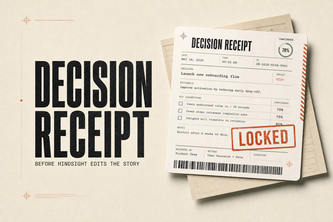
Decision Receipt is a self-reported tool designed to help users capture and review decisions made over time, with an emphasis on reducing hindsight bias in decision-making processes. The product is described as a system that allows users to "freeze" their expectations before outcomes are known, then later "review reality" and learn from evidence across decisions.
What changed
This project was submitted to the OpenAI 2026 hackathon, indicating it is likely an early-stage prototype or proof-of-concept. There is no evidence of prior development, funding, or commercial traction beyond this submission.
The single most important open question
Is there a clear and compelling use case for capturing and reviewing decisions over time that would justify building a product around this concept?
What The Product Actually Is
The description states: “Decision Receipt” is a tool to “freeze what you expect before hindsight edits the story. Review reality later and learn from evidence across decisions.”
- Product nature: Not clearly defined beyond a conceptual framework.
- Functionality claimed: To store initial expectations about decisions, then compare them with actual outcomes for learning purposes.
- Not evidenced Specific features, UI/UX design, or technical implementation details.
Inference (not fact) Based on the tagline and context of a hackathon submission, it may be a web-based tool that allows users to log decisions and track their evolution over time. However, this is speculative without further detail.
Positioning & Claim Evolution
The author states: “Freeze what you expect before hindsight edits the story. Review reality later and learn from evidence across decisions.”
- Positioning claim: A decision journal or audit trail system that helps reduce cognitive biases in decision-making.
- Evolution of claims: No evolution is evident; only a single tagline and no narrative development.
- Not evidenced Any positioning strategy, target audience segmentation, or differentiation from existing tools.
Inference (not fact) The product seems to aim at individuals or teams who want to improve decision-making through structured reflection. However, this is not confirmed by the description.
Target Customer & ICP
The description does not state any specific customer segment or ideal customer profile (ICP).
- Not evidenced Who uses it, why they would use it, or how it fits into their workflow.
- Inference (not fact): It could appeal to project managers, product leaders, or decision-makers who want to reflect on past choices. But this is unproven.
Business Model & Pricing Evidence
The description does not mention any business model or pricing information.
- Not evidenced Revenue streams, monetization strategy, or pricing tiers.
- Inference (not fact): If launched as a SaaS product, it might follow freemium or tiered pricing models common in developer tools. But no evidence supports this.
Technical & Delivery Signals
The author declares the following technologies were used:
- codex
- gpt-5.6
- next.js
- openai-javascript-sdk
- playwright
- react
- tailwind-css
- testing-library
- typescript
- vercel
- vitest
- zod
- Signal: The use of AI tools (e.g., GPT, codex) and modern frontend stack suggests a tech-savvy developer-focused approach.
- Not evidenced Whether the tool is functional or deployed; whether it's a working prototype or just conceptual.
Traction & Maturity Signals
The project was submitted to the OpenAI 2026 hackathon on Devpost.
- Signal: Early-stage development, likely a prototype or MVP.
- Not evidenced Any user base, revenue, customer feedback, or product adoption metrics.
- Inference (not fact): Given its hackathon origin, it is probably not yet mature for commercial use.
Competitive Context
The description does not reference any competitors or similar products.
- Not evidenced Existing solutions in the market that address decision tracking or bias reduction.
- Inference (not fact): Similar concepts may exist in areas like project management, decision logs, or cognitive bias tools. But no evidence of such comparisons is provided.
Open Questions & Risks
- Risk 1: Lack of clarity on core functionality and user value proposition.
- Risk 2: No evidence of traction, revenue, or customer validation.
- Risk 3: The product appears to be a hackathon submission with no indication of further development or commercial viability.
- Open Question: The absence of any detailed write-up beyond the tagline raises questions about whether this is more than an idea.
Questions the description leaves open
- What specific problem are you solving, and how does your solution address it?
- Who are your early users or potential customers?
- How do you plan to monetize this product?
- Are there any existing tools that solve a similar problem? If so, what makes yours different?
- What is the current state of development (e.g., prototype, beta, MVP)?
- Have you validated demand for this tool with real users?
Overall Assessment
Assessment Not evidenced.
- Confidence level: Low.
- Reasoning: The description provides only a tagline and minimal technical context. There is no evidence of product-market fit, traction, or commercial viability.
- Inference (not fact): If the idea proves valuable and scalable, this could be an interesting opportunity. However, at present, there is insufficient evidence to support investment or partnership interest.
User Stories BotA demo video on every pull request
Get a demo video on every new feature
GitHub App that watches your pull requests and records a narrated, captioned demo.
Save time on demo prep and make informed decisions faster with a video walkthrough of every new feature.
Source
Submitted to the OpenAI 2026 hackathon on Devpost. Project home on Devpost. Back to the full gallery on Devpost.
This competitive analysis was produced by top-founders.com (opens in a new tab)
Generated by a language model from this project's public Devpost page — its tagline and any built-with tags listed there, since the author published no write-up — as captured in August 2026. Short quotations are the author's words. It is an opinion on the idea as a business, not on the people behind it, and it reflects the description as published then. If the project has moved on, request a correction below. The analysis is not independent research and contains no verified traction, revenue or customer data.
An independent guide by KFG International LLC — not affiliated with, endorsed by, or connected to Devpost or OpenAI.