

Archive position — measured, not model output
1 like on Devpost
505 of the 7,850 archived projects have more likes, and 1,758 share exactly 1 — so this project's #1,747 place in the like-ranked listing is a tie-break inside that group, not a ranking.
Projects (log scale)
Likes on Devpost. ▲ marks this project's group.
Show the figures
| Likes | Projects | Share of archive |
|---|---|---|
| 0 | 5,587 | 71.2% |
| 1 | 1,758 | 22.4% |
| 2 | 284 | 3.6% |
| 3–4 | 132 | 1.7% |
| 5–9 | 75 | 1.0% |
| 10+ | 14 | 0.2% |
 User Stories BotA demo video on every pull request
Get a demo video on every new feature
GitHub App that watches your pull requests and records a narrated, captioned demo.
Save time on demo prep and make informed decisions faster with a video walkthrough of every new feature.
Executive Summary
Company: Pulsewell RESET
Self-reported basis: The description is entirely self-reported by the author, unverified, and submitted as part of a Devpost hackathon entry. No independent evidence of traction, revenue, customers or operational data exists.
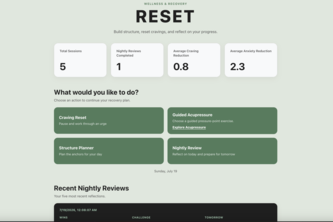
What it appears to be: A web-based recovery support app for individuals managing cravings and anxiety, built using AI-assisted development tools (Codex, GPT-5.6), with features including guided breathing, optional acupressure, progress tracking, and adaptive workflows.
What changed: The author states the project was developed as part of an OpenAI 2026 hackathon submission, using AI tools to accelerate development and refine UX. No prior version or evolution is described.
Most important open question: Is there evidence that this app will be adopted by users in real-world clinical settings, or whether it has been validated for effectiveness in managing substance use disorders?
What The Product Actually Is
- The description states that Pulsewell RESET is an AI-assisted recovery support app.
- It helps users manage cravings, reduce anxiety, and regain clarity.
- Features include:
- Personalized breathing exercises
- Optional acupressure guidance
- Progress tracking through an interactive dashboard
- Adaptive workflow based on user inputs (craving intensity, anxiety levels)
- The app is built as a React web application using Supabase for backend services.
- AI tools used in development:
- OpenAI Codex for component generation and refactoring
- GPT-5.6 for UX refinement, adaptive logic, and translating clinical concepts into digital experience
Inference: The product is described as a digital tool aimed at individuals managing emotional distress related to addiction or behavioral health, with an emphasis on immediate, accessible support.
Positioning & Claim Evolution
- The description states that Pulsewell RESET was created to provide “accessible, evidence-informed recovery support”.
- It aims to help users interrupt cravings and regulate anxiety using simple interventions that can be completed in minutes.
- The app is positioned as a tool for people between medical appointments who need immediate practical support.
- The author claims the app integrates clinical concepts into an intuitive digital experience through AI collaboration.
Inference: The positioning appears to be toward individuals seeking self-directed emotional regulation tools, particularly those with substance use disorders or related behavioral health challenges. It is not described as a replacement for professional care but rather a supplement.
Target Customer & ICP
- The description states the app targets individuals managing cravings and anxiety between medical appointments.
- These users are described as needing “immediate, practical support during moments of distress.”
- The app is intended for people living with substance use disorders or other behavioral health challenges.
- No specific demographic data, user segments, or market size is provided.
Inference: The ICP likely includes individuals in early recovery stages or those experiencing high emotional distress who are looking for low-barrier digital support tools. However, no evidence of actual users or customer personas exists.
Business Model & Pricing Evidence
- No pricing model, monetization strategy, or business model is described.
- The app is presented as a prototype built for a hackathon.
- There is no mention of subscriptions, freemium tiers, partnerships, or B2B elements.
- The author does not state whether the tool will be offered free-of-charge or sold.
Inference: No evidence exists to suggest how the product would generate revenue or sustain itself beyond its initial development phase.
Technical & Delivery Signals
- Built using:
- React (frontend)
- Supabase (backend, authentication, data storage)
- OpenAI Codex and GPT-5.6 (development assistance)
- Development process involved:
- AI-assisted component generation
- Debugging and architectural improvements
- UX refinement and clinical concept translation
- Deployment was completed for a Devpost submission.
- The app includes:
- Guided breathing exercises
- Adaptive decision logic
- Optional acupressure guidance
- Progress tracking dashboard
Inference: The technical stack suggests a modern, lightweight web application. AI tools were used extensively in development but not necessarily integrated into the user-facing product.
Traction & Maturity Signals
- No evidence of users, customers, or adoption.
- No revenue data, ARR, or usage metrics are provided.
- The project was submitted to a hackathon and is described as a prototype.
- There is no mention of testing in real-world clinical settings or user feedback loops.
Inference: The product has not yet reached a stage where traction or maturity can be assessed. It remains in early-stage development.
Competitive Context
- No information about competitors or market landscape is provided.
- The description does not reference existing apps, platforms, or tools for addiction recovery or mental health support.
- No mention of how Pulsewell RESET differentiates from similar offerings (if any).
Inference: There is no evidence to assess competitive positioning or market saturation. The project’s place in the broader ecosystem is unknown.
Open Questions & Risks
- Unvalidated clinical claims: The app is described as “evidence-informed,” but there is no indication of peer-reviewed validation or clinical trials.
- AI dependency: Heavy reliance on AI tools for development raises questions about scalability, control, and long-term maintainability.
- Lack of user data: No evidence of real-world testing or user feedback.
- No monetization path: No business model or revenue plan is evident.
- Single-founder team: Only one member listed (Errol Omay), which may limit execution capacity.
Inference: The project lacks clinical validation, user traction, and a clear path to commercial viability. Risks include unproven effectiveness, over-reliance on AI tools, and lack of scalability or monetization strategy.
Questions the description leaves open
- What evidence supports the clinical accuracy of the recovery interventions included in the app?
- Has the app been tested with real users or in clinical settings?
- How does the team plan to validate the effectiveness of the breathing and acupressure components?
- Is there a roadmap for expanding beyond the current features (e.g., additional evidence-based interventions)?
- What is the long-term vision for monetization or product sustainability?
- Are there plans to collaborate with healthcare providers or institutions?
Overall Assessment
- Not evidenced: No financials, traction, or customer data are available.
- The project is described as a hackathon prototype built by one person using AI tools.
- It addresses a real need in behavioral health but lacks validation and commercialization strategy.
- The app’s potential for impact depends on future development, clinical testing, and user adoption — none of which are evidenced.
Inference: At this stage, the project is not ready for investment or partnership consideration. It requires further development, clinical validation, and demonstration of real-world utility before it can be evaluated as a viable product or business.
User Stories BotA demo video on every pull request
Get a demo video on every new feature
GitHub App that watches your pull requests and records a narrated, captioned demo.
Save time on demo prep and make informed decisions faster with a video walkthrough of every new feature.
Source
Submitted to the OpenAI 2026 hackathon on Devpost. Project home on Devpost. Back to the full gallery on Devpost.
This competitive analysis was produced by top-founders.com (opens in a new tab)
Generated by a language model from this project's public Devpost page — its tagline, the author's own write-up and any built-with tags listed there — as captured in August 2026. Short quotations are the author's words. It is an opinion on the idea as a business, not on the people behind it, and it reflects the description as published then. If the project has moved on, request a correction below. The analysis is not independent research and contains no verified traction, revenue or customer data.
An independent guide by KFG International LLC — not affiliated with, endorsed by, or connected to Devpost or OpenAI.