

Archive position — measured, not model output
3 likes on Devpost
128 of the 7,850 archived projects have more likes, and 93 share exactly 3 — so this project's #190 place in the like-ranked listing is a tie-break inside that group, not a ranking.
Projects (log scale)
Likes on Devpost. ▲ marks this project's group.
Show the figures
| Likes | Projects | Share of archive |
|---|---|---|
| 0 | 5,587 | 71.2% |
| 1 | 1,758 | 22.4% |
| 2 | 284 | 3.6% |
| 3–4 | 132 | 1.7% |
| 5–9 | 75 | 1.0% |
| 10+ | 14 | 0.2% |
 User Stories BotA demo video on every pull request
Get a demo video on every new feature
GitHub App that watches your pull requests and records a narrated, captioned demo.
Save time on demo prep and make informed decisions faster with a video walkthrough of every new feature.
Executive Summary
What the company appears to be
Pull Guard is a self-reported system that claims to automate verification of pull requests in open-source repositories. It uses AI (specifically Codex and GPT-5.6 family) to fingerprint, deduplicate, and validate PRs by generating adversarial tests based on claims made in PR descriptions. The system aims to reduce the burden on maintainers by filtering out low-quality or redundant PRs early and recommending safe merge orders.
What changed
The project description indicates a shift from manual code review to AI-assisted verification. It positions itself as addressing a bottleneck in open-source development where maintainers spend time verifying claims rather than writing code, due to an increase in PR volume and quality issues.
Single most important open question
Is there any evidence of actual deployment or usage by maintainers? The description is entirely self-reported and lacks data on adoption, revenue, or customer feedback.
What The Product Actually Is
The description states that Pull Guard:
- Fingerprints incoming PRs using SHA-256 hashes over patch content, filenames, and renames.
- Deduplicates overlapping attempts into a single comparison.
- Detects flood waves of near-identical submissions.
- Filters out low-quality or policy-violating work early.
- Generates adversarial tests based on claims in PR descriptions using Codex.
- Tests PRs in pairs to determine safe merge order.
- Stores immutable version records for traceability.
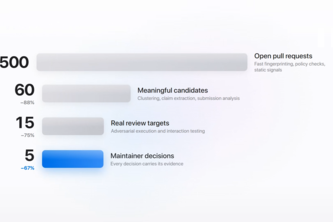
- Operates as a funnel: 500 PRs → 60 candidates → 15 review targets → 5 decisions.
- Never merges or closes anything automatically; it recommends, humans decide.
Evidence Self-reported by the author. No independent verification provided.
Inference This is a system designed to reduce human review time in open-source repositories through AI-assisted filtering and validation.
Positioning & Claim Evolution
The description states that:
- The bottleneck in open-source development has shifted from writing code to verifying it.
- PR descriptions are claims, not facts.
- AI coding agents have increased PR volume, making verification harder.
- Pull Guard addresses this by checking claims before human review.
Evidence Self-reported. No external data or market positioning beyond the author’s own narrative.
Inference The product is positioned as a solution to inefficiencies in open-source maintenance caused by AI-generated code and increased PR volume.
Target Customer & ICP
The description states:
- The system targets open-source maintainers.
- It addresses the problem of high-volume, low-quality PRs.
- It aims to reduce the time maintainers spend reviewing PRs.
Evidence Self-reported. No explicit segmentation or customer personas provided.
Inference The primary ICP is open-source maintainers managing repositories with high PR volumes and quality concerns.
Business Model & Pricing Evidence
The description states:
- The system is built for open-source projects.
- It plans to wrap its verification pipeline in an agent-facing CLI.
- Future integration into CI systems and agent harnesses is anticipated.
- Actions such as merging or closing pull requests remain separately permissioned.
Evidence Self-reported. No pricing, monetization strategy, or revenue model described.
Inference The business model appears to be B2B SaaS or developer tooling, likely targeting open-source maintainers and potentially integrating into CI/CD pipelines.
Technical & Delivery Signals
The description states:
- Built with: codex, gpt, node.js, openai, python, typescript.
- Control plane: Python/FastAPI backend.
- Frontend: React + Vite dashboard.
- Immutable versioning and fingerprinting used for traceability.
- Adversarial tests generated by Codex in disposable Docker sandboxes.
- Pairwise merge-order testing with isolated worktrees.
- Runners are disposable, run with --network none, empty environments, restricted mounts.
- Isolation audit verifies hardening was applied.
Evidence Self-reported. No independent technical validation or delivery data provided.
Inference The system is built using modern developer tooling and AI infrastructure, with strong emphasis on sandboxing and immutability for trust and reproducibility.
Traction & Maturity Signals
The description states:
- The project was submitted to the OpenAI 2026 hackathon.
- It includes a funnel of PR reduction: 500 → 60 → 15 → 5.
- It plans to integrate with agent-facing CLIs and CI systems.
Evidence Self-reported. No data on actual usage, adoption, or traction beyond the hackathon submission.
Inference The system is in early development stage, likely prototyped or built for a hackathon. No evidence of real-world deployment or user feedback.
Competitive Context
The description does not mention any competitors.
Evidence Not evidenced.
Inference No competitive landscape is described, which may indicate limited market awareness or lack of competitive analysis in the self-report.
Open Questions & Risks
- The system is entirely self-reported and unverified.
- No evidence of traction, revenue, or customer adoption.
- The project was submitted to a hackathon — no indication of commercialization.
- The team size is listed as 1, suggesting limited development capacity.
- Claims about AI capabilities (e.g., GPT-5.6 family) are not independently verifiable.
- The system is described as advisory only, which may limit adoption unless it proves significant value.
Evidence Self-reported. No external validation or data to support claims.
Questions the description leaves open
- What is the actual usage or testing of Pull Guard in real repositories?
- How does the system handle edge cases like PRs with no description or malformed diffs?
- Has there been any feedback from open-source maintainers or developers who tried it?
- Is there a plan to monetize this tool, and if so, how?
- What is the current state of the product — prototype, alpha, beta, or production-ready?
- How does the system handle conflicts between multiple PRs that are trying to modify the same code?
Overall Assessment
The description indicates that Pull Guard is a self-reported hackathon project with no evidence of traction, revenue, or customer adoption. The team size is 1, and there is no indication of commercialization or market readiness.
Confidence Level Low
Assessment Not ready for investment or partnership at this stage. The system appears to be in early development and lacks any demonstrated product-market fit or real-world usage.
User Stories BotA demo video on every pull request
Get a demo video on every new feature
GitHub App that watches your pull requests and records a narrated, captioned demo.
Save time on demo prep and make informed decisions faster with a video walkthrough of every new feature.
Source
Submitted to the OpenAI 2026 hackathon on Devpost. Project home on Devpost. Back to the full gallery on Devpost.
This competitive analysis was produced by top-founders.com (opens in a new tab)
Generated by a language model from this project's public Devpost page — its tagline, the author's own write-up and any built-with tags listed there — as captured in August 2026. Short quotations are the author's words. It is an opinion on the idea as a business, not on the people behind it, and it reflects the description as published then. If the project has moved on, request a correction below. The analysis is not independent research and contains no verified traction, revenue or customer data.
An independent guide by KFG International LLC — not affiliated with, endorsed by, or connected to Devpost or OpenAI.