

Archive position — measured, not model output
0 likes on Devpost
2,263 of the 7,850 archived projects have more likes, and 5,587 share exactly 0 — so this project's #6,135 place in the like-ranked listing is a tie-break inside that group, not a ranking.
Projects (log scale)
Likes on Devpost. ▲ marks this project's group.
Show the figures
| Likes | Projects | Share of archive |
|---|---|---|
| 0 | 5,587 | 71.2% |
| 1 | 1,758 | 22.4% |
| 2 | 284 | 3.6% |
| 3–4 | 132 | 1.7% |
| 5–9 | 75 | 1.0% |
| 10+ | 14 | 0.2% |
 User Stories BotA demo video on every pull request
Get a demo video on every new feature
GitHub App that watches your pull requests and records a narrated, captioned demo.
Save time on demo prep and make informed decisions faster with a video walkthrough of every new feature.
Executive Summary
What the company appears to be
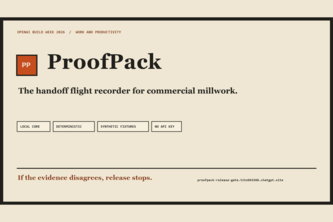
ProofPack Release Gate is a self-reported tool for managing AI-era handoffs in document-intensive workflows. It claims to enforce deterministic rules over evidence, classify claims into five states (VERIFIED, INFERRED, NEEDS_CONFIRMATION, CONFLICTED, BLOCKED), and prevent unauthorized changes to decision-making authority during release gates.
What changed
The project description indicates a focus on safety in AI-assisted workflows—specifically, preventing document contradictions from becoming physical errors. It positions itself as a bounded evidence compiler that uses deterministic rules and human oversight rather than relying on AI to make final decisions.
Single most important open question
Is there any evidence of real-world usage or adoption beyond the author’s own synthetic demonstrations?
Note: This analysis is based entirely on the self-reported, unverified description provided by the author. No external data, revenue figures, customer names, or traction metrics are available.
What The Product Actually Is
The description states that ProofPack Release Gate is a bounded evidence compiler for safer handoffs. It compiles Markdown, JSON, and log fixtures through explicit packet rules into normalized observations and five claim states: VERIFIED, INFERRED, NEEDS_CONFIRMATION, CONFLICTED, and BLOCKED.
It includes:
- An evidence ledger
- A HOLD or READY fabrication decision
- A mechanism to reset and recompile original packets with SHA-256 receipts
The tool is described as having a pure TypeScript core, a CLI, and a React interface. It uses GPT-5.6 Sol for optional AI proposal generation but does not allow the model to assign status or clear blockers.
Claim: The system compiles raw-ish Markdown, JSON, and log fixtures through explicit packet rules into normalized observations.
- Evidence: Yes (from author's write-up)
- Inference: No
Claim: GPT-5.6 Sol powers one optional developer command (
npm run ai:propose) that proposes candidate bindings but cannot assign status or clear blockers.
- Evidence: Yes
- Inference: No
Claim: ProofPack does not ingest or expose client data; all files in demo are synthetic.
- Evidence: Yes
- Inference: No
Positioning & Claim Evolution
The author positions ProofPack as a pattern for AI-era handoffs where evidence must "outrank confidence." It is framed as a solution to the problem of document contradictions becoming physical mistakes in industries like millwork fabrication.
Key claims:
- AI proposes candidate bindings.
- Deterministic rules judge admissibility.
- Humans keep release authority.
- Contradictory documents stay on HOLD instead of becoming fabricated mistakes.
It also emphasizes that it’s not trying to “magically understand any document,” but rather to constrain the packet, preserve evidence anchors, and classify claims transparently.
Claim: ProofPack is a pattern for AI-era handoffs where evidence outranks confidence.
- Evidence: Yes
- Inference: No
Claim: The tool prevents unauthorized model suggestions from becoming authority.
- Evidence: Yes
- Inference: No
Claim: It does not attempt to understand documents in general but instead constrains them and classifies claims transparently.
- Evidence: Yes
- Inference: No
Target Customer & ICP
The description does not name specific customers or industries beyond the example of millwork shops. However, it implies a target audience that includes:
- PMs or estimators coordinating between proposals and architectural sets
- Drafters who must align drawings with conflicting documents
- Anyone managing document handoffs in high-risk workflows where errors are costly
There is no evidence of segmentation, personas, or specific buyer profiles.
Claim: The tool targets industries like millwork fabrication where document contradictions lead to physical errors.
- Evidence: Yes (via example)
- Inference: No
Claim: It serves users coordinating between proposals and architectural sets.
- Evidence: Yes (via example)
- Inference: No
Claim: There is a defined ICP or buyer persona.
- Evidence: Not evidenced
- Inference: No
Business Model & Pricing Evidence
There is no mention of pricing, monetization strategy, or business model in the description.
Claim: The tool has a defined business model or pricing structure.
- Evidence: Not evidenced
- Inference: No
Technical & Delivery Signals
The system is built with:
- TypeScript core
- Node.js, React, Vite, Web
- Codex and GPT-5.6 Sol for optional AI assistance
- Deterministic outputs (SHA-256 receipts)
- Local execution (no network access required)
It supports:
- Exact text-line checks
- JSON Pointer equality or presence
- Four fixed claim kinds
- Named dependencies
- Authority resolver for mutually exclusive values
The author notes challenges around maintaining byte-stability, separating epistemic status from operational release, and preventing AI wording from becoming authority.
Claim: The system uses a pure TypeScript core with deterministic outputs.
- Evidence: Yes
- Inference: No
Claim: It supports exact text-line checks, JSON Pointer equality, and named dependencies.
- Evidence: Yes
- Inference: No
Claim: GPT-5.6 Sol is used for optional AI proposal generation in a sandboxed environment.
- Evidence: Yes
- Inference: No
Claim: The system prevents favorable AI wording from becoming authority.
- Evidence: Yes (mentioned as challenge)
- Inference: No
Traction & Maturity Signals
There is no evidence of revenue, customers, or adoption beyond the author’s own synthetic demonstration.
Claim: There is traction or customer adoption.
- Evidence: Not evidenced
- Inference: No
Claim: The tool has undergone testing (e.g., 163 TypeScript tests).
- Evidence: Yes
- Inference: No
Competitive Context
The description does not reference competitors or similar tools.
Claim: There are known competitive products in this space.
- Evidence: Not evidenced
- Inference: No
Open Questions & Risks
- No real-world usage — all evidence is synthetic and self-generated.
- Unproven scalability — the tool is described as intentionally bounded.
- Limited scope — no mention of integrations, OCR, or upload capabilities.
- Single-founder project — team size is listed as one member.
- Self-reported only — no third-party validation or external data.
Risk: The tool has not been tested in real-world conditions.
- Evidence: Not evidenced
- Inference: Yes
Risk: It may not scale beyond the current bounded scope.
- Evidence: Not evidenced
- Inference: Yes
Risk: No evidence of external validation or adoption.
- Evidence: Not evidenced
- Inference: Yes
Questions the description leaves open
- What real-world workflows have you observed that would benefit from this tool?
- Have you tested it in any actual handoff scenarios beyond the synthetic demo?
- How do you plan to expand beyond the current bounded scope (e.g., OCR, integrations)?
- Is there a path toward monetization or customer acquisition?
- What are the key assumptions about how users will interact with the system?
Overall Assessment
Not evidenced
The description provides no information on financials, traction, or market opportunity beyond the author’s own claims. It is unclear whether this represents a viable product or just an idea in development.
Assessment: No clear commercial due-diligence signal.
- Evidence: Not evidenced
- Inference: Yes
User Stories BotA demo video on every pull request
Get a demo video on every new feature
GitHub App that watches your pull requests and records a narrated, captioned demo.
Save time on demo prep and make informed decisions faster with a video walkthrough of every new feature.
Source
Submitted to the OpenAI 2026 hackathon on Devpost. Project home on Devpost. Back to the full gallery on Devpost.
This competitive analysis was produced by top-founders.com (opens in a new tab)
Generated by a language model from this project's public Devpost page — its tagline, the author's own write-up and any built-with tags listed there — as captured in August 2026. Short quotations are the author's words. It is an opinion on the idea as a business, not on the people behind it, and it reflects the description as published then. If the project has moved on, request a correction below. The analysis is not independent research and contains no verified traction, revenue or customer data.
An independent guide by KFG International LLC — not affiliated with, endorsed by, or connected to Devpost or OpenAI.