

Archive position — measured, not model output
0 likes on Devpost
2,263 of the 7,850 archived projects have more likes, and 5,587 share exactly 0 — so this project's #6,120 place in the like-ranked listing is a tie-break inside that group, not a ranking.
Projects (log scale)
Likes on Devpost. ▲ marks this project's group.
Show the figures
| Likes | Projects | Share of archive |
|---|---|---|
| 0 | 5,587 | 71.2% |
| 1 | 1,758 | 22.4% |
| 2 | 284 | 3.6% |
| 3–4 | 132 | 1.7% |
| 5–9 | 75 | 1.0% |
| 10+ | 14 | 0.2% |
 User Stories BotA demo video on every pull request
Get a demo video on every new feature
GitHub App that watches your pull requests and records a narrated, captioned demo.
Save time on demo prep and make informed decisions faster with a video walkthrough of every new feature.
Executive Summary
What the company appears to be
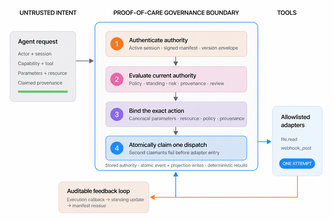
Proof-of-Care is a self-reported runtime governance system for AI agents. The description states it enforces a trust boundary between agent intent and tool execution, using HMAC-signed capability manifests, canonical JSON action envelopes, and SQLite-backed state. It claims to bind one authenticated decision to one exact action, with auditable policy and human review.
What changed
The project was built over a 5-day Build Week for the OpenAI 2026 hackathon. The author states that it began as an executable governance specification and evolved through Milestone 8 (M8.0–M8.12), incorporating adversarial testing, security regression harnesses, and formalized authority binding.
The single most important open question
Is Proof-of-Care a working prototype or a conceptual framework? The description states it was submitted to a hackathon and does not claim production readiness. There is no evidence of revenue, customers, or adoption beyond the author’s own account.
What The Product Actually Is
The description states
Proof-of-Care is a runtime governance system for AI agents that places an enforceable, auditable trust boundary between agent intent and tool execution. It validates session and signed capability manifest, evaluates provider/operator policy, incorporates domain-specific standing and authenticated contextual provenance, binds authorization to a canonical exact-action envelope, requires a single atomic dispatch claim at the final adapter boundary, and preserves a causally linked, reviewable history of authorization decisions, dispatch claims, and execution outcomes.
Inferred It is a Python-based system with SQLite governance state, HMAC-signed manifests, and strict JSON action envelopes. It supports filesystem read and one allowlisted HTTPS webhook path. It uses subprocess local executor and has no third-party runtime dependencies.
Positioning & Claim Evolution
The description states
AI agents need more than static permission toggles and activity logs. Proof-of-Care began as an executable governance specification for that boundary, with a focus on hardening against adversarial use—not merely adding happy-path features.
Inferred It positions itself as a security-first approach to AI agent control, focused on runtime enforcement rather than documentation or static policies. It evolved from a prototype to a hardened system through adversarial testing and audit feedback.
Target Customer & ICP
The description states
Not explicitly stated. The project is described as a governance system for AI agents, but no specific customer segment or persona is named.
Not evidenced No evidence of target customers, use cases, or ideal customer profile beyond the author’s own claims.
Business Model & Pricing Evidence
The description states
Not explicitly stated. The project is described as a prototype built for a hackathon and does not claim production readiness or pricing model.
Not evidenced No evidence of business model, pricing, revenue, or monetization strategy.
Technical & Delivery Signals
The description states
Built with Python 3.9+, SQLite, HMAC, JSON, webhooks, pytest, GitHub, Codex, GPT-5.6. Uses strict canonical JSON action envelopes, transactional event and projection writes, local executor subprocess, and concrete filesystem/webhook adapters. No runtime third-party dependencies.
Inferred It is a Python-based system with strong security engineering practices, including adversarial testing, formalized state transitions, and atomic writes. It was built using constrained AI collaboration (Codex) and adversarial audit feedback.
Traction & Maturity Signals
The description states
The project was submitted to the OpenAI 2026 hackathon. Milestone 8 (M8.0–M8.12) was added during the Build Week, including security regression harnesses, canonical action envelopes, and atomic projection rebuilds. The suite grew from 343 to 528 passing tests.
Not evidenced No evidence of revenue, customers, product adoption, or post-hackathon traction. The system is described as not production-ready.
Competitive Context
The description states
Not explicitly stated. No mention of competitors or market positioning beyond the author’s own claims.
Not evidenced No evidence of competitive landscape, existing solutions, or differentiation in the market.
Open Questions & Risks
Inferred from the description
- The system is described as a prototype built for a hackathon and not production-ready.
- It has no third-party dependencies but also lacks broader integration or scalability claims.
- The author states that runtime remediations are merged, but formal closure and audit are pending.
- The project is self-reported and unverified; no external validation or traction data exists.
Questions the description leaves open
- What specific AI agent use cases does Proof-of-Care intend to govern?
- Has the system been tested in any real-world or simulated environments beyond the hackathon?
- What are the key assumptions about trust and provenance that underpin its design?
- How does it scale with increasing numbers of agents or actions?
- Are there plans for integration with existing AI agent platforms or frameworks?
Overall Assessment
The description states
Proof-of-Care is a prototype built for a hackathon and not claimed to be production-ready. It was submitted as part of the OpenAI 2026 hackathon.
Not evidenced No evidence of commercial traction, revenue, or market validation. The system is described as experimental and under active development.
Inference This is an early-stage technical prototype with strong security engineering claims but no demonstrated product-market fit or commercial viability. It may be a valuable R&D asset or proof-of-concept, but not a commercial investment or partnership target at this stage.
User Stories BotA demo video on every pull request
Get a demo video on every new feature
GitHub App that watches your pull requests and records a narrated, captioned demo.
Save time on demo prep and make informed decisions faster with a video walkthrough of every new feature.
Source
Submitted to the OpenAI 2026 hackathon on Devpost. Project home on Devpost. Back to the full gallery on Devpost.
This competitive analysis was produced by top-founders.com (opens in a new tab)
Generated by a language model from this project's public Devpost page — its tagline, the author's own write-up and any built-with tags listed there — as captured in August 2026. Short quotations are the author's words. It is an opinion on the idea as a business, not on the people behind it, and it reflects the description as published then. If the project has moved on, request a correction below. The analysis is not independent research and contains no verified traction, revenue or customer data.
An independent guide by KFG International LLC — not affiliated with, endorsed by, or connected to Devpost or OpenAI.