

Archive position — measured, not model output
2 likes on Devpost
221 of the 7,850 archived projects have more likes, and 284 share exactly 2 — so this project's #233 place in the like-ranked listing is a tie-break inside that group, not a ranking.
Projects (log scale)
Likes on Devpost. ▲ marks this project's group.
Show the figures
| Likes | Projects | Share of archive |
|---|---|---|
| 0 | 5,587 | 71.2% |
| 1 | 1,758 | 22.4% |
| 2 | 284 | 3.6% |
| 3–4 | 132 | 1.7% |
| 5–9 | 75 | 1.0% |
| 10+ | 14 | 0.2% |
 User Stories BotA demo video on every pull request
Get a demo video on every new feature
GitHub App that watches your pull requests and records a narrated, captioned demo.
Save time on demo prep and make informed decisions faster with a video walkthrough of every new feature.
Executive Summary
What the company appears to be
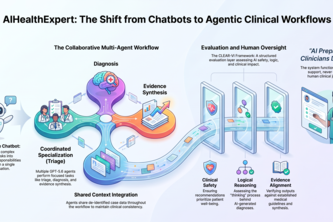
AIHealthExpert: Agentic Clinical Workspace is a self-reported project built as an MVP for the OpenAI 2026 hackathon. It describes itself as a multi-agent clinical workspace powered by GPT-5.6, designed to support healthcare professionals through structured AI workflows that include triage, diagnosis, evidence synthesis, documentation, and quality evaluation using the CLEAR-VI framework.
What changed
The project is presented as an experimental approach to clinical AI, moving away from chatbot-style interactions toward a coordinated agent-based system with human oversight. It emphasizes transparency, clinician control, and structured output evaluation.
Single most important open question
Is there evidence of any real-world use or traction beyond the hackathon MVP?
What The Product Actually Is
The description states that AIHealthExpert is a multi-agent clinical workspace built with OpenAI GPT-5.6, where specialized AI agents collaborate on different stages of clinical workflows such as triage, differential diagnosis, evidence synthesis, documentation, and patient education.
It integrates the CLEAR-VI quality evaluation framework to assess AI-generated outputs before human review.
The system is described as not replacing clinical judgment but serving as decision support, with a focus on clinician-centered design.
- Evidenced from: Project write-up
- Inferred: The product is an experimental MVP, not yet deployed in production or commercialized.
- Not evidenced: Actual functionality beyond the demo, real-world usage, or integration into existing healthcare systems.
Positioning & Claim Evolution
The author positions AIHealthExpert as a clinical AI platform that moves beyond chatbots to support structured workflows using specialized agents. The core claim is:
“AI prepares. Clinicians decide.”
This reflects an evolution from generic LLM tools toward workflow-oriented, agent-based clinical assistance, with emphasis on transparency and human-in-the-loop design.
- Evidenced from: Inspiration section, what it does, what we learned
- Inferred: This is a novel approach within healthcare AI, but not proven to be scalable or adopted.
- Not evidenced: Market positioning beyond the hackathon, competitive advantages, or differentiation from other clinical AI tools.
Target Customer & ICP
The target customer is healthcare professionals, specifically those involved in clinical decision-making such as physicians, nurses, or other clinicians who manage complex cases requiring reasoning, documentation, and evidence review.
The system is intended to support workflows involving:
- Clinical triage
- Differential diagnosis
- Evidence synthesis
- Documentation
- Patient education
- Evidenced from: Inspiration section, what it does
- Inferred: The ICP likely includes clinicians working in hospital or outpatient settings.
- Not evidenced: Specific customer segments, use cases, or personas beyond general healthcare professionals.
Business Model & Pricing Evidence
There is no evidence of a business model or pricing structure in the description.
The project is described as an MVP built for a hackathon and does not mention any monetization strategy, licensing, or enterprise sales.
- Evidenced from: Project write-up
- Not evidenced: Revenue streams, pricing tiers, customer acquisition plans, or commercial partnerships.
Technical & Delivery Signals
The system uses:
- GPT-5.6 as the foundational model
- A multi-agent architecture
- CLEAR-VI framework for quality evaluation
- Built with technologies including:
- React
- Tailwind CSS
- Vite
- REST API
- JavaScript
It is described as a clinician-centered interface, designed to reflect real clinical processes rather than simple chat experiences.
- Evidenced from: How we built it, technology tags
- Inferred: The system is built for usability and transparency.
- Not evidenced: Deployment architecture, scalability, or backend infrastructure details beyond MVP level.
Traction & Maturity Signals
The project is described as an MVP submitted to the OpenAI 2026 hackathon. There is no evidence of:
- Customers
- Revenue
- Product adoption
- User engagement metrics
- Post-hackathon development or deployment
It is explicitly stated that this is a demo, not a commercial product.
- Evidenced from: What we accomplished, what's next for AIHealthExpert
- Not evidenced: Any traction beyond the hackathon submission.
Competitive Context
There is no mention of competitors in the description. The author does not reference existing tools or platforms in the healthcare AI space.
The project appears to be self-contained, without comparison or alignment with current market offerings.
- Evidenced from: Project write-up
- Not evidenced: Competitor landscape, market positioning, or differentiation strategy.
Open Questions & Risks
Several potential risks and open questions are present:
- No commercial traction or revenue: The project is an MVP with no evidence of real-world use.
- Unverified claims about GPT-5.6: The author claims to use GPT-5.6, but this version does not exist publicly; it may be a placeholder or misstatement.
- Limited team size (1 person): A solo developer working on a complex healthcare AI system raises questions about scalability and long-term viability.
- No clear path to market: No evidence of go-to-market strategy, enterprise sales, or customer development.
- Unproven clinical impact: The CLEAR-VI framework is integrated, but no data or validation is provided.
- Evidenced from: Project write-up, team size
- Inferred: Risk of overstatement in claims due to lack of independent verification.
- Not evidenced: Any clinical validation, regulatory compliance, or safety testing.
Questions the description leaves open
- What is the source of the GPT-5.6 model? Is it a real version or placeholder?
- How does the CLEAR-VI framework integrate into the workflow in practice? Can you show examples?
- Has there been any testing with actual clinicians or healthcare organizations?
- What are the plans for scaling beyond the MVP and entering clinical environments?
- Are there any partnerships, pilot programs, or early adopters?
- How is the system secured and compliant with healthcare regulations (e.g., HIPAA)?
- What is the long-term vision for monetization or product development?
Overall Assessment
This project is a self-reported hackathon MVP with no evidence of traction, revenue, or commercial viability.
It represents an experimental idea in clinical AI that may have potential but lacks validation or proof-of-concept beyond the demo stage.
- Evidenced from: Project write-up
- Inferred: The idea could be valuable if further developed and validated.
- Not evidenced: Any investment-ready metrics, strategic partnerships, or market validation.
Assessment: Not investment-ready. Early-stage concept with unproven commercial potential. Requires significant development and validation before any serious consideration for funding or partnership.
User Stories BotA demo video on every pull request
Get a demo video on every new feature
GitHub App that watches your pull requests and records a narrated, captioned demo.
Save time on demo prep and make informed decisions faster with a video walkthrough of every new feature.
Source
Submitted to the OpenAI 2026 hackathon on Devpost. Project home on Devpost. Back to the full gallery on Devpost.
This competitive analysis was produced by top-founders.com (opens in a new tab)
Generated by a language model from this project's public Devpost page — its tagline, the author's own write-up and any built-with tags listed there — as captured in August 2026. Short quotations are the author's words. It is an opinion on the idea as a business, not on the people behind it, and it reflects the description as published then. If the project has moved on, request a correction below. The analysis is not independent research and contains no verified traction, revenue or customer data.
An independent guide by KFG International LLC — not affiliated with, endorsed by, or connected to Devpost or OpenAI.