

Archive position — measured, not model output
1 like on Devpost
505 of the 7,850 archived projects have more likes, and 1,758 share exactly 1 — so this project's #2,196 place in the like-ranked listing is a tie-break inside that group, not a ranking.
Projects (log scale)
Likes on Devpost. ▲ marks this project's group.
Show the figures
| Likes | Projects | Share of archive |
|---|---|---|
| 0 | 5,587 | 71.2% |
| 1 | 1,758 | 22.4% |
| 2 | 284 | 3.6% |
| 3–4 | 132 | 1.7% |
| 5–9 | 75 | 1.0% |
| 10+ | 14 | 0.2% |
 User Stories BotA demo video on every pull request
Get a demo video on every new feature
GitHub App that watches your pull requests and records a narrated, captioned demo.
Save time on demo prep and make informed decisions faster with a video walkthrough of every new feature.
Executive Summary
What the company appears to be
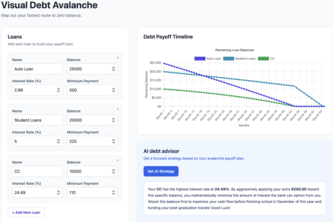
Visual Debt Avalanche is a self-reported personal finance tool built as a frontend web application. The author describes it as an interactive visualizer that uses the "avalanche method" for debt payoff planning, with a custom logic engine and real-time strategy generation.
What changed
This project was submitted by one individual (Victor Pacheco) to the OpenAI 2026 hackathon on Devpost. It is presented as a prototype or proof-of-concept built in a short timeframe using React, Chart.js, and other frontend technologies.
The single most important open question
Is there any evidence of actual user adoption, revenue, or traction beyond the author’s own submission? The description contains no data on users, customers, monetization, or product-market fit beyond self-reported claims.
What The Product Actually Is
The description states that Visual Debt Avalanche is an interactive visualizer for debt payoff planning. It uses the avalanche method, which prioritizes paying off debts with the highest interest rates first to minimize total interest paid over time.
It includes:
- A custom logic engine that calculates monthly interest using the formula $ I = B \times \frac{r}{12} $
- Real-time strategy generation based on user inputs
- Dynamic sorting of debts by interest rate
- Integration with Chart.js for data visualization
- Built in React (Vite) with Tailwind CSS, deployed via Vercel
It is described as a frontend-only application, without any backend API or database integration.
The author states: “I built Visual Debt Avalanche using React (Vite) for a lightning-fast development environment and Tailwind CSS for a clean, accessible UI.”
The author states: “The core data visualization is powered by Chart.js.”
The author states: “The application relies on a custom logic engine to calculate the mathematical Avalanche Method.”
The author states: “It computes the monthly interest for each loan using the standard formula: $ I = B \times \frac{r}{12} $”
The author states: “The custom algorithmic advisor then dynamically sorts the user's debts in descending order by interest rate…”
The author states: “This project was submitted to the OpenAI 2026 hackathon on Devpost.”
Positioning & Claim Evolution
The product is positioned as a personal finance tool that makes debt payoff planning more visual and actionable. It claims to offer:
- A custom logic engine
- An interactive visualizer
- Real-time, personalized payoff strategies
- Motivation through dynamic visualization
It is described as an alternative to standard spreadsheets, which the author says lack “the dynamic, reactive motivation needed to truly stick to an avalanche strategy.”
The author states: “The motivation to aggressively pay down these debts and build a solid financial buffer before finishing school in December 2026 to fund post-graduation travel sparked the idea for this project.”
The author states: “Standard spreadsheets lack the dynamic, reactive motivation needed to truly stick to an avalanche strategy…”
The author states: “This interactive visualizer uses the avalanche method and a custom logic engine to generate aggressive, personalized payoff strategies in real-time.”
Target Customer & ICP
The description does not provide explicit information about target customers or ideal customer profiles (ICP). However, it implies that the tool is aimed at individuals managing multiple debts, such as student loans or auto loans.
It was built with a specific use case in mind: someone preparing for post-graduation travel and looking to reduce debt before leaving school. This suggests an early-stage user base — likely students or recent graduates.
The author states: “Managing multiple balances, like student and auto loans, often feels overwhelming without a clear visual timeline.”
The author states: “The motivation to aggressively pay down these debts and build a solid financial buffer before finishing school in December 2026…”
Business Model & Pricing Evidence
There is no evidence of any business model or pricing structure. The project is described as a hackathon submission with no mention of monetization, subscriptions, or paid features.
The author states: “Everything above is the authors' own account. It is not independently verified, and no revenue, customer or traction data is available beyond what they state.”
Technical & Delivery Signals
The project was built using:
- Frontend stack: React (Vite), Chart.js, Tailwind CSS
- Deployment: Vercel
- Logic engine: Custom algorithmic logic for calculating interest and payoff strategies
- Challenges addressed:
- Complex state management with dynamic arrays of loans
- Simulated asynchronous logic using useRef and useEffect
The author states: “I built Visual Debt Avalanche using React (Vite) for a lightning-fast development environment and Tailwind CSS for a clean, accessible UI.”
The author states: “The core data visualization is powered by Chart.js.”
The author states: “Complex State Management: Managing dynamic arrays of loan objects where users can infinitely add, edit, or delete items required careful synchronization…”
The author states: “Simulated Asynchronous Logic: Building a front-end logic engine that parses the user's specific inputs and generates custom advice without a backend API…”
Traction & Maturity Signals
There is no evidence of traction, users, or adoption beyond the author’s own submission. It was submitted to a hackathon and has no data on:
- Active users
- Revenue
- Customer feedback
- Product usage metrics
The author states: “Everything above is the authors' own account. It is not independently verified, and no revenue, customer or traction data is available beyond what they state.”
Competitive Context
There are no details provided about competitors or market positioning. The description does not mention existing tools in the personal finance or debt payoff space.
Not evidenced.
Open Questions & Risks
- No traction or user data: The tool is a hackathon submission with no evidence of real-world usage.
- Single-person team: Only one developer (Victor Pacheco) built it, which may limit scalability or long-term maintenance.
- Frontend-only prototype: No backend or database integration implies limited functionality for real-world use.
- Self-reported claims only: All descriptions are unverified and lack independent corroboration.
The author states: “This project was submitted to the OpenAI 2026 hackathon on Devpost.”
The author states: “Everything above is the authors' own account. It is not independently verified…”
Questions the description leaves open
- What is the actual user base or adoption rate beyond this prototype?
- Are there any plans to monetize the tool, and if so, how?
- Has the tool been tested with real users or financial advisors?
- How does it handle edge cases like partial payments, loan refinancing, or interest rate changes?
- What are the technical limitations of the current frontend-only approach for long-term scalability?
Overall Assessment
Not evidenced.
There is no evidence of revenue, customers, traction, or a scalable business model beyond the author’s own self-description. The project is presented as a hackathon submission with no indication of commercial viability or product-market fit.
The author states: “Everything above is the authors' own account. It is not independently verified…”
The author states: “No revenue, customer or traction data is available beyond what they state.”
User Stories BotA demo video on every pull request
Get a demo video on every new feature
GitHub App that watches your pull requests and records a narrated, captioned demo.
Save time on demo prep and make informed decisions faster with a video walkthrough of every new feature.
Source
Submitted to the OpenAI 2026 hackathon on Devpost. Project home on Devpost. Back to the full gallery on Devpost.
This competitive analysis was produced by top-founders.com (opens in a new tab)
Generated by a language model from this project's public Devpost page — its tagline, the author's own write-up and any built-with tags listed there — as captured in August 2026. Short quotations are the author's words. It is an opinion on the idea as a business, not on the people behind it, and it reflects the description as published then. If the project has moved on, request a correction below. The analysis is not independent research and contains no verified traction, revenue or customer data.
An independent guide by KFG International LLC — not affiliated with, endorsed by, or connected to Devpost or OpenAI.