

Archive position — measured, not model output
2 likes on Devpost
221 of the 7,850 archived projects have more likes, and 284 share exactly 2 — so this project's #234 place in the like-ranked listing is a tie-break inside that group, not a ranking.
Projects (log scale)
Likes on Devpost. ▲ marks this project's group.
Show the figures
| Likes | Projects | Share of archive |
|---|---|---|
| 0 | 5,587 | 71.2% |
| 1 | 1,758 | 22.4% |
| 2 | 284 | 3.6% |
| 3–4 | 132 | 1.7% |
| 5–9 | 75 | 1.0% |
| 10+ | 14 | 0.2% |
 User Stories BotA demo video on every pull request
Get a demo video on every new feature
GitHub App that watches your pull requests and records a narrated, captioned demo.
Save time on demo prep and make informed decisions faster with a video walkthrough of every new feature.
Executive Summary
What the company appears to be
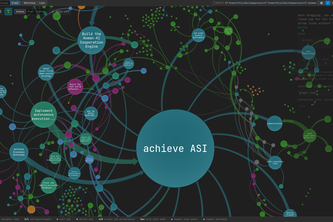
Aimparency is a self-reported local-first graph-based system designed to help humans express aims and coordinate with AI agents in pursuit of those aims. It is described as an experimental framework for aligning human intent with AI action, particularly in the context of a hackathon project.
What changed
The author reports that Aimparency was used during OpenAI Build Week 2026 to pursue the specific aim of winning the hackathon. The system was extended to support a recursive workflow where Codex (via GPT-5.6) implemented changes based on the graph, and results were recorded back into the graph.
Single most important open question
Is Aimparency a functional prototype or an experimental proof-of-concept? The description does not clarify whether it has been used beyond this one hackathon experiment, nor if it supports real-world use cases outside of the described context.
What The Product Actually Is
The description states that Aimparency is a local-first graph where humans express aims and AI agents help realize them. It stores versioned graphs of aims, dependencies, phases, reflections, and linked repositories inside .bowman beside code. It uses a model-context-protocol (MCP) to connect AI agents like GPT-5.6 in Codex with the graph.
It is described as an interface through which humans can express ideas, needs, priorities, dependencies, conflicts, and evidence to a more capable intelligence.
Inference The system appears to be a conceptual or experimental framework for managing human-AI coordination via a structured graph of aims and actions. It is not a production-ready product but rather a prototype built for a hackathon.
Positioning & Claim Evolution
The author positions Aimparency as an experiment in human-AI alignment, aiming to move beyond the idea that humans must control AI, toward a model where AI understands and cares for human needs. The project is framed as a micro-experiment to test how AI can be guided by human intent.
It claims to offer transparency by participation, not control by force—meaning it does not compel AI agents to use it but allows them to do so voluntarily.
Inference The positioning is aspirational and conceptual. It is not a commercial product yet, but rather a speculative tool for future AI-human coordination.
Target Customer & ICP
The description states that Aimparency is designed to help people realize ideas of any scale: software, research, organizations, physical projects, or personal goals.
It is described as an interface for humans to express aims and have them coordinated with AI agents. It is not clear if it targets developers, researchers, or general users.
Inference The ICP is not clearly defined. The system appears to be aimed at human users who want to coordinate with AI, but the exact persona or use case beyond the hackathon is not detailed.
Business Model & Pricing Evidence
There is no evidence of a business model, pricing structure, or monetization strategy in the description.
Inference No commercial elements are evident. The project is described as a hackathon experiment with no indication of a revenue path or customer base.
Technical & Delivery Signals
The system is built using:
- Codex
- GPT-5.6
- Model-context-protocol (MCP)
- Node.js, TypeScript, Vue 3, tRPC, Vitest
It integrates with Git repositories and Devpost for submission.
The description mentions that the system supports a recursive workflow where:
- A human states an aim.
- The graph connects it to larger goals and supporting work.
- Codex retrieves the aim and its path-to-root through MCP.
- Codex executes and verifies actionable work.
- Results return to the graph.
Inference The technical stack is experimental and built for a hackathon. It uses AI agents (Codex) in a structured way, but there is no evidence of scalability or production-grade delivery.
Traction & Maturity Signals
There is no evidence of traction, customers, or adoption beyond the single hackathon project.
The system is described as:
- A proof-of-concept
- An experimental framework
- Built for a single-use case
It is open source under the ISC license.
Inference No maturity or traction signals are evident. The project has not been used outside of this one-time experiment.
Competitive Context
The description does not mention any competitors or direct market context.
Inference There is no evidence of a competitive landscape. The project appears to be in a conceptual or experimental space, not yet part of an existing market.
Open Questions & Risks
- No commercial viability: No business model, pricing, or customer base.
- Experimental only: The system has no demonstrated use beyond one hackathon.
- Unproven AI integration: The described workflow is not validated in real-world settings.
- Self-reported and unverified: All claims are from the author and lack independent verification.
Inference The project is a speculative, experimental idea with no evidence of traction or commercial potential. It is not yet a product but a concept.
Questions the description leaves open
- What is the intended use case beyond this hackathon?
- Has Aimparency been used in any other real-world scenarios?
- How does it scale beyond a single developer’s workflow?
- Is there a plan to move beyond experimental use into production or commercial deployment?
- What are the limitations of the current implementation, and how would they be addressed?
Overall Assessment
Not evidenced.
The description provides no evidence of revenue, customers, traction, or business model. It is a self-reported hackathon experiment with no indication of commercial viability or product-market fit.
Inference This is not a viable investment or partnership opportunity at this time. It is an experimental idea in early-stage development and lacks any demonstrated value beyond its own proof-of-concept.
User Stories BotA demo video on every pull request
Get a demo video on every new feature
GitHub App that watches your pull requests and records a narrated, captioned demo.
Save time on demo prep and make informed decisions faster with a video walkthrough of every new feature.
Source
Submitted to the OpenAI 2026 hackathon on Devpost. Project home on Devpost. Back to the full gallery on Devpost.
This competitive analysis was produced by top-founders.com (opens in a new tab)
Generated by a language model from this project's public Devpost page — its tagline, the author's own write-up and any built-with tags listed there — as captured in August 2026. Short quotations are the author's words. It is an opinion on the idea as a business, not on the people behind it, and it reflects the description as published then. If the project has moved on, request a correction below. The analysis is not independent research and contains no verified traction, revenue or customer data.
An independent guide by KFG International LLC — not affiliated with, endorsed by, or connected to Devpost or OpenAI.