

Archive position — measured, not model output
0 likes on Devpost
2,263 of the 7,850 archived projects have more likes, and 5,587 share exactly 0 — so this project's #6,118 place in the like-ranked listing is a tie-break inside that group, not a ranking.
Projects (log scale)
Likes on Devpost. ▲ marks this project's group.
Show the figures
| Likes | Projects | Share of archive |
|---|---|---|
| 0 | 5,587 | 71.2% |
| 1 | 1,758 | 22.4% |
| 2 | 284 | 3.6% |
| 3–4 | 132 | 1.7% |
| 5–9 | 75 | 1.0% |
| 10+ | 14 | 0.2% |
 User Stories BotA demo video on every pull request
Get a demo video on every new feature
GitHub App that watches your pull requests and records a narrated, captioned demo.
Save time on demo prep and make informed decisions faster with a video walkthrough of every new feature.
Executive Summary
What the company appears to be
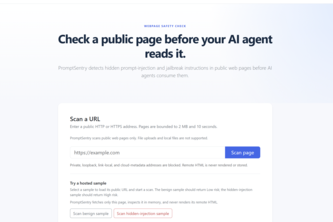
PromptSentry is a self-reported web-based scanner designed to detect hidden prompt injections in public web pages before AI agents trust them. It is built as a deterministic tool with optional GPT-5.6 integration for explanation, and uses .NET 10, C#, Blazor Server, Azure services, and EF Core.
What changed
The project was submitted to the OpenAI 2026 hackathon, indicating an early-stage development effort focused on AI security. No prior traction or commercial activity is evidenced.
Single most important open question
Is there a real market need for a deterministic prompt-injection scanner that can be integrated into AI agent workflows, and does the author have a clear path to product-market fit or customer validation?
What The Product Actually Is
The description states:
- PromptSentry is a web prompt-injection scanner.
- It fetches public web pages, validates DNS and redirects, limits response size/time, extracts concealed content, and applies explicit prompt-injection rules.
- It uses a deterministic approach with optional GPT-5.6 for evidence review (via Azure OpenAI API).
- The AI layer receives only redacted metadata, not full HTML, and cannot override deterministic scores.
- It is built using .NET 10, C#, Blazor Server, EF Core, Azure SQL, Azure App Service, and integrates with Codex for development.
Inference The product appears to be a developer tool for AI agent security, not a commercial SaaS offering. It is likely intended for use in AI agent pipelines where trust of web content is critical.
Positioning & Claim Evolution
The description states:
- The tool aims to detect hidden prompt injections in web pages that AI agents might consume.
- It positions itself as a security layer that provides an “explainable screening step” before AI agents trust web content.
- It emphasizes deterministic controls over AI, with AI used only for explanation.
Inference The author frames the tool as a developer-focused security utility, not a general-purpose AI platform or SaaS product. The positioning is narrow and technical, focused on AI agent safety rather than broader AI applications.
Target Customer & ICP
The description states:
- The tool is built for developers who work with AI agents that rely on web content.
- It is designed to be used as a security layer in AI workflows.
- No specific customer segments or personas are named.
Inference The target customer is likely AI developers, security engineers, or DevOps teams working with AI agent systems. The ICP is not clearly defined beyond this general audience.
Business Model & Pricing Evidence
The description states:
- No pricing model or commercial structure is described.
- The tool is presented as a self-contained project, not a service or product.
- It uses Azure services and integrates with Azure OpenAI API, but no billing or monetization details are given.
Inference There is no evidence of a business model or pricing structure. The tool appears to be a prototype or proof-of-concept, not a commercial offering.
Technical & Delivery Signals
The description states:
- Built with .NET 10, C#, Blazor Server, EF Core, Azure SQL, Azure App Service.
- Uses Codex with GPT-5.6 for development and testing.
- Implements URL validation, redirect revalidation, and atomic usage limits.
- Integrates Azure OpenAI API in a failure-safe way.
Inference The tool is built with enterprise-grade security and reliability in mind, using deterministic logic to avoid AI bias or unpredictability. It shows awareness of network security, cloud integration, and fail-safes.
Traction & Maturity Signals
The description states:
- The project was submitted to the OpenAI 2026 hackathon.
- Team size is 0.
- No revenue, customers, or adoption data are provided.
- It is described as a self-built prototype, not a product.
Inference There is no evidence of traction or maturity beyond the hackathon submission. The project is at an early stage and lacks any commercial validation.
Competitive Context
The description states:
- No mention of competitors, market analysis, or competitive positioning.
- It is not clear if similar tools exist in the market for detecting prompt injections in web content.
Inference There is no evidence of a competitive landscape or prior market players. The tool may be novel or niche, but no data supports this claim.
Open Questions & Risks
The description states:
- The project is a single-person hackathon submission, with no team or commercial structure.
- It uses Azure services and GPT-5.6, which may introduce dependency risks.
- No clear path to monetization or customer acquisition is evident.
Inference
Key risks include:
- Lack of team or product-market fit.
- No revenue model or scalability plan.
- Dependency on external AI services (Azure OpenAI) that may not be stable or cost-effective at scale.
- Unclear commercial viability or long-term roadmap.
Questions the description leaves open
- What specific use cases are you targeting for PromptSentry?
- Have you identified any potential customers or early adopters for this tool?
- How do you plan to monetize or scale the product beyond a hackathon prototype?
- Are there any known competitors in this space, and how does your solution differ?
- What are the technical limitations of the deterministic approach vs. AI-based detection?
- Do you have plans for integrating with specific AI agent platforms or workflows?
Overall Assessment
The description states:
- The project is a hackathon submission, not a commercial product.
- No evidence of revenue, customers, or traction exists.
- It is built as a developer tool with no clear business model.
Inference This is a very early-stage idea, likely not ready for investment or partnership. The author has demonstrated technical capability but lacks any commercial or market validation. The project may be a preliminary prototype with potential, but it is not yet a viable product or business.
User Stories BotA demo video on every pull request
Get a demo video on every new feature
GitHub App that watches your pull requests and records a narrated, captioned demo.
Save time on demo prep and make informed decisions faster with a video walkthrough of every new feature.
Source
Submitted to the OpenAI 2026 hackathon on Devpost. Project home on Devpost. Back to the full gallery on Devpost.
This competitive analysis was produced by top-founders.com (opens in a new tab)
Generated by a language model from this project's public Devpost page — its tagline, the author's own write-up and any built-with tags listed there — as captured in August 2026. Short quotations are the author's words. It is an opinion on the idea as a business, not on the people behind it, and it reflects the description as published then. If the project has moved on, request a correction below. The analysis is not independent research and contains no verified traction, revenue or customer data.
An independent guide by KFG International LLC — not affiliated with, endorsed by, or connected to Devpost or OpenAI.