

Archive position — measured, not model output
2 likes on Devpost
221 of the 7,850 archived projects have more likes, and 284 share exactly 2 — so this project's #231 place in the like-ranked listing is a tie-break inside that group, not a ranking.
Projects (log scale)
Likes on Devpost. ▲ marks this project's group.
Show the figures
| Likes | Projects | Share of archive |
|---|---|---|
| 0 | 5,587 | 71.2% |
| 1 | 1,758 | 22.4% |
| 2 | 284 | 3.6% |
| 3–4 | 132 | 1.7% |
| 5–9 | 75 | 1.0% |
| 10+ | 14 | 0.2% |
 User Stories BotA demo video on every pull request
Get a demo video on every new feature
GitHub App that watches your pull requests and records a narrated, captioned demo.
Save time on demo prep and make informed decisions faster with a video walkthrough of every new feature.
Executive Summary
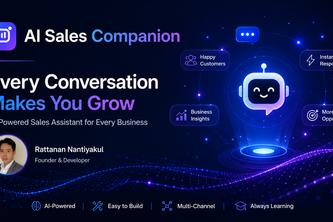
The company appears to be a two-person team building an AI-powered sales assistant platform designed for small businesses. The product allows users to quickly create an AI chatbot that can serve customers via LINE and website widgets by uploading basic business information, images, and a URL. It uses OpenAI models and a multi-tenant architecture, with a focus on ease-of-use and rapid deployment.
The description states the team built an MVP in a short timeframe, but no revenue, customer base or traction data is available beyond what the authors claim. The platform is positioned as a tool to simplify AI adoption for non-technical users, though it is unclear whether this has been validated in the market.
The single most important open question is: Has there been any real-world usage or feedback from early adopters?
What The Product Actually Is
- The description states that AI Sales Companion helps businesses create an AI sales assistant in minutes.
- Users describe their business, upload product/store photos, and provide a website URL.
- The platform automatically generates a knowledge base and FAQs, then deploys an AI assistant to LINE Official Account and an embeddable website chat widget.
- It continuously learns from conversations and evolves its responses.
Inference: The system appears to use OpenAI GPT models for conversational AI and vision models to interpret uploaded images. It leverages embeddings for semantic knowledge retrieval, function calling for tool orchestration, and a multi-tenant MySQL database architecture.
Not evidenced: No details on how the knowledge base is structured or whether it supports dynamic updates beyond initial setup.
Positioning & Claim Evolution
- The description states that small businesses and sales teams often miss opportunities due to scattered knowledge.
- It positions itself as a solution to make creating an AI assistant “as easy as describing your business and clicking Deploy.”
- The platform aims to reduce AI assistant setup from hours to minutes.
- The vision includes building, serving, learning, and growing — with every conversation making the AI smarter.
Inference: This is a product aimed at simplifying AI adoption for non-technical users, especially small businesses. It evolves from an MVP into a scalable SaaS-ready platform with plans for CRM integration, multi-agent collaboration, and enterprise features.
Not evidenced: No evidence of market validation or customer feedback on positioning claims.
Target Customer & ICP
- The description states that the target is small businesses and sales teams.
- It emphasizes that AI assistant setup is too technical for most organizations.
- Users are expected to provide basic business information, website URL, and product images.
Inference: The ICP likely includes small-to-medium enterprises (SMEs) with limited technical resources who want to improve customer service through automation but lack the expertise or time to build AI systems from scratch.
Not evidenced: No segmentation data, user personas, or specific industry focus is provided.
Business Model & Pricing Evidence
- The description does not mention any pricing model, subscription tiers, or monetization strategy.
- It focuses on deployment and learning capabilities rather than commercial aspects.
- The team mentions building a scalable multi-tenant architecture ready for SaaS growth.
Inference: Based on the architecture described, it is likely intended to be a SaaS product with potential for recurring revenue. However, no pricing or monetization details are stated.
Not evidenced: No indication of how the platform will generate revenue or what its commercial model looks like.
Technical & Delivery Signals
- Built using Next.js, Docker, MySQL, Playwright, Prisma, shadcn/ui, Tailwind.
- Uses OpenAI GPT models, vision models, embeddings, function calling.
- Implements cloud deployment via Cloud Run, LINE Messaging API, and website crawler.
- Designed for multi-tenant data storage and scalable architecture.
Inference: The tech stack suggests a modern full-stack SaaS approach with AI integration. The use of Playwright and crawlers implies some automation in content ingestion.
Not evidenced: No information on performance metrics, scalability limits, or production readiness beyond MVP status.
Traction & Maturity Signals
- The team built a working end-to-end MVP in a short timeframe.
- They claim to have reduced AI assistant setup from hours to minutes.
- The platform supports deployment to LINE and website chat widgets.
- A guided onboarding experience is designed to require no AI expertise.
Inference: This shows early-stage development maturity, with an emphasis on usability and speed of delivery. However, there is no evidence of real-world usage or user feedback.
Not evidenced: No data on active users, retention rates, or product adoption beyond the hackathon submission.
Competitive Context
- The description does not reference direct competitors.
- It implies a gap in the market for easy-to-use AI assistants tailored to small businesses.
- The platform supports LINE and website chat — similar to tools like Chatfuel, ManyChat, or Zendesk Answer Bot.
Inference: The product likely competes with low-code/no-code AI assistant platforms that cater to SMEs. However, no competitive analysis or differentiation strategy is stated.
Not evidenced: No mention of existing solutions or competitive positioning.
Open Questions & Risks
- The platform is described as a hackathon MVP — no evidence of real-world testing or product-market fit.
- No revenue, customer base, or traction data is provided beyond self-reported claims.
- The team size is only two members — raises questions about execution capacity and scalability.
- The vision includes future features like CRM integration and multi-agent collaboration, but these are not yet implemented.
Inference: Risk of overstatement in the product’s maturity and potential. Lack of traction makes it difficult to assess commercial viability or market demand.
Not evidenced: No evidence of competitive moat, IP protection, or long-term roadmap execution.
Questions the description leaves open
- What specific feedback have you received from early users or test customers?
- How do you plan to monetize the platform beyond the current MVP?
- Have you validated demand for this solution in real-world use cases?
- What are the key assumptions behind your go-to-market strategy?
- How do you intend to scale the knowledge base generation and conversation learning as businesses grow?
- Can you describe how you will handle data privacy and security, especially with multi-tenant architecture?
Overall Assessment
- The project is described as a hackathon MVP with no verified traction or revenue.
- It shows potential for solving a real problem — simplifying AI adoption for non-technical users.
- However, the lack of evidence around customer validation, monetization strategy, and team capacity raises significant concerns.
Assessment: Not ready for investment or partnership at this stage. The product is conceptually aligned with current market trends but lacks any demonstrated commercial viability or user feedback. Further due diligence would require evidence of early adoption, traction, or a clear path to monetization.
User Stories BotA demo video on every pull request
Get a demo video on every new feature
GitHub App that watches your pull requests and records a narrated, captioned demo.
Save time on demo prep and make informed decisions faster with a video walkthrough of every new feature.
Source
Submitted to the OpenAI 2026 hackathon on Devpost. Project home on Devpost. Back to the full gallery on Devpost.
This competitive analysis was produced by top-founders.com (opens in a new tab)
Generated by a language model from this project's public Devpost page — its tagline, the author's own write-up and any built-with tags listed there — as captured in August 2026. Short quotations are the author's words. It is an opinion on the idea as a business, not on the people behind it, and it reflects the description as published then. If the project has moved on, request a correction below. The analysis is not independent research and contains no verified traction, revenue or customer data.
An independent guide by KFG International LLC — not affiliated with, endorsed by, or connected to Devpost or OpenAI.