

Archive position — measured, not model output
0 likes on Devpost
2,263 of the 7,850 archived projects have more likes, and 5,587 share exactly 0 — so this project's #4,157 place in the like-ranked listing is a tie-break inside that group, not a ranking.
Projects (log scale)
Likes on Devpost. ▲ marks this project's group.
Show the figures
| Likes | Projects | Share of archive |
|---|---|---|
| 0 | 5,587 | 71.2% |
| 1 | 1,758 | 22.4% |
| 2 | 284 | 3.6% |
| 3–4 | 132 | 1.7% |
| 5–9 | 75 | 1.0% |
| 10+ | 14 | 0.2% |
 User Stories BotA demo video on every pull request
Get a demo video on every new feature
GitHub App that watches your pull requests and records a narrated, captioned demo.
Save time on demo prep and make informed decisions faster with a video walkthrough of every new feature.
Executive Summary
What the company appears to be
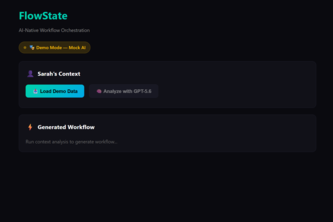
FlowState is a self-reported ambient AI workflow orchestration layer that integrates into existing tools like Slack, Jira, GitHub, Notion, Gmail, Calendar, and the browser. It claims to understand user context and act on implicit intent without explicit commands, using structured JSON outputs from GPT-5.6 and Codex for intent detection and workflow generation.
What changed
The author states they built this as a solution to reduce time lost in context switching between tools, inspired by their own team's experience. The project was developed over a short timeframe (likely a hackathon) and includes a prototype architecture with multiple components including a context engine, intent router, workflow generator, and safety layer.
The single most important open question
Is there evidence of real-world usage or traction beyond the author’s personal experience? The description lacks any data on adoption, revenue, customers, or product-market fit beyond self-reported claims.
What The Product Actually Is
The description states that FlowState is an ambient AI workflow orchestration layer. It lives inside tools teams already use — Slack, Jira, GitHub, Notion, Gmail, Calendar, and the browser.
It uses:
- A Context Engine powered by GPT-5.6 with structured JSON output to analyze real-time activity streams across connected tools.
- An Intent Router & Workflow Generator using Codex for detecting implicit intent and generating 3-step cross-tool workflows.
- A Safety Layer that assigns a trust score (0–1) to each workflow, requiring human approval if below 0.95.
- Technical components include:
- WebSocket streams + OAuth2 APIs for ingestion
- GPT-5.6 with custom fine-tuning
- Codex for structured JSON generation
- ChromaDB for vector memory (1536-dim embeddings)
- Neo4j Aura for graph memory (relationships, blockers)
- Puppeteer sandbox + REST APIs for action execution
- Chrome extension and Express dashboard for frontend
This is a self-reported technical architecture. No evidence of actual deployment or usage exists beyond the author’s account.
Positioning & Claim Evolution
The description states that FlowState aims to be an “ambient intelligence layer” that understands what users are doing and acts on it without asking — unlike existing solutions which add dashboards.
It positions itself as:
- An ambient AI that integrates into workflows rather than disrupting them.
- A context-aware automation tool, not a command-based one.
- A tool for reducing mechanical work caused by context switching between apps.
- A future-oriented agentic protocol, where tools register actions and FlowState orchestrates them without human-coded integrations.
These claims are self-reported. There is no evidence of market positioning, branding, or customer feedback to validate these assertions.
Target Customer & ICP
The description states that the inspiration came from observing teammates lose hours daily due to context switching — specifically mentioning a 10-person team with roles like PMs and engineers.
It implies:
- Primary users: Teams working in multiple tools (Slack, Jira, GitHub, Notion, etc.)
- Use case: Reducing time spent manually copying status updates, drafting summaries, scheduling reviews
- ICP: Product teams or individuals who perform repetitive cross-tool tasks
No explicit segmentation or targeting beyond this narrative is provided.
Business Model & Pricing Evidence
Not evidenced. The description does not mention any pricing strategy, monetization model, or business structure beyond the author’s personal development effort.
Technical & Delivery Signals
The description provides a detailed technical architecture:
- Uses GPT-5.6 with structured JSON output for context processing.
- Employs Codex for intent detection and workflow generation.
- Leverages ChromaDB, Neo4j Aura, and Puppeteer sandbox.
- Built as a Chrome extension + Express dashboard.
- Includes a mock AI layer used during development to simulate API responses.
It also mentions:
- A SemanticCompressor that reduces token payloads while maintaining semantic retention.
- A trust scorer that gates autonomy based on confidence levels.
- Use of pnpm workspaces for monorepo management.
However, no evidence exists regarding scalability, performance metrics, or production readiness beyond the prototype stage.
Traction & Maturity Signals
Not evidenced. The description does not include any data on:
- Number of users
- Revenue or monetization
- Customer feedback or testimonials
- Product usage statistics
- Market traction or adoption
The project was submitted to a hackathon, suggesting early-stage development and no commercial traction.
Competitive Context
Not evidenced. No mention of competitors or competitive landscape is included in the description.
Open Questions & Risks
Inferences based on self-reported information:
- Unproven market demand: The author’s personal experience may not reflect broader market needs.
- Technical feasibility concerns: GPT-5.6 and Codex are claimed to be used, but no details on accuracy or reliability of outputs are given.
- Trust score dependency: Requiring human approval for workflows below 0.95 suggests low autonomy — a potential limitation in user experience or scalability.
- Limited demo scope: The project was built as a hackathon submission and pivoted away from a Chrome extension to a dashboard, indicating possible incomplete functionality.
- No evidence of real-world testing or feedback: No mention of pilot users, beta testers, or iterative improvements.
Questions the description leaves open
- What specific problems did you observe in your team’s workflow that led to building this?
- How do you plan to validate whether the trust score mechanism is effective at preventing errors?
- Are there any early adopters or users who have tested the system beyond your own use case?
- What are the key assumptions about user behavior and tool adoption that underlie your design decisions?
- Can you describe how the system handles edge cases or unexpected inputs from tools like Slack or Jira?
- How do you intend to scale this beyond a single developer’s prototype?
Overall Assessment
Not evidenced. The description lacks any indication of:
- Revenue or financial performance
- Customer base or traction
- Product-market fit
- Go-to-market strategy
- Team experience or prior success
This is a self-reported hackathon project with no evidence of commercial viability, product-market fit, or scalability. It appears to be an experimental idea rather than a developed business.
The author states that the next step is plugin distribution via Chrome Web Store and Slack app marketplace listings — but this remains unverified and speculative.
User Stories BotA demo video on every pull request
Get a demo video on every new feature
GitHub App that watches your pull requests and records a narrated, captioned demo.
Save time on demo prep and make informed decisions faster with a video walkthrough of every new feature.
Source
Submitted to the OpenAI 2026 hackathon on Devpost. Project home on Devpost. Back to the full gallery on Devpost.
This competitive analysis was produced by top-founders.com (opens in a new tab)
Generated by a language model from this project's public Devpost page — its tagline, the author's own write-up and any built-with tags listed there — as captured in August 2026. Short quotations are the author's words. It is an opinion on the idea as a business, not on the people behind it, and it reflects the description as published then. If the project has moved on, request a correction below. The analysis is not independent research and contains no verified traction, revenue or customer data.
An independent guide by KFG International LLC — not affiliated with, endorsed by, or connected to Devpost or OpenAI.