

Archive position — measured, not model output
1 like on Devpost
505 of the 7,850 archived projects have more likes, and 1,758 share exactly 1 — so this project's #1,719 place in the like-ranked listing is a tie-break inside that group, not a ranking.
Projects (log scale)
Likes on Devpost. ▲ marks this project's group.
Show the figures
| Likes | Projects | Share of archive |
|---|---|---|
| 0 | 5,587 | 71.2% |
| 1 | 1,758 | 22.4% |
| 2 | 284 | 3.6% |
| 3–4 | 132 | 1.7% |
| 5–9 | 75 | 1.0% |
| 10+ | 14 | 0.2% |
 User Stories BotA demo video on every pull request
Get a demo video on every new feature
GitHub App that watches your pull requests and records a narrated, captioned demo.
Save time on demo prep and make informed decisions faster with a video walkthrough of every new feature.
Executive Summary
What the company appears to be
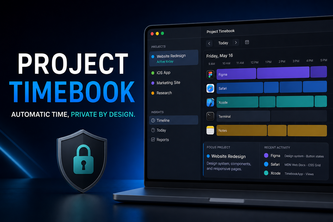
Project Timebook is a self-reported Mac app that silently records user activity on-device, then uses GPT-5.6 to generate client-ready work briefs without any raw data leaving the machine until the user presses “Generate.” The author states it was built for a consultant who struggled with time tracking and billing.
What changed
The project description indicates this is a hackathon submission (submitted to OpenAI 2026 hackathon), not yet a commercial product. It includes claims about privacy, encryption, and AI integration but lacks evidence of revenue, customers, or adoption.
Single most important open question
Is there any evidence that the described functionality has been shipped beyond the prototype stage, or that it is being used by anyone other than its creator?
What The Product Actually Is
The description states:
- Project Timebook is a Mac app that records user activity in real time (app usage, documents, browser tabs).
- It stores this data locally and encrypted.
- At the end of a day or period, users can press “Generate” to have GPT-5.6 write a client brief using only summary data.
- The app runs on Rust, uses egui/eframe, and integrates with OpenAI API via user’s own key.
- It is built with Codex as a pair programmer.
Inference The product appears to be a time-tracking and reporting tool for professionals, designed to reduce friction in billing by automating narrative generation from activity logs.
Not evidenced
- Whether the app has been released or is available for download.
- If it supports any other platforms beyond macOS.
- Any details on how the AI prompt is structured or whether it’s customizable.
Positioning & Claim Evolution
The description states:
- The app was inspired by a consultant’s need to avoid guessing timesheets.
- It aims to be private, with no data leaving the device until “Generate” is pressed.
- It uses GPT-5.6 for narrative generation, not just raw activity summaries.
- It promises no screenshots, keylogging, or cloud upload.
Inference The positioning appears to be a privacy-first time-tracking tool with AI-powered reporting, targeting freelancers and consultants who bill hourly.
Not evidenced
- No mention of competitors or how it differentiates from existing tools.
- No evidence of branding, marketing, or user feedback.
- No indication of whether the app is intended for personal use or enterprise.
Target Customer & ICP
The description states:
- The inspiration came from a consultant who bills by the hour and struggles with time tracking.
- The app is designed to help professionals write up work they’ve actually done, without manual logging.
Inference The primary customer segment appears to be freelancers or consultants who bill hourly and want an automated, private way to generate reports.
Not evidenced
- No explicit segmentation beyond “consultants.”
- No evidence of target personas, user interviews, or market research.
- No indication of whether the app is intended for individuals or teams.
Business Model & Pricing Evidence
The description states:
- The app uses WyConnect for account state and Stripe-backed edge function for billing.
- It mentions a “one future permanent license” covering all platforms.
- It was built as a hackathon project, not yet commercialized.
Inference There is an implied business model involving licensing or subscription, but no pricing details are provided.
Not evidenced
- No pricing tiers, revenue streams, or monetization strategy.
- No evidence of paid users or sales.
- No mention of freemium features or usage limits.
Technical & Delivery Signals
The description states:
- Built in Rust, using egui/eframe for UI.
- Uses local SQLite database with AES-256-GCM encryption.
- Sends only a summary of activity to OpenAI API, not raw data.
- Uses Codex for development.
- App is Developer ID-signed, notarized, and stapled.
Inference The technical stack suggests a secure, native desktop app with strong privacy controls. The use of Codex implies rapid prototyping.
Not evidenced
- No evidence of performance benchmarks or scalability.
- No mention of testing, QA, or user feedback loops.
- No details on how the AI prompt is structured or validated.
Traction & Maturity Signals
The description states:
- The app was submitted to a hackathon (OpenAI 2026).
- It is described as a signed, notarized Mac app that can be installed and used today.
- It includes automated privacy guard tests.
Inference This is likely a prototype or early-stage product, not yet in production use.
Not evidenced
- No evidence of user base, downloads, or usage metrics.
- No evidence of revenue, customers, or adoption.
- No mention of post-hackathon development or commercialization plans.
Competitive Context
The description states:
- The app was built to solve a problem with existing tools that require manual timer start/stop or file entry.
- It is designed to be private, unlike other time-tracking tools.
Inference It competes with traditional time-tracking apps (e.g., Toggl, Clockify) and potentially AI-enhanced productivity tools.
Not evidenced
- No mention of specific competitors or market share.
- No evidence of competitive analysis or pricing comparisons.
- No indication of how it differentiates from existing solutions beyond privacy.
Open Questions & Risks
The description states:
- The app is a hackathon submission, not yet commercialized.
- It uses GPT-5.6, which may be costly or unstable.
- It relies on user’s own OpenAI API key, which could be a barrier to adoption.
Inference
Key risks include:
- Lack of commercial traction or monetization strategy.
- Dependency on external APIs (OpenAI) that may change or cost more.
- Limited platform support (only macOS).
- No evidence of user feedback, testing, or iteration beyond the hackathon.
Not evidenced
- No evidence of a roadmap or product development plan.
- No mention of legal or compliance risks around AI use or data handling.
Questions the description leaves open
- Is this app currently available for download or use by others?
- What is the current status of the Mac App Store submission?
- How does the AI prompt work, and how is it validated to avoid instruction injection?
- Are there any plans to support Windows or Linux beyond a single license?
- What are the technical limitations of using GPT-5.6 in this context?
- Has the app been tested with real users beyond the creator?
Overall Assessment
The description states:
- This is a hackathon project, not yet commercialized.
- It includes claims about privacy, encryption, and AI integration but lacks evidence of traction or monetization.
Inference This is an early-stage idea with strong privacy positioning. However, there is no evidence of product-market fit, revenue, or adoption.
Not evidenced
- No financials, customer data, or market validation.
- No indication of whether the team plans to commercialize it or raise capital.
- No evidence of a sustainable business model or competitive advantage beyond privacy.
Assessment This is a pre-product idea with potential, but lacks any evidence of traction, revenue, or commercial viability. It should be considered a conceptual prototype at best.
User Stories BotA demo video on every pull request
Get a demo video on every new feature
GitHub App that watches your pull requests and records a narrated, captioned demo.
Save time on demo prep and make informed decisions faster with a video walkthrough of every new feature.
Source
Submitted to the OpenAI 2026 hackathon on Devpost. Project home on Devpost. Back to the full gallery on Devpost.
This competitive analysis was produced by top-founders.com (opens in a new tab)
Generated by a language model from this project's public Devpost page — its tagline, the author's own write-up and any built-with tags listed there — as captured in August 2026. Short quotations are the author's words. It is an opinion on the idea as a business, not on the people behind it, and it reflects the description as published then. If the project has moved on, request a correction below. The analysis is not independent research and contains no verified traction, revenue or customer data.
An independent guide by KFG International LLC — not affiliated with, endorsed by, or connected to Devpost or OpenAI.