

Archive position — measured, not model output
0 likes on Devpost
2,263 of the 7,850 archived projects have more likes, and 5,587 share exactly 0 — so this project's #6,080 place in the like-ranked listing is a tie-break inside that group, not a ranking.
Projects (log scale)
Likes on Devpost. ▲ marks this project's group.
Show the figures
| Likes | Projects | Share of archive |
|---|---|---|
| 0 | 5,587 | 71.2% |
| 1 | 1,758 | 22.4% |
| 2 | 284 | 3.6% |
| 3–4 | 132 | 1.7% |
| 5–9 | 75 | 1.0% |
| 10+ | 14 | 0.2% |
 User Stories BotA demo video on every pull request
Get a demo video on every new feature
GitHub App that watches your pull requests and records a narrated, captioned demo.
Save time on demo prep and make informed decisions faster with a video walkthrough of every new feature.
Executive Summary
What the company appears to be
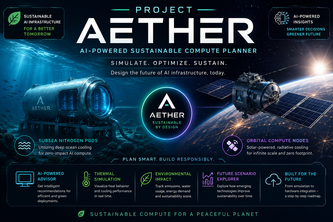
Project AETHER, as described by its author, is a software platform positioned to help researchers and infrastructure teams design, simulate, and optimize environmentally sustainable AI data centers before physical construction begins. The platform is built with Python and leverages AI technologies.
What changed
The project was submitted to the OpenAI 2026 hackathon on Devpost, indicating it is in an early-stage development or prototype phase. No evidence of prior traction, revenue, or customer adoption is provided.
Single most important open question
Is there a clear commercial need for this platform, and does the author have sufficient technical depth to deliver a viable product that could be adopted by real users?
What The Product Actually Is
The description states:
“A software platform that helps researchers and infrastructure teams design, simulate, and optimize environmentally sustainable AI data centers before building them.”
This is a self-reported definition. The author does not describe the specific features or functionality of the platform beyond its general purpose.
Evidence
- The product is described as a software platform.
- It supports design, simulation, and optimization of AI data centers.
- It is intended for use by researchers and infrastructure teams.
- It is positioned to enable environmentally sustainable outcomes.
Inference The platform likely involves modeling or simulation tools that allow users to evaluate energy efficiency, carbon footprint, or other environmental metrics before physical construction. However, this is not explicitly stated.
Positioning & Claim Evolution
The description states:
“sustainable AI”
This tagline and the accompanying text position the product as focused on sustainability in AI infrastructure development.
Evidence
- The tagline "sustainable AI" is used.
- The platform is described as helping users design, simulate, and optimize environmentally sustainable data centers.
Inference The positioning suggests a niche within the broader AI hardware or infrastructure space, possibly targeting environmental impact concerns. However, no claim about market size, adoption, or differentiation from existing tools is made.
Target Customer & ICP
The description states:
“helps researchers and infrastructure teams design, simulate, and optimize environmentally sustainable AI data centers”
Evidence
- The platform targets researchers.
- It also targets infrastructure teams.
- These are likely in the AI or tech sectors, possibly within large organizations or research institutions.
Inference The ICP (Ideal Customer Profile) appears to be early-stage or academic users with access to AI modeling and data center design capabilities. No evidence of enterprise adoption or specific customer segments is provided.
Business Model & Pricing Evidence
Evidence
- No mention of pricing, licensing, or monetization strategy.
- No indication of whether the platform will be sold as a SaaS product, open-source tool, or research collaboration.
Inference The business model is unclear. It may be early-stage and experimental, possibly intended for academic or hackathon use rather than commercial deployment.
Technical & Delivery Signals
The description states:
“Built with (author-declared): ai, python”
Evidence
- The platform is built using Python.
- AI technologies are used in its development.
Inference This suggests the tool may involve machine learning or data modeling capabilities. However, no details on architecture, scalability, or delivery mechanism are provided.
Traction & Maturity Signals
Evidence
- Submitted to the OpenAI 2026 hackathon.
- Team size is listed as 1 (Akhil Mani).
- No mention of revenue, customers, or product usage.
Inference The project appears to be in a very early stage — likely a prototype or proof-of-concept. There is no evidence of traction or commercial maturity.
Competitive Context
Evidence
- No mention of competitors.
- No indication of existing tools or platforms addressing similar needs.
Inference It is unclear whether there are existing solutions in this space, and the author does not reference them. This could be a gap in the market or an unproven niche.
Open Questions & Risks
- Single founder: The team size is listed as 1, which may indicate limited execution capacity.
- No traction or revenue: No evidence of product usage, customers, or monetization.
- Unverified claims: All descriptions are self-reported and unverified.
- Unclear business model: No indication of how the platform will be monetized or scaled.
- Limited technical detail: The description lacks specifics on functionality, delivery, or scalability.
Questions the description leaves open
- What specific environmental metrics does the platform optimize for?
- How does it simulate or model data center performance?
- Is there a clear path to monetization or commercial adoption?
- What is the intended user workflow from design to optimization?
- Are there any existing partnerships or pilot programs with research institutions or infrastructure teams?
Overall Assessment
Not evidenced.
The description provides no evidence of revenue, customers, traction, or a clear business model. The platform appears to be in an early-stage prototype submitted for a hackathon, with no indication of commercial viability or scalability.
This is a highly speculative opportunity, with limited evidence to support any conclusion about its potential value or risk profile. Any further diligence would require deeper engagement with the founder and access to more detailed product information.
User Stories BotA demo video on every pull request
Get a demo video on every new feature
GitHub App that watches your pull requests and records a narrated, captioned demo.
Save time on demo prep and make informed decisions faster with a video walkthrough of every new feature.
Source
Submitted to the OpenAI 2026 hackathon on Devpost. Project home on Devpost. Back to the full gallery on Devpost.
This competitive analysis was produced by top-founders.com (opens in a new tab)
Generated by a language model from this project's public Devpost page — its tagline and any built-with tags listed there, since the author published no write-up — as captured in August 2026. Short quotations are the author's words. It is an opinion on the idea as a business, not on the people behind it, and it reflects the description as published then. If the project has moved on, request a correction below. The analysis is not independent research and contains no verified traction, revenue or customer data.
An independent guide by KFG International LLC — not affiliated with, endorsed by, or connected to Devpost or OpenAI.