

Archive position — measured, not model output
0 likes on Devpost
2,263 of the 7,850 archived projects have more likes, and 5,587 share exactly 0 — so this project's #6,082 place in the like-ranked listing is a tie-break inside that group, not a ranking.
Projects (log scale)
Likes on Devpost. ▲ marks this project's group.
Show the figures
| Likes | Projects | Share of archive |
|---|---|---|
| 0 | 5,587 | 71.2% |
| 1 | 1,758 | 22.4% |
| 2 | 284 | 3.6% |
| 3–4 | 132 | 1.7% |
| 5–9 | 75 | 1.0% |
| 10+ | 14 | 0.2% |
 User Stories BotA demo video on every pull request
Get a demo video on every new feature
GitHub App that watches your pull requests and records a narrated, captioned demo.
Save time on demo prep and make informed decisions faster with a video walkthrough of every new feature.
Executive Summary
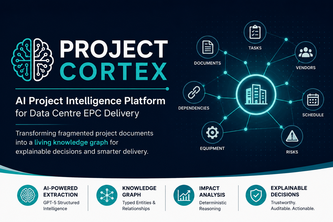
Project Cortex is an AI-powered project intelligence platform for Engineering, Procurement and Construction (EPC) projects, initially focused on data centre delivery. The author states that it transforms unstructured engineering documents into structured knowledge using GPT-5, then builds a persistent "Living Project Model" using deterministic algorithms to perform dependency analysis, compliance checks, and impact assessments.
The platform is described as not being another chatbot but rather a continuously updated digital understanding of the project, with a focus on explainability and auditability. It uses a hybrid architecture combining LLMs for document parsing and deterministic software for reasoning.
What Changed: The author claims to have addressed challenges in balancing AI flexibility with engineering reliability by separating LLM responsibilities from deterministic project logic.
Key Open Question: Is there evidence of real-world adoption or traction beyond the prototype, and how does this platform's architecture scale to complex infrastructure domains outside data centres?
What The Product Actually Is
The description states that Project Cortex is an AI-powered project intelligence platform for EPC projects, initially focused on data centre delivery.
It transforms engineering documents into:
- Structured entities
- Relationships
- Project events
- A connected Knowledge Graph
- A continuously evolving Living Project Model
From this, it can:
- Detect downstream schedule impacts
- Analyse dependency chains
- Perform specification compliance checks
- Generate explainable recommendations
- Produce executive-ready decision support
The system is described as not a chatbot, but rather a persistent digital understanding of the project.
It uses:
- GPT-5 for converting unstructured documents into structured knowledge (only for extraction)
- Deterministic algorithms for all downstream reasoning and analysis
Inference: The platform appears to be a prototype or proof-of-concept, not yet deployed in production environments. The author notes that this is only the beginning of their roadmap.
Positioning & Claim Evolution
The description states that Project Cortex is positioned as an AI system for intelligent EPC project delivery, inspired by the concept of the cerebral cortex — integrating fragmented information into a single intelligent model capable of reasoning over the entire project instead of isolated documents.
The author claims:
- The problem isn't a lack of information, but fragmentation
- The name "Cortex" reflects the brain’s role in integrating information and decision-making
- It aims to bring together thousands of engineering documents into one coherent understanding
Evolution of Claims:
- Initial inspiration came from data centre construction trends and outages
- The core idea evolved from recognizing that project knowledge is fragmented, not missing
- The platform's architecture was refined to separate LLM document parsing from deterministic software reasoning
Inference: This positioning reflects a shift from generic AI tools toward specialized, explainable, engineering-focused systems.
Target Customer & ICP
The description states that Project Cortex targets EPC projects, initially focused on data centre delivery.
It is designed for:
- Engineering teams
- Project managers
- Construction professionals working with complex infrastructure projects
The author notes that while the current prototype focuses on data centres, the underlying architecture can be extended to other domains such as:
- Semiconductor fabrication plants
- Metro rail systems
- Airports
- Renewable energy
- Power infrastructure
Inference: The initial ICP is likely engineering and project delivery teams in large-scale construction environments. The long-term vision suggests expansion into broader infrastructure sectors.
Business Model & Pricing Evidence
Not evidenced.
The description does not contain any information about pricing, monetization strategy, or business model.
Technical & Delivery Signals
The author states that Project Cortex combines:
- Large Language Models (GPT-5) for document parsing
- Deterministic software engineering for reasoning and analysis
Specific technical components mentioned:
- OpenAI GPT-5 (Responses API)
- NetworkX for directed dependency graph
- Pydantic for typed domain models
- FastAPI for backend
- React/Vite for frontend
The system architecture separates:
- LLM responsibility: extracting entities, relationships, events from documents
- Software engineering responsibility: dependency propagation, schedule analysis, compliance checking, impact assessment
Inference: The hybrid approach suggests a deliberate attempt to balance AI flexibility with software reliability and explainability.
Traction & Maturity Signals
Not evidenced.
There is no mention of revenue, customers, users, or adoption beyond the prototype stage. The project was submitted to a hackathon and described as "only the beginning."
Competitive Context
Not evidenced.
The description does not reference competitors, market positioning, or competitive dynamics in the EPC or AI-powered project intelligence space.
Open Questions & Risks
- Prototype-only: The platform is described as a prototype submitted to a hackathon; no evidence of real-world deployment or traction.
- Limited scope: While the roadmap includes integrations and extensions, the current version only addresses data centre EPC delivery.
- Unverified claims: The author makes strong claims about explainability, auditability, and engineering workflow integration without demonstrating actual use cases or validation.
- Dependency on GPT-5: Uses a proprietary LLM (GPT-5) for document parsing — raises questions about scalability, cost, and availability.
- No commercialization path: No evidence of pricing, monetization, or go-to-market strategy.
Questions the description leaves open
- What specific engineering workflows does Project Cortex aim to improve, and how is it different from existing project management tools?
- How do you plan to validate the accuracy of LLM-generated structured data in real-world EPC environments?
- Are there any pilot projects or partnerships with EPC firms currently underway?
- What are the key technical challenges in scaling the Living Project Model across thousands of connected entities?
- How will you ensure that deterministic algorithms remain accurate and up-to-date as project conditions change?
- What is your roadmap for monetization, and how do you plan to reach target customers beyond hackathons?
Overall Assessment
Not evidenced.
There is no evidence of funding rounds, valuation, or investor interest. The description does not indicate whether this is a startup seeking investment or a side project by an individual developer.
The platform appears to be a proof-of-concept prototype submitted to a hackathon with ambitious claims but no demonstrated traction or commercial viability. It shows potential in addressing fragmentation in EPC projects, but lacks evidence of real-world application or scalability beyond the current scope.
Confidence Level: Low — based entirely on self-reported description with no external validation or data points.
User Stories BotA demo video on every pull request
Get a demo video on every new feature
GitHub App that watches your pull requests and records a narrated, captioned demo.
Save time on demo prep and make informed decisions faster with a video walkthrough of every new feature.
Source
Submitted to the OpenAI 2026 hackathon on Devpost. Project home on Devpost. Back to the full gallery on Devpost.
This competitive analysis was produced by top-founders.com (opens in a new tab)
Generated by a language model from this project's public Devpost page — its tagline, the author's own write-up and any built-with tags listed there — as captured in August 2026. Short quotations are the author's words. It is an opinion on the idea as a business, not on the people behind it, and it reflects the description as published then. If the project has moved on, request a correction below. The analysis is not independent research and contains no verified traction, revenue or customer data.
An independent guide by KFG International LLC — not affiliated with, endorsed by, or connected to Devpost or OpenAI.