

Archive position — measured, not model output
3 likes on Devpost
128 of the 7,850 archived projects have more likes, and 93 share exactly 3 — so this project's #193 place in the like-ranked listing is a tie-break inside that group, not a ranking.
Projects (log scale)
Likes on Devpost. ▲ marks this project's group.
Show the figures
| Likes | Projects | Share of archive |
|---|---|---|
| 0 | 5,587 | 71.2% |
| 1 | 1,758 | 22.4% |
| 2 | 284 | 3.6% |
| 3–4 | 132 | 1.7% |
| 5–9 | 75 | 1.0% |
| 10+ | 14 | 0.2% |
 User Stories BotA demo video on every pull request
Get a demo video on every new feature
GitHub App that watches your pull requests and records a narrated, captioned demo.
Save time on demo prep and make informed decisions faster with a video walkthrough of every new feature.
Executive Summary
The company appears to be a student- or job-seeker-focused AI-powered resume analysis tool, built as a hackathon project during OpenAI Build Week. The description states that it uses an agent-based pipeline with LLMs and embeddings to analyze resumes against job descriptions, offering features like gap analysis, ATS keyword recommendations, and interview preparation.
What changed: This is a self-reported project submitted to a hackathon — there is no evidence of prior existence or commercial activity beyond the author's own account. The team has not yet launched a product for public use or generated revenue.
The single most important open question: Is there any evidence that this tool has been used by job seekers, or that it has traction in the market?
Note: All findings are based on self-reported information from the project description and are unverified. No third-party data, customer feedback, or financials are available.
What The Product Actually Is
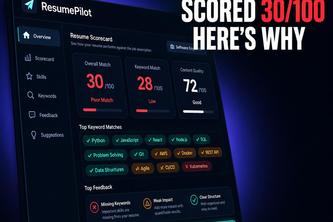
The description states that ResumePilot is an AI-powered job-application assistant for students and job seekers applying to jobs. It analyzes a resume against a job description using an agentic pipeline.
It generates:
- AI-powered Resume Match Score
- Semantic Similarity Score using sentence embeddings
- Gap Analysis (missing skills, experience, and ATS keywords)
- Tailored Resume Improvement Suggestions
- ATS Keyword Recommendations
- AI-generated Interview Questions with model answers
- Downloadable multi-page PDF report
The backend is built with FastAPI, and the frontend uses HTML. It leverages OpenAI models for reasoning, resume analysis, and interview preparation, while sentence-transformers provide semantic similarity.
Claim: ResumePilot is an AI-powered job-application assistant.
Evidence: The project description explicitly states this.
Claim: The tool provides a multi-step analysis workflow.
Evidence: The description lists the steps in the pipeline: Resume Match Scoring, Semantic Similarity Analysis, Gap Analysis, ATS Keyword Extraction, Resume Improvement Suggestions, Interview Question Generation, and Suggestion Self-Evaluation.
Claim: It produces downloadable PDF reports.
Evidence: The write-up says “Downloadable multi-page PDF report” is generated.
Positioning & Claim Evolution
The description states that ResumePilot doesn’t just tell applicants if their resume matches a job — it tells why and how to fix it, with a self-graded quality check.
It positions itself as:
- A tool for improving job applications before submission
- An assistant that goes beyond scoring by explaining gaps and offering actionable advice
Claim: ResumePilot is positioned as an assistant that explains why a resume matches or doesn’t match a role.
Evidence: The tagline says “it tells why, and how to fix it with a self graded quality check.”
Claim: It offers a more detailed analysis than typical ATS checkers.
Evidence: The inspiration section says existing ATS checkers only provide match scores or missing keywords, leaving applicants unsure of what to improve.
Target Customer & ICP
The description states that ResumePilot is for students and job seekers applying to jobs.
Claim: The target customer is students and job seekers.
Evidence: The tagline says “for students and job seekers applying.”
Claim: The tool is aimed at people tailoring resumes for multiple roles.
Evidence: The inspiration section mentions that applicants often tailor the same resume for dozens of different roles.
Business Model & Pricing Evidence
Not evidenced. The description does not mention any pricing, monetization strategy, or business model.
Finding: No evidence of a business model or pricing structure.
Technical & Delivery Signals
The project is built with:
- Backend: FastAPI
- Frontend: HTML
- AI models: OpenAI GPT models and Codex
- Embedding models: sentence-transformers
- PDF generation: ReportLab
- Deployment tools: uvicorn, PyMuPDF, Pydantic
It uses an agent-based workflow where each step performs a specialized task.
Claim: The tool is built with FastAPI.
Evidence: The “How we built it” section says the backend is built with FastAPI.
Claim: It uses OpenAI models for reasoning and analysis.
Evidence: The write-up states that GPT models power resume analysis, recommendations, and interview preparation.
Claim: It uses sentence-transformers for semantic similarity.
Evidence: The “How we built it” section says sentence-transformers provide an independent semantic similarity score.
Claim: It generates downloadable PDF reports.
Evidence: The write-up states that ReportLab is used to generate downloadable multi-page PDF reports.
Traction & Maturity Signals
Not evidenced. There is no mention of users, customers, or adoption beyond the authors’ own account.
Finding: No evidence of traction, customers, or usage.
Competitive Context
The description does not reference any competitors or market positioning relative to existing ATS tools or resume analysis platforms.
Finding: No evidence of competitive landscape or differentiation from other tools.
Open Questions & Risks
- The tool is described as a hackathon project with no prior commercial activity.
- It has no evidence of revenue, customers, or product-market fit.
- The team size is small (3 members), and there’s no indication of scaling or deployment beyond the development stage.
- No mention of security, privacy, or data handling practices.
- The tool is not yet publicly available for use.
Inference: The lack of any commercial activity or traction raises questions about whether this is a prototype or a product in development.
Inference: The small team size and hackathon origin suggest limited resources for scaling or long-term development.
Questions the description leaves open
- Is this tool currently being used by job seekers or students?
- What are the actual user feedback or adoption rates?
- How is the product monetized, if at all?
- Are there any plans to integrate with job boards or platforms like LinkedIn?
- What is the current development status — is it a prototype or a working product?
- How do you plan to scale beyond the current team size and hackathon-level development?
Overall Assessment
Not evidenced.
Finding: No evidence of any investment, partnership, or commercial traction. The project is described as a hackathon submission with no indication of prior activity or market validation.
Inference: This appears to be an early-stage idea or prototype, not a product ready for investment or partnership.
User Stories BotA demo video on every pull request
Get a demo video on every new feature
GitHub App that watches your pull requests and records a narrated, captioned demo.
Save time on demo prep and make informed decisions faster with a video walkthrough of every new feature.
Source
Submitted to the OpenAI 2026 hackathon on Devpost. Project home on Devpost. Back to the full gallery on Devpost.
This competitive analysis was produced by top-founders.com (opens in a new tab)
Generated by a language model from this project's public Devpost page — its tagline, the author's own write-up and any built-with tags listed there — as captured in August 2026. Short quotations are the author's words. It is an opinion on the idea as a business, not on the people behind it, and it reflects the description as published then. If the project has moved on, request a correction below. The analysis is not independent research and contains no verified traction, revenue or customer data.
An independent guide by KFG International LLC — not affiliated with, endorsed by, or connected to Devpost or OpenAI.