

Archive position — measured, not model output
0 likes on Devpost
2,263 of the 7,850 archived projects have more likes, and 5,587 share exactly 0 — so this project's #6,071 place in the like-ranked listing is a tie-break inside that group, not a ranking.
Projects (log scale)
Likes on Devpost. ▲ marks this project's group.
Show the figures
| Likes | Projects | Share of archive |
|---|---|---|
| 0 | 5,587 | 71.2% |
| 1 | 1,758 | 22.4% |
| 2 | 284 | 3.6% |
| 3–4 | 132 | 1.7% |
| 5–9 | 75 | 1.0% |
| 10+ | 14 | 0.2% |
 User Stories BotA demo video on every pull request
Get a demo video on every new feature
GitHub App that watches your pull requests and records a narrated, captioned demo.
Save time on demo prep and make informed decisions faster with a video walkthrough of every new feature.
Executive Summary
What the company appears to be
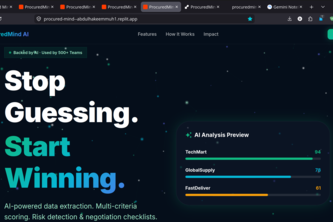
ProcuredMind AI is a self-reported AI-powered procurement intelligence platform designed to assist procurement professionals in analyzing supplier quotations and procurement documents. It claims to automate document processing, normalize data across vendors, perform weighted multi-criteria scoring, identify risks, and generate explainable recommendations using a combination of deterministic logic and LLM reasoning.
What changed
The project description indicates that the team evolved from building a simple document summarizer into a full procurement decision-support platform with features like vendor comparison, risk detection, executive reporting, and an AI chat assistant. This suggests a shift in scope and ambition during development.
Single most important open question
Is there evidence of traction or early adoption by procurement teams to validate the need for this tool? The description lacks any mention of customers, revenue, usage metrics, or pilot programs — all of which would be critical to assess commercial viability.
Note: This analysis is based solely on the self-reported, unverified account provided in the project description. No external corroboration exists for any claims made.
What The Product Actually Is
The description states that ProcuredMind AI is an AI-powered procurement intelligence platform. It allows users to upload RFQs, quotations, vendor proposals, invoices, spreadsheets, PDFs, and other procurement documents.
Key functions include:
- Automatic extraction of procurement information
- Normalization of data across vendors
- Weighted multi-criteria scoring (based on price, delivery, technical capability, service quality, risk)
- Identification of procurement risks
- Generation of explainable recommendations
- Creation of negotiation checklists and executive-ready reports
- An AI procurement assistant capable of answering grounded questions using extracted evidence
The system combines deterministic procurement logic with LLM reasoning via GPT-5.6 to ensure transparency and traceability in its outputs.
Inference: The platform appears to be a full-stack SaaS product built for enterprise procurement use cases, though no evidence of actual deployment or customer interaction is provided.
Positioning & Claim Evolution
The author states that the vision behind ProcuredMind AI was to "transform procurement from manual document review into an intelligent, evidence-backed decision-making process."
Initially, it started as a document summarizer but evolved into a more comprehensive platform focused on decision support. The team emphasizes:
- Transparency and explainability in AI outputs
- Grounded recommendations based on extracted procurement evidence
- A hybrid model combining deterministic scoring with LLM reasoning
This evolution reflects an intent to move beyond basic automation toward intelligent assistance that supports human judgment rather than replacing it.
Claim: The platform positions itself as a tool for enterprise procurement teams seeking faster, more defensible purchasing decisions.
Inference: The positioning implies a focus on trustworthiness and compliance within regulated procurement environments.
Target Customer & ICP
The description does not explicitly name target customers or define an ideal customer profile (ICP). However, it mentions that the tool is intended for "procurement professionals" and supports "enterprise environments."
It also notes that the platform aims to help organizations make "faster, more transparent, and more defensible purchasing decisions while saving both time and cost."
Claim: The primary user base consists of procurement teams within enterprises.
Inference: Based on the mention of enterprise workflows, ERP integrations, and RBAC features, the ICP likely includes mid-to-large-sized organizations with complex procurement processes.
Business Model & Pricing Evidence
There is no evidence in the description regarding pricing models, monetization strategies, or business model assumptions. The author does not describe how the platform will be sold, whether through subscriptions, per-use fees, or licensing.
Not evidenced: No information about revenue streams, pricing tiers, or commercial arrangements.
Technical & Delivery Signals
The project was built as a full-stack TypeScript application using:
- Frontend: React, Vite, Material UI (MUI), TypeScript
- Backend: Node.js, Express, MongoDB
- AI Layer: GPT-5.6, OpenAI Codex for development
- Document handling: Supports PDFs, spreadsheets, etc.
- Features: Responsive dashboard, multilingual support, report visualization
The team mentions:
- Modular architecture ready for expansion
- Use of deterministic logic combined with LLM reasoning
- Prompt engineering and retrieval grounding techniques
- Support for OCR, multi-language understanding, and ERP integrations in future plans
Inference: The technical stack suggests a modern, scalable SaaS architecture suitable for enterprise deployment. However, no evidence exists that the product is currently live or deployed.
Traction & Maturity Signals
The description indicates this was developed as part of a hackathon (OpenAI 2026) and is described as an MVP (Minimum Viable Product).
Accomplishments listed include:
- End-to-end procurement workflow
- Intelligent document ingestion
- Multi-vendor comparison
- Weighted scoring and risk detection
- Explainable AI recommendations
- Executive reporting
- AI chat assistant
Future enhancements mentioned include:
- OCR support
- ERP integrations
- Vendor performance analytics
- Spend forecasting
Not evidenced: No data on user adoption, customer feedback, or product usage metrics. The project is described as a hackathon submission with no indication of real-world traction.
Competitive Context
The description does not provide any information about existing competitors in the procurement intelligence space. It does not reference other platforms, tools, or vendors offering similar services.
Not evidenced: No competitive landscape analysis or differentiation strategy provided.
Open Questions & Risks
Several potential risks and open questions emerge from the self-reported account:
- Lack of traction: The project is described as an MVP built during a hackathon with no evidence of real-world usage.
- Unproven market need: No mention of customer validation, pilot programs, or early adopters.
- AI explainability challenge: While the platform claims to provide grounded recommendations, there's no evidence that this functionality has been tested or validated in practice.
- Scalability concerns: The architecture is described as modular and ready for expansion, but no details on how it scales beyond a single developer’s prototype.
- Dependency on GPT-5.6: The platform relies heavily on a specific LLM version that may not be available or stable in production environments.
Inference: Without traction or validation, the commercial viability of this product remains unproven.
Questions the description leaves open
- Has the platform been tested with real procurement teams? What feedback have you received?
- How do you plan to validate the accuracy and reliability of your AI-generated recommendations in enterprise settings?
- Are there any existing partnerships or pilot programs with procurement departments or ERP vendors?
- What is your go-to-market strategy for reaching procurement professionals at scale?
- How will you ensure data privacy, security, and compliance (e.g., GDPR, SOX) in a procurement context?
- What are the key assumptions underlying your business model, and how do they align with market realities?
- Can you walk us through the process of integrating with ERP systems like SAP or Oracle?
Overall Assessment
Not evidenced: There is insufficient evidence to assess whether ProcuredMind AI represents a viable investment or partnership opportunity.
The project is presented as an MVP built during a hackathon, without any indication of traction, revenue, or customer validation. While the concept aligns with emerging trends in AI procurement tools, the lack of real-world data makes it difficult to evaluate its commercial potential.
Confidence Level: Low — due to absence of evidence for product-market fit, user adoption, or financial viability.
Next Step Recommendation: Further due diligence should include interviews with potential users, competitive analysis, and exploration of early-stage traction indicators.
User Stories BotA demo video on every pull request
Get a demo video on every new feature
GitHub App that watches your pull requests and records a narrated, captioned demo.
Save time on demo prep and make informed decisions faster with a video walkthrough of every new feature.
Source
Submitted to the OpenAI 2026 hackathon on Devpost. Project home on Devpost. Back to the full gallery on Devpost.
This competitive analysis was produced by top-founders.com (opens in a new tab)
Generated by a language model from this project's public Devpost page — its tagline, the author's own write-up and any built-with tags listed there — as captured in August 2026. Short quotations are the author's words. It is an opinion on the idea as a business, not on the people behind it, and it reflects the description as published then. If the project has moved on, request a correction below. The analysis is not independent research and contains no verified traction, revenue or customer data.
An independent guide by KFG International LLC — not affiliated with, endorsed by, or connected to Devpost or OpenAI.