

Archive position — measured, not model output
3 likes on Devpost
128 of the 7,850 archived projects have more likes, and 93 share exactly 3 — so this project's #184 place in the like-ranked listing is a tie-break inside that group, not a ranking.
Projects (log scale)
Likes on Devpost. ▲ marks this project's group.
Show the figures
| Likes | Projects | Share of archive |
|---|---|---|
| 0 | 5,587 | 71.2% |
| 1 | 1,758 | 22.4% |
| 2 | 284 | 3.6% |
| 3–4 | 132 | 1.7% |
| 5–9 | 75 | 1.0% |
| 10+ | 14 | 0.2% |
 User Stories BotA demo video on every pull request
Get a demo video on every new feature
GitHub App that watches your pull requests and records a narrated, captioned demo.
Save time on demo prep and make informed decisions faster with a video walkthrough of every new feature.
Executive Summary
Company: Online Museum
Self-reported basis: The analysis is based entirely on the project description provided by the caller — its name, tagline, author's own write-up, and technology stack. No third-party verification or historical data are available.
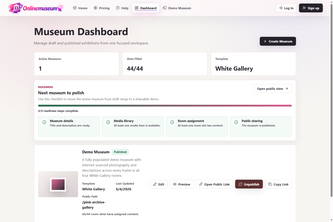
What it appears to be: A browser-based platform for creating and publishing 3D virtual exhibitions using a simplified gallery-building interface. It allows users to upload media, organize content into rooms, customize environments, and publish shareable links.
What changed: The project evolved from an experimental prototype into a deployed full-stack application with user registration, content management, and public directory features. It includes automated testing, responsive design, and performance optimization for mobile devices.
Single most important open question: Is there evidence of any real-world usage or demand beyond the hackathon submission? The description states no revenue, customers, or traction data are available.
What The Product Actually Is
The description states that Online Museum is a platform enabling users to create immersive 3D exhibitions directly in their browser. Creators can upload images and videos, organize them into four gallery rooms, customize wall finishes, add room introductions, and publish the finished exhibition through a shareable link.
It supports 44 curated display positions per museum and allows visitors to navigate between rooms, explore collections, and select individual works for details.
The platform includes:
- A public directory of active museums
- Onboarding center
- Downloadable user guide
- Responsive visitor controls
Evidence: The author's own write-up describes the product’s functionality in detail.
Inference: The product is a browser-based 3D exhibition builder with limited creative control but structured content organization.
Positioning & Claim Evolution
The description states that Online Museum was inspired by the idea that art and cultural storytelling should not be limited by geography, venue costs, or technical expertise.
It positions itself as:
- An accessible tool for artists, educators, brands, and cultural organizations
- A way to transform work into immersive exhibitions without specialized 3D skills
The evolution from a static gallery experiment to a deployed platform indicates a shift toward a functional product with user-facing features like registration, publishing, and content management.
Evidence: The author’s own write-up describes the inspiration, functionality, and development trajectory.
Inference: The positioning reflects an intent to democratize virtual museum creation, but no evidence of market traction or adoption is provided.
Target Customer & ICP
The description states that Online Museum targets:
- Artists
- Educators
- Brands
- Cultural organizations
These are described as users who want to create immersive 3D exhibitions without technical expertise.
Evidence: The tagline and author's write-up identify these personas.
Inference: The ICP is likely early adopters or niche users within creative and educational sectors, but no data on actual customer segments or usage is provided.
Business Model & Pricing Evidence
The description states that the next milestone for Online Museum is preparing for its first public paid launch. This includes:
- Completing Stripe checkout
- Subscription management
- Webhook, cancellation, failed-payment, and account-entitlement testing
No pricing information, revenue model, or monetization strategy beyond a future paid launch is provided.
Evidence: The author’s own write-up mentions the upcoming paid launch and related technical steps.
Inference: The business model appears to be subscription-based with a focus on monetizing access to platform features, but no confirmed pricing or revenue data exists.
Technical & Delivery Signals
The frontend was built using:
- React
- TypeScript
- Vite
- Three.js
- React Three Fiber
- Drei
Backend uses:
- PHP and SQLite hosted on Hostinger
- Supabase as an optional persistence layer
Testing includes:
- Playwright for automated unit, integration, cross-browser, mobile, and end-to-end testing
Performance optimizations include:
- Lazy loading of 3D viewer
- Video loading only when needed
- Texture loading limited to active room
- Optimization for mobile devices
Evidence: The author’s own write-up details the tech stack and development approach.
Inference: The platform is built with modern web technologies, but the backend infrastructure (shared hosting) may limit scalability.
Traction & Maturity Signals
The description states that:
- Online Museum evolved from a static gallery experiment to a deployed full-stack platform
- It includes user registration, content management, and public directory features
- The current release passes automated tests, security checks, production builds, and live desktop/mobile validation
- A demonstration museum exists
- There is an onboarding center and downloadable user guide
No evidence of:
- Revenue
- Customers
- User engagement metrics
- Active usage beyond the demo or test environment
Evidence: The author’s own write-up describes platform features and testing.
Inference: The product is mature enough for a public beta or early launch, but no real-world traction is reported.
Competitive Context
The description does not mention any competitors or market context. No information is provided about:
- Similar platforms
- Market size or growth trends
- Competitive advantages or differentiation
Evidence: Not evidenced
Inference: The competitive landscape is unknown; the platform may be in a niche or emerging space.
Open Questions & Risks
Key risks and open questions include:
- Backend limitations: Shared hosting with PHP/SQLite may not scale for a growing user base.
- No revenue or customer data: No evidence of monetization, adoption, or user engagement.
- Unproven market demand: The platform is described as a hackathon project that evolved into a deployed product, but no real-world usage is reported.
- Limited technical depth: The use of a static gallery architecture and slot-based display may limit creative flexibility or scalability.
Evidence: The author’s own write-up highlights challenges like performance on mobile devices and backend constraints.
Inference: These are likely real issues, but their impact is unknown without usage data.
Questions the description leaves open
- What specific user feedback has been gathered from early adopters or test users?
- How many active users or museums have been created on the platform?
- What is the current conversion rate from free to paid users (if any)?
- Are there any partnerships or pilot programs with cultural institutions or educators?
- What are the key performance indicators (KPIs) used to measure success beyond automated testing?
- How does the team plan to address backend scalability and hosting limitations?
- What is the timeline for the paid launch, and what features will be included in the first subscription tier?
Overall Assessment
Confidence: Low
Reasoning: The description is self-reported and unverified. No evidence of revenue, customers, or traction exists beyond the author’s own account.
The platform appears to be a functional prototype that evolved from a hackathon project into a deployed product with basic user features and testing. It targets niche users in creative and educational sectors but lacks any data on adoption, monetization, or market demand.
Assessment: Not evidenced. The project shows early signs of development and technical execution, but no commercial due-diligence signals are present. Further investigation into usage, revenue, and user engagement is required before any investment or partnership decision can be made.
User Stories BotA demo video on every pull request
Get a demo video on every new feature
GitHub App that watches your pull requests and records a narrated, captioned demo.
Save time on demo prep and make informed decisions faster with a video walkthrough of every new feature.
Source
Submitted to the OpenAI 2026 hackathon on Devpost. Project home on Devpost. Back to the full gallery on Devpost.
This competitive analysis was produced by top-founders.com (opens in a new tab)
Generated by a language model from this project's public Devpost page — its tagline, the author's own write-up and any built-with tags listed there — as captured in August 2026. Short quotations are the author's words. It is an opinion on the idea as a business, not on the people behind it, and it reflects the description as published then. If the project has moved on, request a correction below. The analysis is not independent research and contains no verified traction, revenue or customer data.
An independent guide by KFG International LLC — not affiliated with, endorsed by, or connected to Devpost or OpenAI.