

Archive position — measured, not model output
0 likes on Devpost
2,263 of the 7,850 archived projects have more likes, and 5,587 share exactly 0 — so this project's #6,046 place in the like-ranked listing is a tie-break inside that group, not a ranking.
Projects (log scale)
Likes on Devpost. ▲ marks this project's group.
Show the figures
| Likes | Projects | Share of archive |
|---|---|---|
| 0 | 5,587 | 71.2% |
| 1 | 1,758 | 22.4% |
| 2 | 284 | 3.6% |
| 3–4 | 132 | 1.7% |
| 5–9 | 75 | 1.0% |
| 10+ | 14 | 0.2% |
 User Stories BotA demo video on every pull request
Get a demo video on every new feature
GitHub App that watches your pull requests and records a narrated, captioned demo.
Save time on demo prep and make informed decisions faster with a video walkthrough of every new feature.
Executive Summary
What the company appears to be
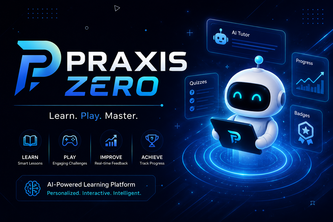
PRAXIS ZERO is an AI-powered learning platform that allows learners to ask questions in natural language, receive explanations from a local AI tutor, and then apply concepts through interactive Unity simulations. The system connects a learner's question to a structured lesson, followed by gameplay where decisions affect outcomes, with results fed back into the original tutor conversation.
What changed
The author states they built PRAXIS ZERO as a connected learning system rather than separate components. They focused on one complete vertical slice (Business and Marketing Storefront Simulator) during Build Week, demonstrating an end-to-end journey from question to simulation to feedback.
Single most important open question
Is there evidence of any traction, revenue, or customer adoption beyond the single developer's self-reported build? The description contains no information about users, customers, or commercial activity.
Note: This analysis is based entirely on the self-reported, unverified project description provided by the author. No third-party verification, historical data, or independent sources are available. All claims in this report are "the author states X" not proof of actual traction or outcomes.
What The Product Actually Is
The description states that PRAXIS ZERO is:
- An AI-powered learning and practical-simulation platform
- A connected system with a tutor, lesson, and Unity simulator
- Designed to let learners ask questions naturally and then apply concepts in interactive environments
- Built using Next.js, React, TypeScript, Unity 6.3 LTS, C#, Ollama, qwen3:4b-instruct, and WebGL
The author describes it as a system that:
- Accepts natural language questions
- Identifies subject, concept, and question intent
- Provides learner-friendly explanations
- Allows follow-up questions without repeating context
- Enables optional practical experience via Unity WebGL simulator
- Returns gameplay evidence to the original tutor conversation
Inference: The product appears to be a prototype or proof-of-concept built for a hackathon. It is not evidenced to have any commercial deployment, users, or revenue.
Positioning & Claim Evolution
The author states that PRAXIS ZERO was built because they felt most learning platforms stop too early — after explaining concepts or giving quizzes. The platform aims to bridge theory and practice by allowing learners to make decisions in simulations and see consequences.
Key claims:
- It is not another chatbot or quiz platform
- It enables learners to "make decisions, see consequences, learn from mistakes, retry"
- It supports multiple subjects (mathematics, physics, chemistry, biology, technology, coding, business, management, research, history, humanities)
- The goal was to create a "universal learning platform"
Inference: The positioning evolved from an idea about better learning experiences to a specific technical implementation involving AI tutoring and Unity simulations. However, the description does not show evidence of any market positioning beyond this single developer's vision.
Target Customer & ICP
The author states that PRAXIS ZERO is designed as a universal learning platform supporting various subjects including:
- Mathematics
- Physics, Chemistry, Biology
- Technology and Coding
- Business and Management
- Research and Investigation
- History and Humanities
- Professional and independent learning
For this Build Week submission, the focus was on one vertical slice: Business and Marketing Storefront Simulator.
Inference: The target customer is not clearly defined beyond "learners" or "students." No specific persona, segment, or use case beyond the author's own experience is evidenced. The description does not indicate any market research or user testing.
Business Model & Pricing Evidence
The description does not contain any information about:
- Revenue streams
- Pricing models
- Monetization strategy
- Customer acquisition costs
- Unit economics
Not evidenced: No business model or pricing evidence is provided. The author only describes the technical architecture and learning flow.
Technical & Delivery Signals
The system uses:
- Next.js, React, TypeScript, JavaScript, HTML, CSS for frontend
- Unity 6.3 LTS with WebGL for simulation
- Ollama + qwen3:4b-instruct for local AI tutoring (not GPT-5.6 as runtime)
- Browser local storage for session management
- Structured data bridge between Next.js and Unity
Key technical claims:
- Local model runs via Ollama, not cloud-based API
- Tutor pipeline handles lesson creation, subject detection, prompt construction, response validation, lesson storage, practical experience eligibility, gameplay evidence return
- Data contract between frontend and Unity includes lesson identifiers, learner question, subject/concept, explanation, objective, decisions, outcomes, retries, mission completion
Inference: The platform is built as a prototype with local AI inference and Unity integration. It shows technical capability but lacks evidence of scalability or production deployment.
Traction & Maturity Signals
The description states:
- This is a Build Week submission
- One complete vertical slice was completed (Business and Marketing Storefront Simulator)
- The full journey from question to simulation to feedback works in testing
- Final verified play-through shows specific outcomes: 8 hoodies sold, PKR 52,000 revenue, PKR 13,000 profit
However, there is no evidence of:
- Users or customers
- Revenue or monetization
- Adoption metrics
- Product-market fit validation
- Commercial traction beyond the author's own testing
Not evidenced: No traction or maturity signals are provided. The project appears to be a prototype or demo.
Competitive Context
The description does not mention any competitors or competitive landscape.
Not evidenced: No information is given about existing platforms, market positioning, or competitive differentiation.
Open Questions & Risks
- Single-person development: Only one team member (Yousuf Ali) is listed
- Prototype nature: Built for a hackathon; no evidence of production deployment or user adoption
- Local AI dependency: Relies on local inference via Ollama, which may limit scalability and performance
- Limited scope: Only one subject area (Business & Marketing) was completed in this submission
- No commercial data: No evidence of revenue, customers, or monetization strategy
Inference: The platform is a technical demonstration with no clear path to market traction or commercial viability.
Questions the description leaves open
- What are the key assumptions about learner behavior and learning outcomes that underpin this approach?
- How does PRAXIS ZERO plan to scale beyond one subject area (Business & Marketing)?
- Has there been any user testing or feedback from actual learners?
- What is the long-term vision for monetization, if any?
- Are there plans to move away from local AI inference to cloud-based models?
- How would you validate that learners actually learn more through this system compared to traditional methods?
Overall Assessment
Not evidenced: There is no evidence of commercial traction, revenue, or customer adoption. The project appears to be a technical prototype built for a hackathon with no indication of market readiness or business model.
Confidence level: Low. This analysis is based solely on the self-reported description and contains no verifiable data about users, customers, or financials. Any commercial due-diligence conclusions are speculative without further evidence.
User Stories BotA demo video on every pull request
Get a demo video on every new feature
GitHub App that watches your pull requests and records a narrated, captioned demo.
Save time on demo prep and make informed decisions faster with a video walkthrough of every new feature.
Source
Submitted to the OpenAI 2026 hackathon on Devpost. Project home on Devpost. Back to the full gallery on Devpost.
This competitive analysis was produced by top-founders.com (opens in a new tab)
Generated by a language model from this project's public Devpost page — its tagline, the author's own write-up and any built-with tags listed there — as captured in August 2026. Short quotations are the author's words. It is an opinion on the idea as a business, not on the people behind it, and it reflects the description as published then. If the project has moved on, request a correction below. The analysis is not independent research and contains no verified traction, revenue or customer data.
An independent guide by KFG International LLC — not affiliated with, endorsed by, or connected to Devpost or OpenAI.