

Archive position — measured, not model output
1 like on Devpost
505 of the 7,850 archived projects have more likes, and 1,758 share exactly 1 — so this project's #2,122 place in the like-ranked listing is a tie-break inside that group, not a ranking.
Projects (log scale)
Likes on Devpost. ▲ marks this project's group.
Show the figures
| Likes | Projects | Share of archive |
|---|---|---|
| 0 | 5,587 | 71.2% |
| 1 | 1,758 | 22.4% |
| 2 | 284 | 3.6% |
| 3–4 | 132 | 1.7% |
| 5–9 | 75 | 1.0% |
| 10+ | 14 | 0.2% |
 User Stories BotA demo video on every pull request
Get a demo video on every new feature
GitHub App that watches your pull requests and records a narrated, captioned demo.
Save time on demo prep and make informed decisions faster with a video walkthrough of every new feature.
Executive Summary
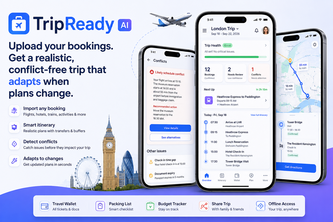
TripReady AI is a self-reported mobile-first travel operations platform built as an MVP for the OpenAI 2026 hackathon. The project claims to convert fragmented travel confirmations into one reviewable, operational itinerary using AI and structured data modeling. It is described as not a booking platform but a workspace that helps travelers understand what is confirmed, uncertain, at risk, and what should happen next.
The author states the product uses GPT-5.6 for explanation and guidance, while deterministic logic handles time zones, buffers, and dependencies. The MVP includes a responsive interface, conflict detection, delay simulation, and travel assistance features — all without live external integrations or real booking modifications.
Key commercial due-diligence read: The description is self-reported and unverified; there is no evidence of revenue, customers, traction, or actual use beyond the fictional demo. The project appears to be a proof-of-concept with an ambitious safety model but lacks any indication of market validation or product-market fit.
What The Product Actually Is
The description states that TripReady AI is a mobile-first travel operations PWA built using Next.js, React, TypeScript, and SQLite. It uses OpenAI’s GPT-5.6 API for generative reasoning and Codex-assisted development.
It claims to:
- Convert scattered travel confirmations into one reviewable itinerary.
- Use structured trip data, source evidence, deterministic checks, and AI guidance.
- Present a timeline with time zones, transfers, buffers, and operational dependencies.
- Detect conflicts in the schedule and explain why they may fail.
- Simulate flight delays and propose safer revised plans.
- Provide travel assistance through GPT-5.6 when configured.
The MVP is said to include:
- A responsive interface
- Conflict detection and explanation
- Delay simulation with impact analysis
- Simplified travel mode showing next action, directions, hotel info, etc.
- Calendar export and read-only sharing
- Travel wallet, packing checklist, budget view
It explicitly states that the MVP does not purchase, cancel, check in, send messages to providers, or modify external reservations. It is designed as a product experience and reasoning boundary, not a full booking platform.
The description states: “TripReady is intentionally not presented as a finished booking platform.”
Positioning & Claim Evolution
The author positions TripReady AI around the idea that travel planning fails in the gap between booking and execution, not because travelers can’t find interesting places. It aims to solve operational inefficiencies by grounding it in real booking evidence.
The project evolved from a question:
“Can AI turn scattered travel evidence into a trip that is not only attractive, but actually feasible, explainable, and adaptable?”
This framing suggests an intent to move beyond destination recommendation chatbots toward practical itinerary management. The positioning emphasizes:
- Grounding in real booking data
- Operational safety and transparency
- Human control over consequential changes
- AI as assistant, not replacement
The description states: “Rather than building another destination-recommendation chatbot, we wanted to explore a more practical question.”
Target Customer & ICP
The author describes the target user as a traveler who has scattered travel confirmations (e.g., flights in emails, hotels in PDFs, etc.) and wants to move from fragmented bookings to a clear, executable plan.
There is no explicit segmentation beyond this general traveler persona. The MVP focuses on a fictional London trip, suggesting early-stage targeting of travelers with complex itineraries involving multiple modes of transport and time-sensitive events.
The description states: “The current MVP uses fictional seeded records and a sample import flow; production ingestion is part of the roadmap.”
No evidence of specific customer personas, buyer roles, or market segmentation beyond the general traveler use case.
Business Model & Pricing Evidence
There is no evidence in the description of any business model or pricing strategy. The author does not mention monetization, subscription tiers, transaction fees, or B2B vs B2C positioning.
The MVP is described as a demo with no live API key required for basic functionality, and it includes an optional GPT-5.6 assistant that requires configuration.
The description states: “Live AI mode is enabled by adding OPENAI_API_KEY.”
No indication of how the product would generate revenue or scale beyond its current demo state.
Technical & Delivery Signals
The project is built using:
- Frontend: Next.js, React, TypeScript
- Backend: Server-side logic, Cloudflare Workers with D1 and R2
- AI Runtime: OpenAI Responses API with GPT-5.6
- Development Tools: Codex-assisted workflow, Drizzle ORM, SQLite
It uses a layered architecture separating:
- Presentation layer
- Server boundary
- AI orchestration
- Persistence layer
- Object-storage boundary
- Runtime layer
The system is designed to distinguish between:
- Deterministic logic (time zones, buffers)
- Generative reasoning (explanation, question answering)
It also includes:
- Time-zone normalization (local/IANA/UTC)
- Field-level confidence and provenance
- Human review of low-confidence values
- Clear separation of AI behavior from external actions
The description states: “We separated deterministic logic from generative reasoning.”
Traction & Maturity Signals
There is no evidence of traction, revenue, or adoption beyond the fictional demo. The MVP is said to be functional with seeded data and no API key required.
The project is described as a hackathon submission, not a production-ready product. It includes:
- Functional demo mode
- Live AI mode (when configured)
- Cloudflare D1/R2 bindings
- Drizzle schema and migrations
However, it does not include:
- Real OCR or file ingestion
- Live maps, routes, or provider status
- External booking modification
- Persisted public sharing
The description states: “This distinction is intentional. The repository demonstrates the product’s reasoning, review, and safety model without claiming that it purchases, cancels, checks in, messages providers, or modifies external reservations.”
Competitive Context
There is no evidence of competitive analysis or market positioning against existing travel tools.
The author does not reference competitors, nor does the description suggest how TripReady would differ from:
- Travel planning apps (e.g., TripIt)
- Itinerary builders
- Booking platforms with itinerary features
No mention of whether the product targets a niche within travel operations or competes broadly in the space.
Open Questions & Risks
Several key risks and open questions are evident from the self-reported description:
- No traction or revenue: The project is described as a hackathon MVP without any evidence of real users, customers, or monetization.
- Unproven safety model: While the product claims to be safe by design (e.g., requiring human review), there is no demonstration of how this would scale or be validated in practice.
- Limited scope and functionality: The MVP does not include live integrations or real-world data ingestion, which may hinder adoption.
- AI dependency without clear guardrails: GPT-5.6 is used for explanation but constrained to bounded inputs — yet there is no evidence of how prompt injection or hallucination risks are mitigated at scale.
- Unverified claims: The entire description is self-reported and unverified, with no third-party validation.
The description states: “The important product and safety decisions were still explicit human decisions...”
Questions the description leaves open
- What is the actual user journey beyond the fictional demo? How many travelers have used this in real-world conditions?
- How does TripReady handle inconsistent or incomplete booking confirmations (e.g., missing time zones, unclear dates)?
- Is there a plan to integrate with real travel providers or APIs for live data?
- What are the key assumptions about user behavior and trust in AI-generated suggestions?
- Has the team tested the safety model under high-stress scenarios (e.g., multiple delays, complex itineraries)?
- How is the product intended to scale beyond a single developer’s MVP?
- Are there any plans for monetization or commercial partnerships?
Overall Assessment
Not evidenced — The description provides no evidence of revenue, customers, traction, or market validation.
The project appears to be a proof-of-concept built as part of a hackathon. It demonstrates an ambitious safety model and structured approach to travel operations but lacks any indication of commercial viability or product-market fit.
It is not clear whether this represents a viable business opportunity or a technical experiment with limited near-term commercial potential.
The description states: “TripReady is intentionally not presented as a finished booking platform.”
User Stories BotA demo video on every pull request
Get a demo video on every new feature
GitHub App that watches your pull requests and records a narrated, captioned demo.
Save time on demo prep and make informed decisions faster with a video walkthrough of every new feature.
Source
Submitted to the OpenAI 2026 hackathon on Devpost. Project home on Devpost. Back to the full gallery on Devpost.
This competitive analysis was produced by top-founders.com (opens in a new tab)
Generated by a language model from this project's public Devpost page — its tagline, the author's own write-up and any built-with tags listed there — as captured in August 2026. Short quotations are the author's words. It is an opinion on the idea as a business, not on the people behind it, and it reflects the description as published then. If the project has moved on, request a correction below. The analysis is not independent research and contains no verified traction, revenue or customer data.
An independent guide by KFG International LLC — not affiliated with, endorsed by, or connected to Devpost or OpenAI.