

Archive position — measured, not model output
0 likes on Devpost
2,263 of the 7,850 archived projects have more likes, and 5,587 share exactly 0 — so this project's #4,085 place in the like-ranked listing is a tie-break inside that group, not a ranking.
Projects (log scale)
Likes on Devpost. ▲ marks this project's group.
Show the figures
| Likes | Projects | Share of archive |
|---|---|---|
| 0 | 5,587 | 71.2% |
| 1 | 1,758 | 22.4% |
| 2 | 284 | 3.6% |
| 3–4 | 132 | 1.7% |
| 5–9 | 75 | 1.0% |
| 10+ | 14 | 0.2% |
 User Stories BotA demo video on every pull request
Get a demo video on every new feature
GitHub App that watches your pull requests and records a narrated, captioned demo.
Save time on demo prep and make informed decisions faster with a video walkthrough of every new feature.
Executive Summary
What the company appears to be
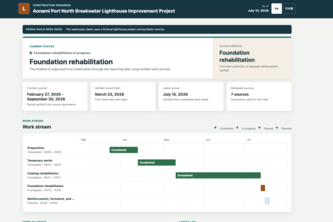
Field Progress Copilot is a self-reported tool built using Codex (an OpenAI-powered development environment) that automates the process of turning project records—such as reports, photos, and documents—into a shared, human-reviewed progress dashboard. It claims to support workflows from project intake through ongoing updates, with an emphasis on separating confirmed work from future plans, managing document privacy, and maintaining audit trails.
What changed
The author states that the tool evolved from a one-off field dashboard into a reusable workflow during a Build Week hackathon event. This version was reconstructed for demonstration purposes using synthetic data and fictional scenarios, but it is claimed to be based on an operational system used in Japan.
Single most important open question
Is there evidence of real-world usage or adoption beyond the author’s own project? The description does not indicate any customers, revenue, or traction outside of personal use or a demo environment.
What The Product Actually Is
The description states that Field Progress Copilot is a system designed to transform accumulated project records into a continuously maintained progress dashboard. It performs:
- Read-only intake inspection of existing project folders.
- Checks source documents for readability (PDFs, OCR), conflicts, and sensitive information.
- Separates confirmed activity from future plans.
- Detects new photographs and proposes milestone images with captions.
- Accepts useful catalogs while excluding transactional or private documents.
- Maintains internal evidence and review records outside the public dashboard.
- Operates through a lifecycle-gated workflow involving initialization, updates, and preflight checks.
It is built using Codex and GPT-5.6, and claims to support both Japanese and English interfaces.
Evidence Self-reported by author; no independent verification or demonstration of actual product functionality beyond the project submission.
Positioning & Claim Evolution
The author positions Field Progress Copilot as a tool that brings clarity to project progress by consolidating disparate information into one shared view. It is described as moving beyond simple storage to enable understanding at a glance, without requiring users to navigate complex folder structures or interpret documents individually.
It evolved from an idea of making progress understandable to a reusable workflow for managing field projects across multiple stakeholders.
Claims
- The system turns reports, photos, and documents into a verified dashboard.
- It supports a structured lifecycle from intake to ongoing updates.
- Human review remains central to decisions about what is published or retained.
Evidence Self-reported; no external validation of positioning or evolution.
Target Customer & ICP
The description implies that Field Progress Copilot targets users involved in public works construction projects, particularly those who manage multiple documents and need a centralized way to share progress. It mentions usage in an active Japanese public-works construction workflow.
Evidence The author describes its use in Japan but does not name specific customers or define target segments beyond general field project management.
Business Model & Pricing Evidence
There is no evidence of pricing, monetization strategy, or business model in the description. The author mentions using the system on real projects and incorporating feedback, but does not describe any revenue streams or customer acquisition methods.
Evidence Not evidenced.
Technical & Delivery Signals
The system uses Codex (OpenAI’s development environment) and GPT-5.6 to perform tasks including:
- Inspecting heterogeneous source folders.
- Implementing lifecycle states and checkpoints.
- Handling OCR, PDF parsing, image detection, and human approval steps.
- Supporting dry-run-first initialization and idempotent execution.
- Generating test data, preparing Git commits, and deploying via Cloudflare Pages.
It is claimed to support both Japanese and English interfaces.
Evidence Self-reported; no independent confirmation of technical architecture or delivery mechanisms.
Traction & Maturity Signals
The author states that the system is used in an active public-works construction workflow in Japan. However, there is no mention of:
- Number of users,
- Revenue,
- Customer retention,
- Product adoption metrics,
- Any measurable traction beyond personal usage.
The demo version was built for a hackathon and uses synthetic data.
Evidence Not evidenced.
Competitive Context
No competitive landscape or market analysis is provided. The description does not mention competitors, alternative tools, or how Field Progress Copilot compares to existing solutions in the field project management or document automation space.
Evidence Not evidenced.
Open Questions & Risks
- Unverified claims: All descriptions are self-reported and unverified.
- No traction evidence: No customers, revenue, or adoption data provided.
- Limited scope: The product appears to be a prototype or demo version built for a hackathon.
- Unclear commercial viability: No indication of monetization or scalability beyond the author’s own use case.
- Dependency on AI tooling: Reliance on Codex and GPT-5.6 introduces potential instability if those tools change or become unavailable.
Inference The lack of real-world usage, customer base, or financial data raises questions about whether this is a viable commercial product or just an experimental prototype.
Questions the description leaves open
- What are the actual use cases and workflows where this tool has been applied in production?
- How many projects currently rely on Field Progress Copilot for ongoing operations?
- Are there any customers or partners who have adopted it beyond personal use?
- What is the current level of automation vs. human involvement in daily operations?
- Has the system undergone any formal testing or validation with end users?
- What are the plans for scaling or expanding functionality beyond the current scope?
- How does the tool handle compliance and data privacy requirements in regulated industries?
Overall Assessment
There is no evidence of a functioning product, customer base, or revenue model. The description indicates that the system was developed as part of a hackathon submission and may be limited to personal use or demo purposes.
Assessment Not ready for investment or partnership consideration at this time. A significant gap exists between the self-reported capabilities and any demonstrated traction or commercial viability. Further due diligence would require evidence of real-world application, adoption, and measurable outcomes.
User Stories BotA demo video on every pull request
Get a demo video on every new feature
GitHub App that watches your pull requests and records a narrated, captioned demo.
Save time on demo prep and make informed decisions faster with a video walkthrough of every new feature.
Source
Submitted to the OpenAI 2026 hackathon on Devpost. Project home on Devpost. Back to the full gallery on Devpost.
This competitive analysis was produced by top-founders.com (opens in a new tab)
Generated by a language model from this project's public Devpost page — its tagline, the author's own write-up and any built-with tags listed there — as captured in August 2026. Short quotations are the author's words. It is an opinion on the idea as a business, not on the people behind it, and it reflects the description as published then. If the project has moved on, request a correction below. The analysis is not independent research and contains no verified traction, revenue or customer data.
An independent guide by KFG International LLC — not affiliated with, endorsed by, or connected to Devpost or OpenAI.