

Archive position — measured, not model output
0 likes on Devpost
2,263 of the 7,850 archived projects have more likes, and 5,587 share exactly 0 — so this project's #6,043 place in the like-ranked listing is a tie-break inside that group, not a ranking.
Projects (log scale)
Likes on Devpost. ▲ marks this project's group.
Show the figures
| Likes | Projects | Share of archive |
|---|---|---|
| 0 | 5,587 | 71.2% |
| 1 | 1,758 | 22.4% |
| 2 | 284 | 3.6% |
| 3–4 | 132 | 1.7% |
| 5–9 | 75 | 1.0% |
| 10+ | 14 | 0.2% |
 User Stories BotA demo video on every pull request
Get a demo video on every new feature
GitHub App that watches your pull requests and records a narrated, captioned demo.
Save time on demo prep and make informed decisions faster with a video walkthrough of every new feature.
Executive Summary
What the company appears to be
Pragyanta Tutor – Grounded AI Learning with RAG is a self-reported educational AI tool designed to act as an adaptive, source-bound tutor for teachers. It uses Retrieval-Augmented Generation (RAG) to ensure that student answers are strictly derived from teacher-uploaded lesson material. The system includes features like misconception detection, remediation, verification, and teacher reporting.
What changed
The project was submitted to the OpenAI 2026 hackathon by one developer, Sudhanshu Shekhar. It represents a proof-of-concept implementation of an AI-powered learning loop that emphasizes correctness, traceability, and alignment with curriculum content.
Single most important open question
Is there any evidence of real-world usage or traction beyond the author’s own development environment?
What The Product Actually Is
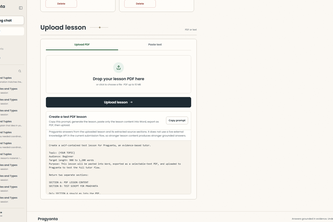
The description states that Pragyanta Tutor is a source-bound adaptive tutor for teachers, built using a Retrieval-Augmented Generation (RAG) approach. It allows teachers to upload lesson content (PDF or text), which becomes the system's source of truth.
- Students ask questions, and answers are generated based only on this approved material.
- Off-topic queries are declined instead of being guessed.
- The system supports a structured learning loop: Detect → Remediate → Verify.
- It includes:
- Practice mode with multiple-choice questions
- Teacher reports showing misconceptions and resolution status
- A deterministic keyless mode for consistent evaluation without API keys
The system is described as running on:
- Frontend: React 18 + Vite
- Backend: FastAPI (Python)
- Database: PostgreSQL 16 with pgvector
- AI Layer: Pluggable provider (deterministic mock and optional live model)
- Infrastructure: Docker and Docker Compose
AI-assisted development tools used include OpenAI Codex and ChatGPT (GPT-5.6 series models).
Inference The system is a prototype built for demonstration purposes, likely intended to showcase how grounded AI can be applied in an educational setting.
Positioning & Claim Evolution
The author claims that most AI tutors today answer from anywhere on the internet, which leads to:
- Unverified or off-syllabus answers
- Incorrect but confident responses
- Lack of visibility into student struggles
Pragyanta Tutor aims to address these issues by behaving like a real classroom assistant — one that teaches only from approved material and helps teachers understand learning gaps.
The positioning is:
- Controlled AI in education
- Evidence-based tutoring
- Trustworthy, measurable AI
It positions itself as an alternative to open-ended chatbots, emphasizing correctness over capability.
Inference This is a self-reported strategic shift toward trustworthiness and alignment in AI education tools. No external validation or market positioning data is available.
Target Customer & ICP
The description states that Pragyanta Tutor targets teachers who want to:
- Provide students with accurate, curriculum-aligned explanations
- Gain insights into student misconceptions and learning progress
- Use a system that ensures AI responses are grounded in trusted lesson content
It also mentions:
- A teacher report showing misconceptions, resolution status, and supporting evidence
- Support for multiple-choice practice questions derived from lesson content
Inference The primary ICP appears to be educators or instructional designers working within structured curricula, particularly those seeking tools that maintain alignment with their teaching materials.
Business Model & Pricing Evidence
There is no mention of pricing, monetization, or business model in the description. The project is presented as a hackathon submission and includes no indication of:
- Revenue streams
- Customer acquisition plans
- Subscription models
- Licensing or usage fees
Not evidenced
Technical & Delivery Signals
The system uses:
- Retrieval-Augmented Generation (RAG) to ensure grounded responses
- pgvector for vector storage and similarity search in PostgreSQL
- FastAPI + React for backend and frontend architecture
- Docker/Docker Compose for containerized deployment
- OpenAI Codex and ChatGPT (GPT-5.6) for development assistance
Key technical features include:
- Strict retrieval constraints to prevent off-topic answers
- Citation-style references for traceability
- Deterministic keyless mode for consistent evaluation
- Persistent learning state across detect → remediate → verify cycles
Inference The system is built with a focus on reliability, traceability, and reproducibility. It shows technical maturity in implementing RAG and maintaining structured interaction.
Traction & Maturity Signals
There is no evidence of:
- Real users or customers
- Revenue or ARR
- Product adoption metrics
- Customer feedback or usage data
- Production deployment history
The project is described as a hackathon submission, with a demo running in deterministic keyless mode for consistent evaluation.
Not evidenced
Competitive Context
The description does not reference any competitors. However, it implies that current AI tutoring systems lack:
- Source-bound responses
- Traceability of answers
- Teacher visibility into student learning gaps
This suggests a gap in the market for controlled, curriculum-aligned AI tutors, which may overlap with:
- Existing EdTech platforms using AI
- LMS integrations with AI features
- Classroom assistant tools
Inference The project identifies a niche where correctness and alignment are prioritized over open-ended knowledge. No competitive analysis or market positioning data is provided.
Open Questions & Risks
- No real-world usage or traction: The system exists only as a prototype, with no evidence of actual classroom use.
- Single-person team: Limited development capacity and scalability concerns.
- Hackathon origin: Likely not production-ready or designed for enterprise-scale deployment.
- Deterministic keyless mode: While useful for evaluation, it may not reflect full functionality in live environments.
- No pricing or monetization strategy: Unclear path to commercial viability.
- Unverified claims: All assertions are self-reported and uncorroborated.
Questions the description leaves open
- Has the system been tested with actual teachers or students?
- What is the expected timeline for moving from prototype to production-ready tool?
- Are there any plans to integrate with existing LMS or curriculum platforms?
- How does the system handle different formats of lesson content (e.g., videos, interactive media)?
- What are the long-term goals for scaling beyond a single classroom or subject?
- Is there any plan to incorporate live AI models alongside the deterministic default?
Overall Assessment
The project is a self-reported hackathon prototype with no evidence of traction, revenue, or customer adoption. It demonstrates technical capability in implementing RAG and structured learning loops but lacks commercial viability indicators.
Confidence: Low
This is not a product ready for investment or partnership at this stage. It may be an interesting concept to explore further if the team can demonstrate real-world usage, scalability, and a clear path to monetization.
User Stories BotA demo video on every pull request
Get a demo video on every new feature
GitHub App that watches your pull requests and records a narrated, captioned demo.
Save time on demo prep and make informed decisions faster with a video walkthrough of every new feature.
Source
Submitted to the OpenAI 2026 hackathon on Devpost. Project home on Devpost. Back to the full gallery on Devpost.
This competitive analysis was produced by top-founders.com (opens in a new tab)
Generated by a language model from this project's public Devpost page — its tagline, the author's own write-up and any built-with tags listed there — as captured in August 2026. Short quotations are the author's words. It is an opinion on the idea as a business, not on the people behind it, and it reflects the description as published then. If the project has moved on, request a correction below. The analysis is not independent research and contains no verified traction, revenue or customer data.
An independent guide by KFG International LLC — not affiliated with, endorsed by, or connected to Devpost or OpenAI.