

Archive position — measured, not model output
0 likes on Devpost
2,263 of the 7,850 archived projects have more likes, and 5,587 share exactly 0 — so this project's #6,044 place in the like-ranked listing is a tie-break inside that group, not a ranking.
Projects (log scale)
Likes on Devpost. ▲ marks this project's group.
Show the figures
| Likes | Projects | Share of archive |
|---|---|---|
| 0 | 5,587 | 71.2% |
| 1 | 1,758 | 22.4% |
| 2 | 284 | 3.6% |
| 3–4 | 132 | 1.7% |
| 5–9 | 75 | 1.0% |
| 10+ | 14 | 0.2% |
 User Stories BotA demo video on every pull request
Get a demo video on every new feature
GitHub App that watches your pull requests and records a narrated, captioned demo.
Save time on demo prep and make informed decisions faster with a video walkthrough of every new feature.
Executive Summary
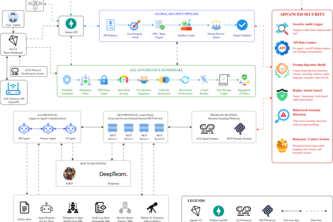
Pramaan is described by its author as a security and governance platform for AI agents, built to address trust and authorization challenges in Agent-to-Agent (A2A) and Model Context Protocol (MCP) networks. The project is presented as an end-to-end, modular system that includes both a governance engine and a security scanning tool (Sentinel).
The author states that Pramaan implements Proof-of-Authority verification, Verifiable Credentials, Zero-Knowledge Proofs, behavioral risk scoring, and AI red-teaming to secure autonomous agent interactions. It is built using Python, FastAPI, LangChain, React, and integrates with A2A SDK, AG-UI, DeepTeam, and MCP.
The project was submitted as part of the OpenAI 2026 hackathon and is described as a working prototype, not a commercial product. No revenue, customers, or traction data are provided.
Key commercial due-diligence question: Is there evidence that Pramaan has moved beyond a hackathon prototype into a viable product with early adopters or enterprise interest?
What The Product Actually Is
The description states that Pramaan is a governance and security platform for AI agents, designed to verify legitimacy, authorization, and compliance in agent-to-agent interactions.
It includes:
- A governance engine that verifies every interaction through a multi-stage pipeline:
- Identity verification
- Delegation validation
- Policy evaluation
- Risk assessment
- Authority computation
- Audit logging
- A Sentinel module, an AI security platform for:
- Scanning A2A agents and MCP servers
- Auditing exposed tools and resources
- Running red-team attacks using DeepTeam
- Generating security reports
The system is described as modular, with components that can be added without changing existing agent implementations.
Inference: The product appears to be a security layer for AI agent ecosystems, not a standalone tool or platform. It is positioned as an infrastructure component for secure agent communication.
Positioning & Claim Evolution
The author positions Pramaan as a trust layer for autonomous AI agents, aiming to bring enterprise-grade governance and security to AI systems that currently lack it.
Key claims:
- “Before one AI agent trusts another, how can it prove that the request is legitimate, authorized, secure, and compliant?”
- “We built Pramaan to answer one fundamental question: how do we secure autonomous AI agents?”
- “Pramaan aims to provide that missing trust layer.”
The project evolves from a hackathon prototype into a visionary platform for enterprise Agentic AI governance.
Inference: The positioning is early-stage, focused on solving an emerging problem in AI agent ecosystems. It does not yet demonstrate traction or product-market fit.
Target Customer & ICP
The description states that Pramaan is designed for enterprises using AI agents, particularly those deploying autonomous systems that interact via A2A and MCP protocols.
It is described as enterprise-ready and aims to provide:
- Governance for agent-to-agent interactions
- Compliance with enterprise security standards
- Trust in autonomous AI behavior
The author also mentions support for multi-organization deployments and SIEM integrations, suggesting a B2B target.
Inference: The ICP is likely enterprise IT teams, security architects, or AI platform engineers managing AI agent ecosystems. No specific customer segments are named.
Business Model & Pricing Evidence
No evidence of pricing, monetization, or business model is provided in the description.
The author states that Pramaan is a prototype, not a commercial product.
Inference: The business model remains undefined and unproven. There is no indication of how revenue would be generated or whether there are any paying customers.
Technical & Delivery Signals
The project is described as built with:
- Backend: Python, FastAPI, LangChain, A2A SDK, DeepTeam
- Frontend: React, AG-UI Protocol
- Governance engine: Multi-stage verification pipeline
- Security features:
- Verifiable Credentials
- Zero-Knowledge Proofs
- Behavioral risk scoring
- Prompt injection detection
- Replay attack prevention
The architecture is described as modular, allowing for extensibility.
Inference: The technical stack and architecture suggest a highly technical, security-focused platform. However, no evidence of production deployment or scalability is provided.
Traction & Maturity Signals
The project was built during the OpenAI 2026 hackathon, and is described as a working prototype.
It includes:
- End-to-end governance pipeline
- Real-time security dashboard
- MCP scanner with red-teaming capabilities
- Audit logs and trust receipts
However, there is no evidence of:
- Customers
- Revenue
- Product usage
- Market validation
- Deployment in real-world environments
Inference: The project is early-stage, with no demonstrated traction or maturity beyond a hackathon prototype.
Competitive Context
The author does not name competitors. However, the problem space includes:
- AI agent security and governance
- Trust and identity management for autonomous systems
- Protocol interoperability (A2A, MCP)
- AI red-teaming and vulnerability scanning
No mention of existing tools or platforms addressing similar problems.
Inference: The competitive landscape is unclear, but likely includes emerging players in AI security, agent frameworks, and governance platforms. No evidence of direct competition is provided.
Open Questions & Risks
- Prototype-only: No commercial product or customer base.
- No revenue or monetization strategy.
- Unproven market demand: No evidence of enterprise interest or adoption.
- High technical complexity: Integrates many emerging technologies (A2A, MCP, ZKPs, Verifiable Credentials).
- Unclear scalability: No evidence of production deployment or large-scale use cases.
- Founder team size: Only one member listed.
Inference: The project is at a very early stage, with significant risk around product-market fit and commercial viability.
Questions the description leaves open
- What specific enterprise use cases have you identified for Pramaan?
- Have you conducted any pilot testing or user feedback sessions?
- How do you plan to monetize the platform?
- What are the key technical challenges in scaling this system?
- Are there any early adopters or partners interested in using Pramaan?
- How does Pramaan differentiate from existing AI security tools or frameworks?
- What is your roadmap for moving beyond the prototype stage?
Overall Assessment
Not evidenced.
The project is described as a hackathon prototype, with no evidence of traction, revenue, customers, or commercial viability.
It is positioned as a visionary platform for securing AI agents but lacks any demonstration of product-market fit or business model.
Confidence level: Low. The description provides no data to support commercial readiness or scalability.
Assessment: Not ready for investment or partnership at this stage. Requires further validation, traction, and evidence of market demand before considering deeper due diligence.
User Stories BotA demo video on every pull request
Get a demo video on every new feature
GitHub App that watches your pull requests and records a narrated, captioned demo.
Save time on demo prep and make informed decisions faster with a video walkthrough of every new feature.
Source
Submitted to the OpenAI 2026 hackathon on Devpost. Project home on Devpost. Back to the full gallery on Devpost.
This competitive analysis was produced by top-founders.com (opens in a new tab)
Generated by a language model from this project's public Devpost page — its tagline, the author's own write-up and any built-with tags listed there — as captured in August 2026. Short quotations are the author's words. It is an opinion on the idea as a business, not on the people behind it, and it reflects the description as published then. If the project has moved on, request a correction below. The analysis is not independent research and contains no verified traction, revenue or customer data.
An independent guide by KFG International LLC — not affiliated with, endorsed by, or connected to Devpost or OpenAI.